How to Wear A-2 REAL McCOY’S
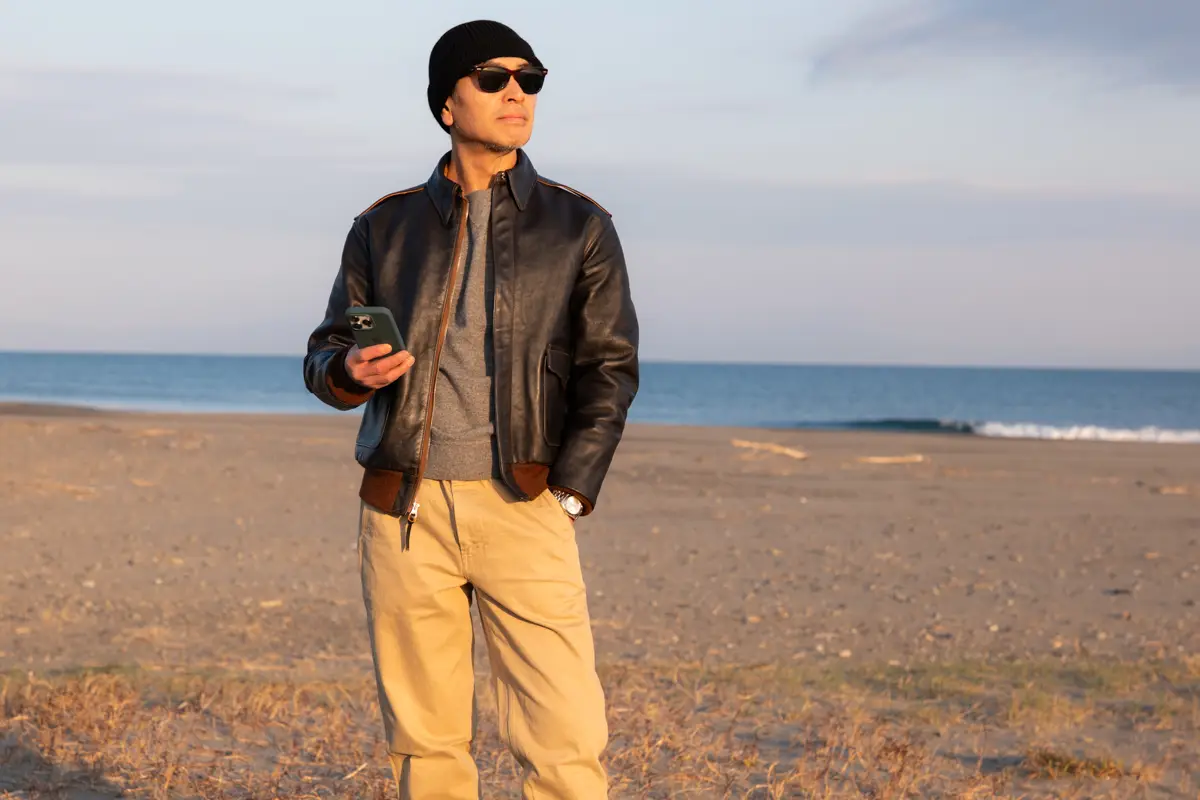
Last time, I wrote about Real McCOY’S A-2 jacket. This time, I’d like to introduce some styling combinations I couldn’t cover in that article.
The previous piece explored how men in their forties and beyond could wear the rugged A-2 in a sophisticated manner without appearing old-fashioned. This time, I wanted to present a more universal take on styling that truly captures the essence of the A-2.
I don’t consider myself particularly well-dressed; I simply put together outfits using the clothes I own. It’s a very orthodox way of dressing, based on basic Americana combinations, but I hope it serves as a useful reference.
Previous Recap
Last time, I wore a Brunello Cucinelli Western shirt as an inner layer, paired with Visvim’s slim straight five-pocket trousers, and draped a stole around my neck. This combination creates an overall slim silhouette with contemporary accessories, deliberately toning down the inherent military ruggedness of the A-2 jacket.
The combinations described in this article
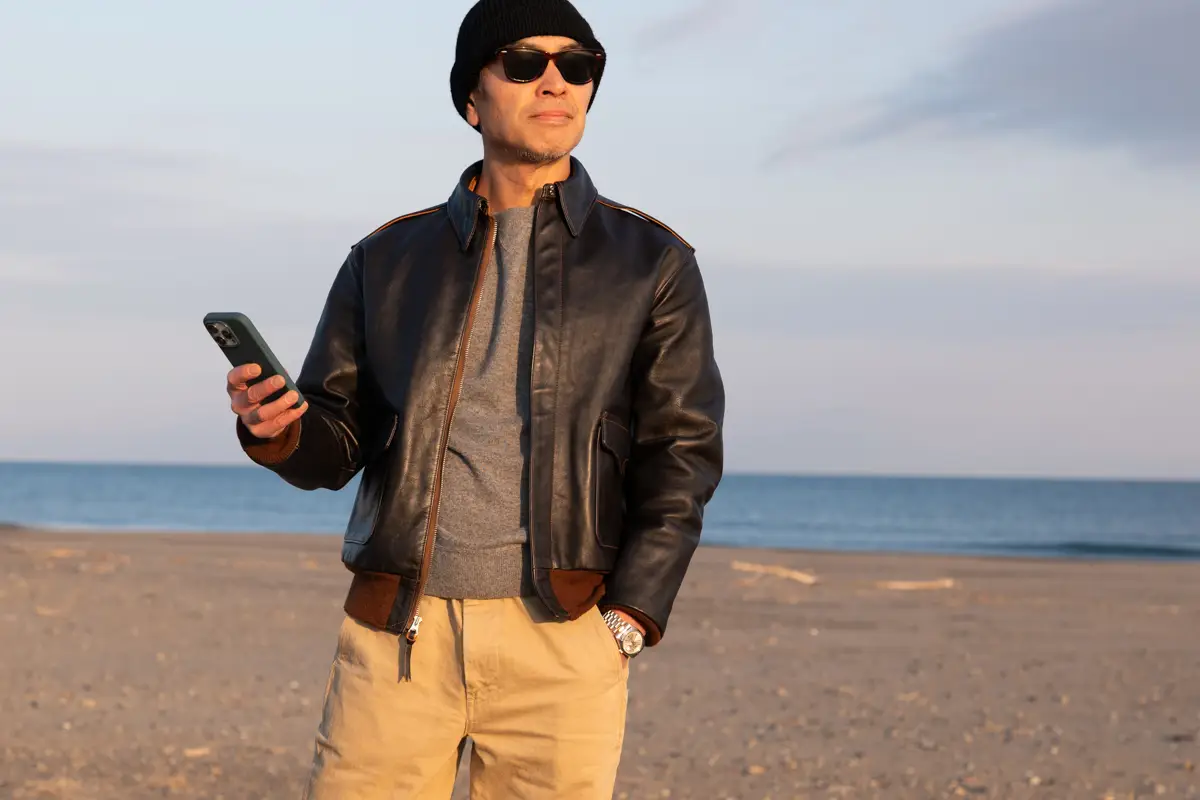
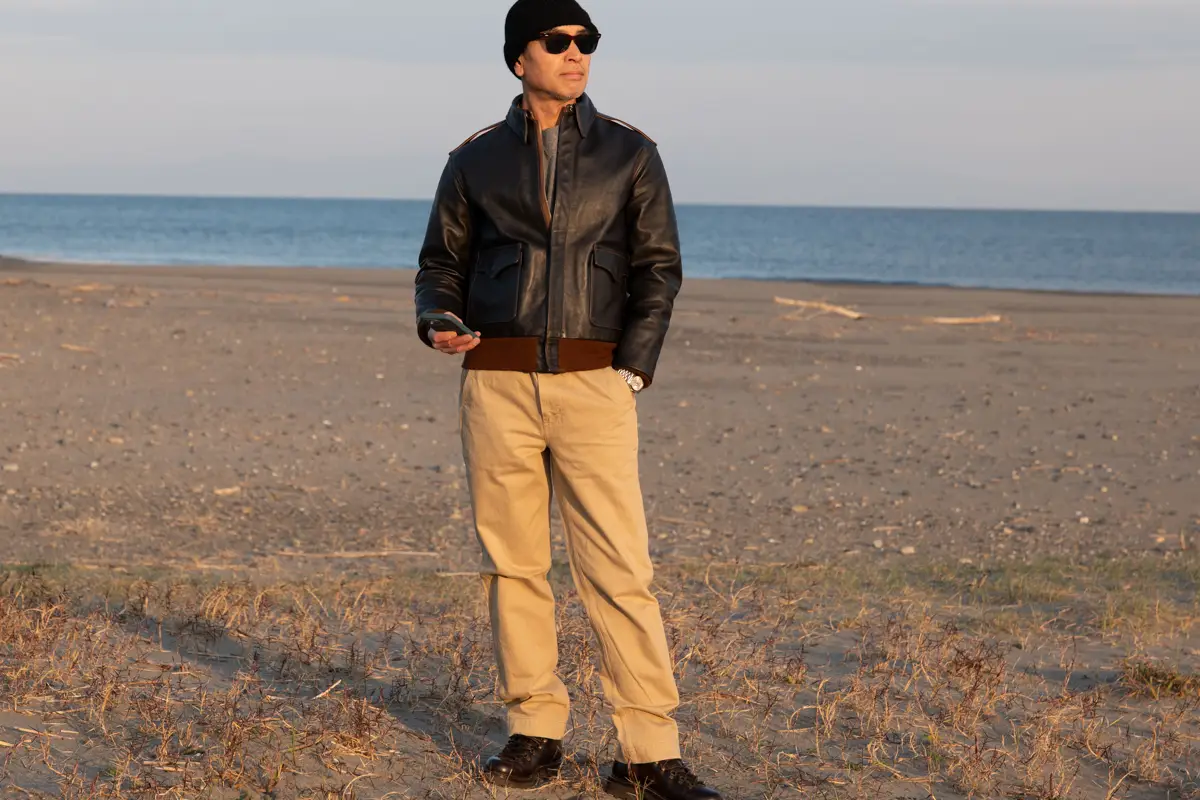
This time, I’ve paired the classic silhouette Boncoura chino trousers with: 1. Brunello Cucinelli’s sweatshirt-style cashmere knit as the inner layer, and 2. A 1980s HealthKnit sweatshirt with a brushed lining.
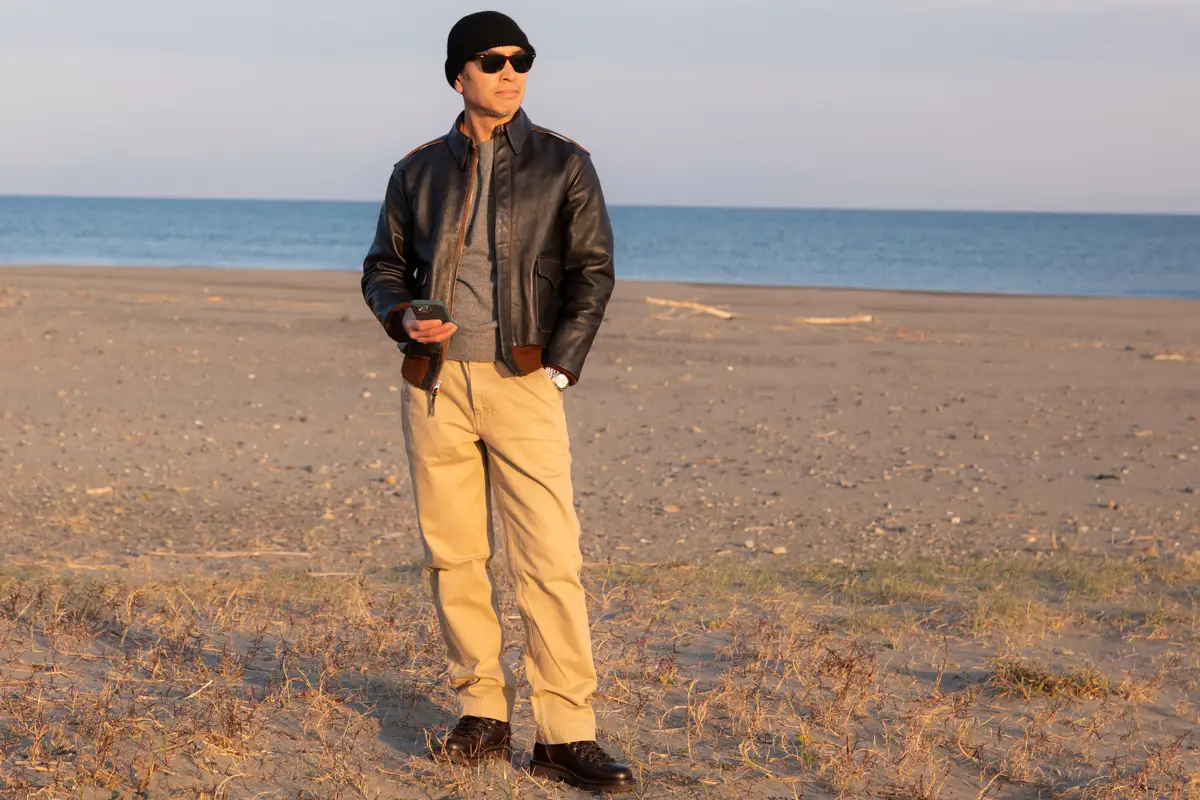
For footwear, I’ve chosen Brunello Cucinelli mountain boots. While pairing them with White’s boots would create a more authentic look, I opted for these as their moderate volume and colour tone complement the A2 jacket perfectly.
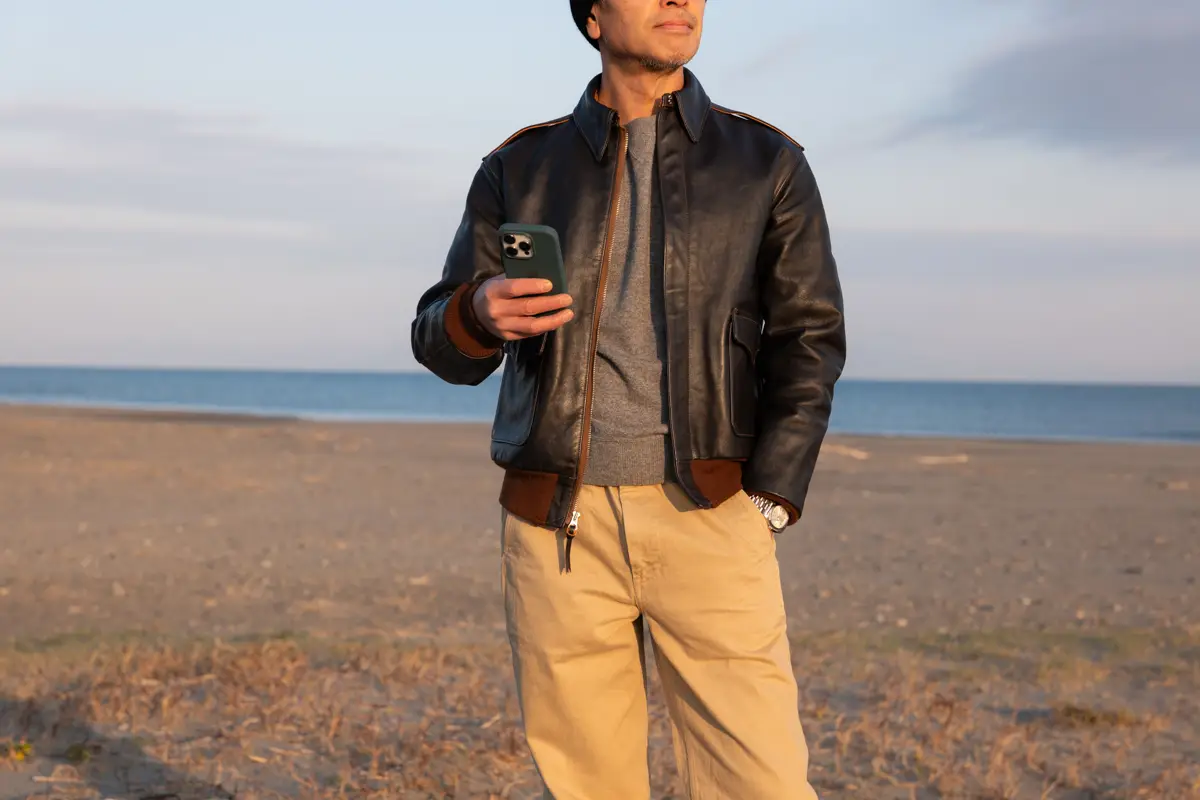
1. Cashmere inner layer
- Outerwear: A-2 flight jacket
- Inner layer: Sweatshirt-style cashmere knit
- Bottom: Chino trousers
- Footwear: Mountain boots
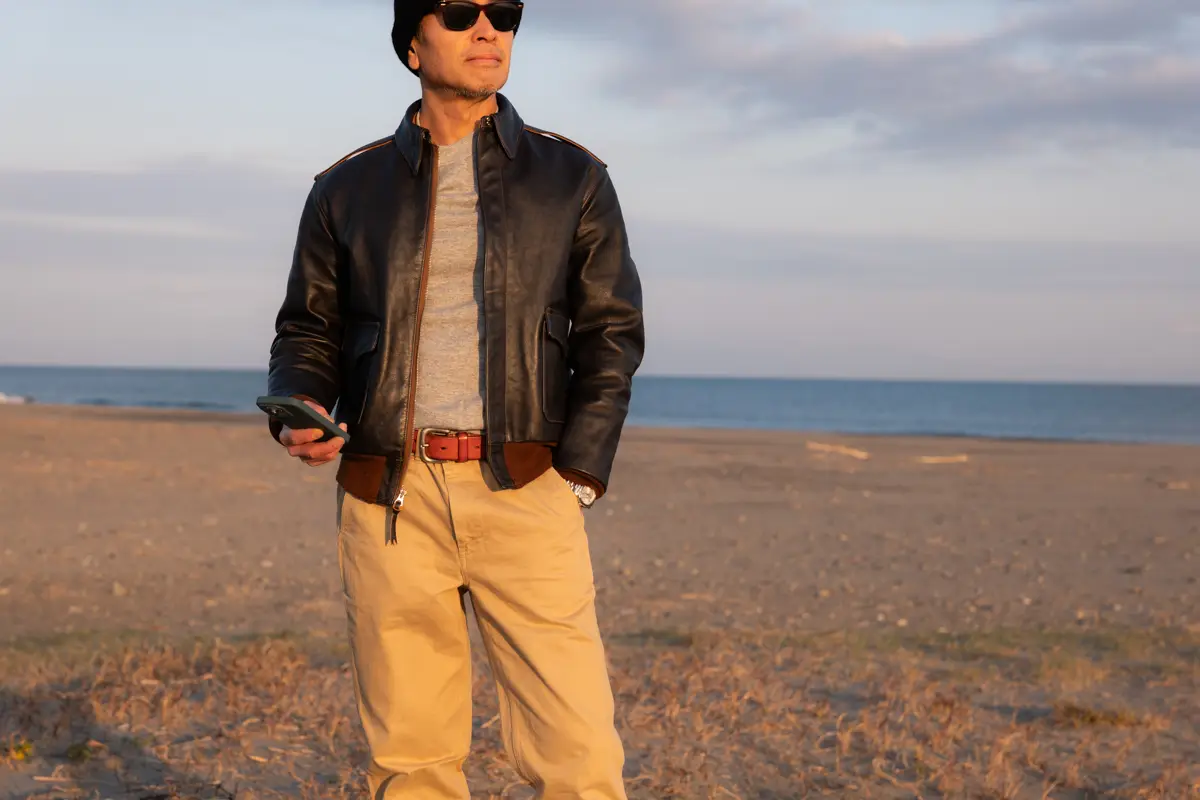
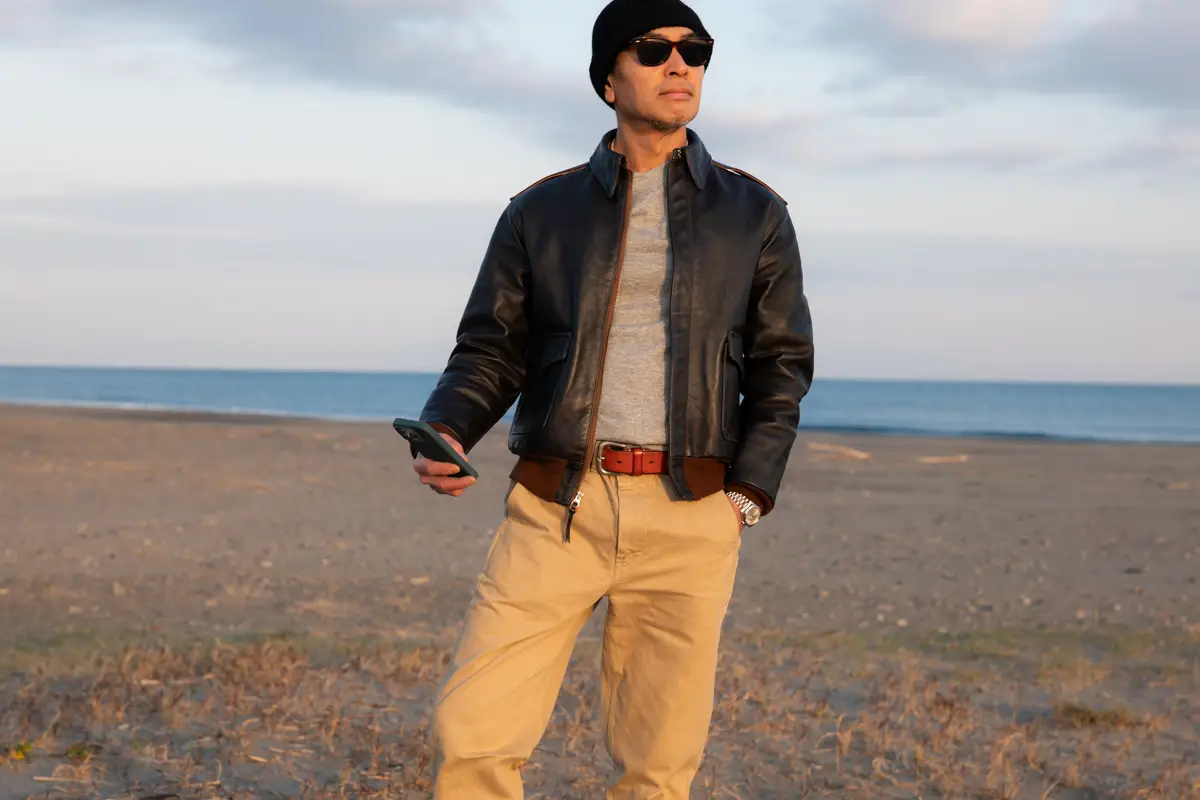
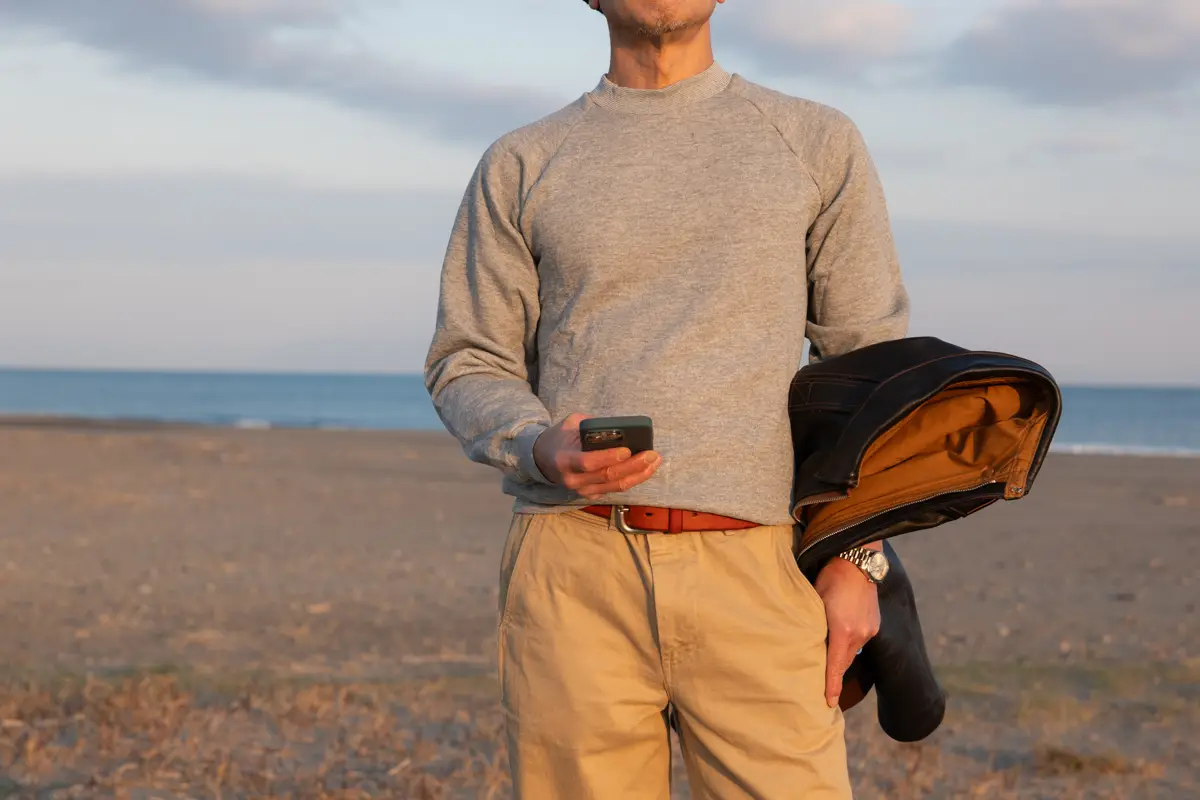
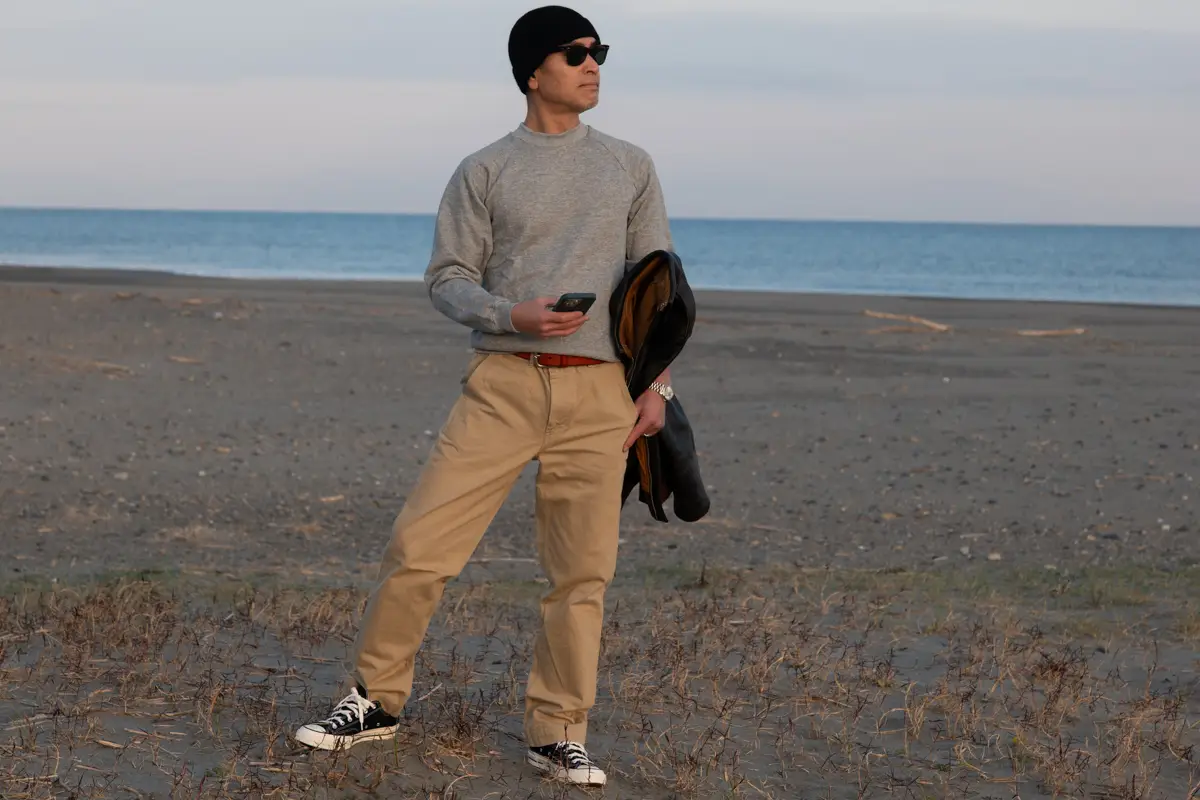
2. Sweat inner
- Outer: A-2 flight jacket
- Inner: Polyester blend crew neck sweatshirt
- Bottom: Chino trousers
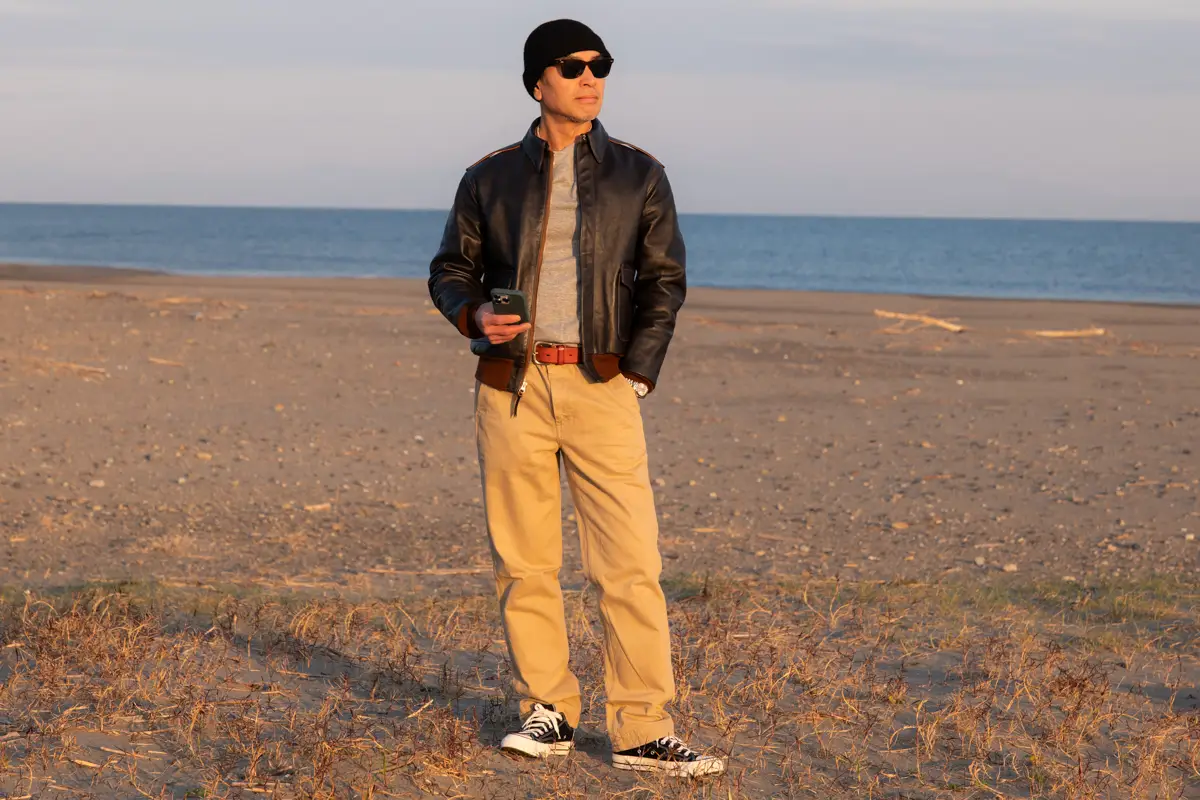
- Shoes: Converse All Star
Wearing a sweatshirt underneath an A-2 jacket with work trousers brings to mind Steve McQueen in The Great Escape, though unfortunately the combination I wore this time didn’t quite achieve that McQueen style.
Still, even simply pairing it with everyday items, the A-2 remains a rugged, masculine outerwear piece with a distinctly military, disciplined edge. It possesses a great deal of character, allowing you to project a masculine, somewhat stoic yet tough aura in a very favourable way.
Introduction.
This year, I’ve been experimenting with slightly slimmer bottoms, such as Dior denim and Visvim cotton trousers. By wearing bottoms that are a touch more streamlined than my usual preferred style, I’m enjoying a more refined way of dressing.
Whilst my beloved jeans and chinos have seen less wear than usual this year, these pieces transcend mere Americana. They form the foundation of American clothing culture – a broader category – rooted in practicality and effortless wearability (ease of movement and garment care). As such, they possess a timeless appeal.
Whilst the theme of the previous article—wearing the A-2 in a modern, slim style—is certainly appealing, I am writing this piece to introduce a slightly more universal approach. Looking at the photographs taken for the article, there is no particularly edgy or sophisticated image, yet it serves as an opportunity to reaffirm the enduring appeal of universal men’s fashion.
In the previous article, I touched upon the difficulty of successfully pulling off the A-2, noting how its strong character can overshadow the wearer, making them appear more as someone “wearing an A-2” rather than showcasing their own individuality. This time, however, I’ve deliberately styled it to let the A-2 take centre stage. Yet, through the power of a timeless combination, the A-2 doesn’t dominate alone; it integrates seamlessly into the overall ensemble. I hope this sense of balance comes across effectively.
1. Cashmere knit inner layer.
When considering an inner layer for the A-2, pairing it with a 100% cotton sweatshirt is the classic approach. However, thick sweatshirts have wide armholes, and with the A-2’s relatively narrow armholes, this can make movement slightly restricted. Furthermore, compared to 100% cotton sweatshirts, cashmere knitwear is thinner yet warmer, meaning I find myself wearing cashmere knitwear more often during the depths of winter.
I don’t wear crew-neck sweatshirts that often; I mostly wear zip-up hoodies. The one I wear most frequently is Boncoura’s zip-up hoodie. Boncoura also has roots in vintage clothing and offers a very meticulously crafted product range; I’m a huge fan myself, so I own and love several Boncoura items, not just sweatshirts.
Boncoura offers exceptionally high-quality sweatshirts, but their robust, thick construction makes them rather impractical as inner layers for an A-2 jacket.
For classic pieces like the A-2 or J-100, my go-to inner layers are either thermal T-shirts or cashmere knits. I’m particularly fond of the thermal T-shirts from Real McCoy’s. True to Real McCoy’s ethos of authenticity, it’s made quite thick and with a solid construction. I’d like to introduce this one too, given the chance.
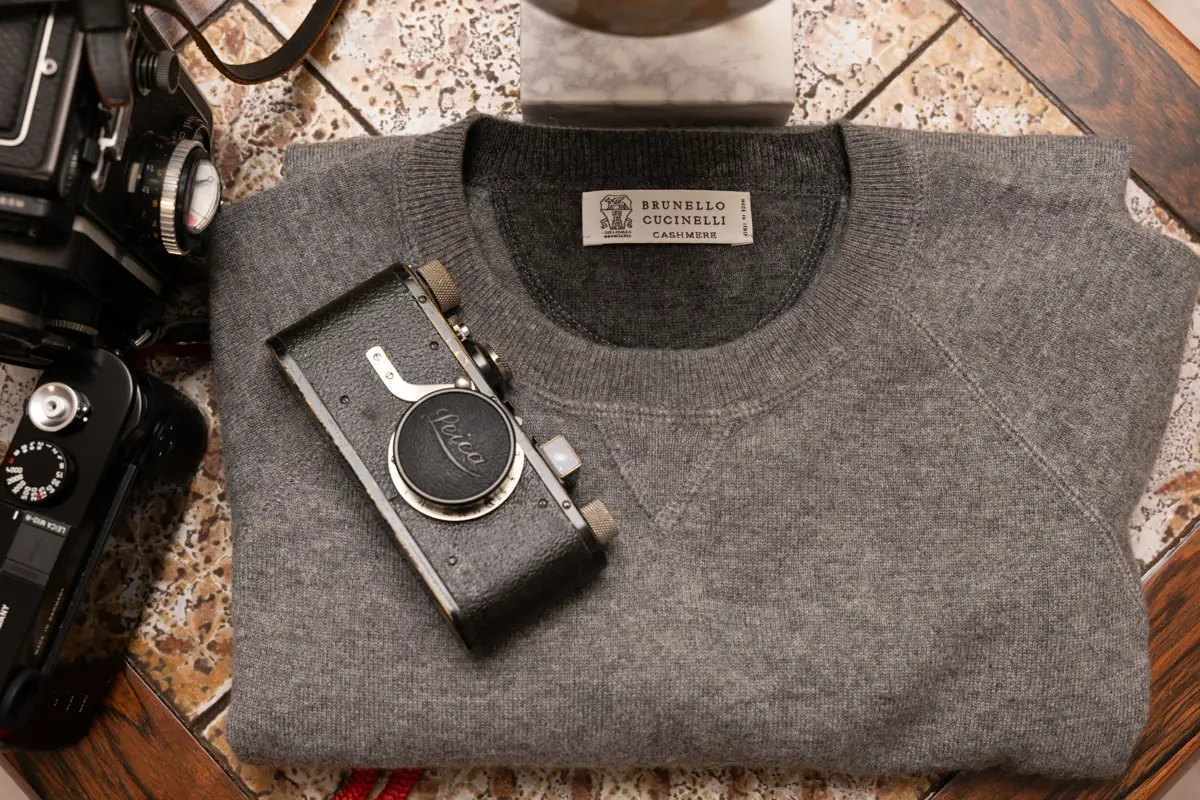
This time, I’ve paired it with my most frequently worn cashmere knit: Brunello Cucinelli’s sweatshirt-style cashmere knit. This knit has just the right amount of volume, is incredibly comfortable to wear, and pairs easily with any outerwear, making it one of my most-worn cashmere pieces.
I also adore Brunello Cucinelli’s cashmere zip hoodie, which shares the same volume as the sweatshirt-style cashmere knit. It’s an excellent cashmere piece that lends itself to a slightly more relaxed look or works brilliantly as an inner layer under jackets or coats. Brunello Cucinelli’s knits are characterised by exceptionally high quality and durability, meaning they are notably less prone to pilling compared to other knits.
2. Polyester-blend sweatshirt inner layer.
The classic choice to layer beneath an A-2 jacket is surely a light grey crew-neck sweatshirt. This time, I considered pairing it with sweatshirts I already own, but modern sweatshirts tend to have quite bulky sleeves. When worn under classic-cut outerwear like the A-2, the armholes feel constricted and restrict movement. Even the CIOTA classic 100% cotton crewneck sweatshirt – the slimmest one I own and which I thought would be the most suitable – feels slightly tight when worn as an inner layer under the A-2.
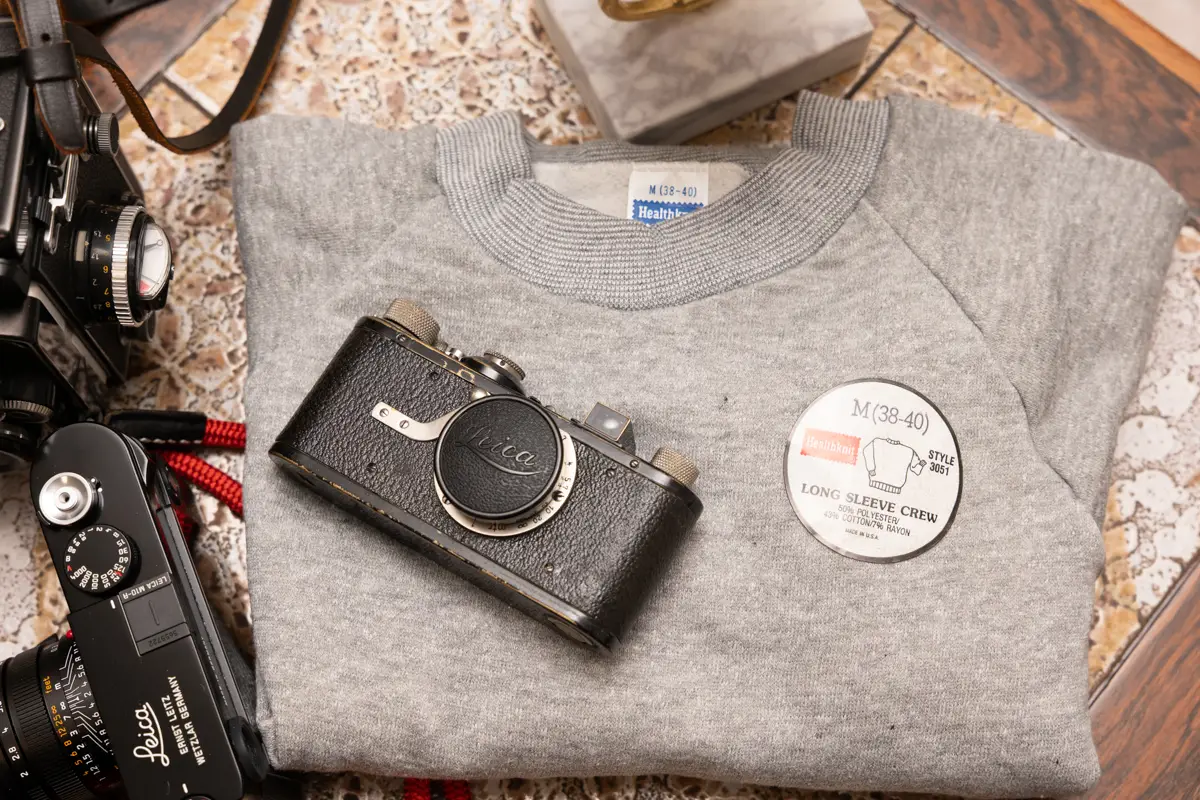
Wondering if there might be a sweatshirt suitable as an inner layer for my A-2 or Buco J-100, I consulted the owner of Post78, a frequent contributor to this blog. True to form, the Post78 owner had deadstock of an 80s HealthKnit sweatshirt with a brushed inner.
This sweatshirt isn’t 100% cotton but a polyester blend. With its brushed lining and 80s sizing (more accurately described as small rather than tight), it works perfectly as an inner layer even under classic silhouettes like the A-2 or Buco J-100. I was thoroughly impressed by the owner’s impeccable selection and bought it immediately. (Post78’s very reasonable prices are also a hallmark.)
The owner of Post78 is truly remarkable, possessing an incredibly broad range of knowledge. If you casually ask for advice, there’s a surprisingly high chance they’ll have something close to what you’re looking for. His antennae are tuned across a wide spectrum – vintage, fashion, recent, meticulously crafted Made in Japan items – and he’s well versed in the cyclical nature of trends. Consequently, he can often accommodate even rather demanding requests, like wanting to wear something that circulated quite some time ago, hasn’t been seen recently, but you fancy it now.
The Schiesser Revival T-shirt, featured in another article, came up during a conversation about Michael Tapia’s T-shirts, whom the owner also greatly admires. When I asked the owner if they had any T-shirts with the same snug fit that Michael Tapia used to make, they pointed me towards this one, noting similarities in style, size, and fabric feel. When I tried it on, it was exactly as I’d imagined, and I now wear it regularly.
Chino trousers
Chino trousers, much like jeans, are available from numerous brands and shops. Even when simply referred to as “chino trousers”, the sheer variety makes finding the right pair quite a challenge.
In my twenties, I was fond of chino trousers and often wore Ralph Lauren ones, but as I grew older, I found fewer occasions to wear them. Around my mid-thirties, I bought a pair of Dolce & Gabbana chinos recommended to me at Barneys. They were extremely low-rise, slim-fitting, and made from a lustrous twill. I wore them a lot, but the suggested top pairing back then was a dark brown shirt or knit polo. The look was very high-fashion, which meant I gradually stopped wearing them. I ended up passing them on to a younger colleague who favoured that kind of fashion.
Once in my forties, I acquired and wore a set of Incotex chinos and Brooks Brothers button-down shirts in different colours. This combination was particularly appealing because Brooks Brothers, following the trends of the time, had begun producing slim-fit button-downs, which I preferred. I owned four of these slim-fit button-down shirts in different colours and wore them regularly with these Incotex trousers.
My approach to wearing chinos involves washing them immediately after purchase to remove the centre crease. I used Ralph Lauren chinos in my twenties precisely in this manner. However, Incotex chinos are designed for the so-called jacket-and-trousers style, featuring a slightly shorter length and double-turned hems, intended to be worn with the centre crease intact. Consequently, I wore them more for slightly formal occasions than purely casually.
When I wear chinos, I favour pairs that have had the centre crease removed. As standard chinos sold in shops typically feature a centre crease, I wash them after purchase to eliminate it. At this stage, I find older, slightly heavier fabrics more suitable than those designed for formal wear.
Boncoura’s chino trousers
Boncoura’s chino trousers are excellent because, whilst orthodox in their sizing and fabric feel, they create an exquisite styling when worn. This characteristic is also shared by Boncoura’s signature denim.
They are not for everyone, but whether worn by a slim, younger person or someone with a more age-appropriate build, they achieve a suitably relaxed styling. Simply wearing them creates a style that seems to distil the best aspects of a well-honed American culture.
This applies to Boncoura’s products in general: they conduct deep research into the items that serve as their motifs, and are extremely particular about fabrics, materials, and construction. The result is not only high quality, but also an exquisite balance in terms of the feel when worn and the styling.
This time, I’ve paired it with the A-2 flight jacket as the bottom piece, and a significant factor in achieving this polished look is choosing Boncoura’s chino trousers.
I personally love Boncoura’s products, not just their denim and chinos, but also their sweatshirts and fisherman sweaters. I hope to feature them in future articles when the opportunity arises.
Wearing example.
As wearing examples with explanations are included within the article this time, there are no additional wearing examples provided.
Combination
- A-2 Flight Jacket : Real McCOY’S
- Chino Trousers : Boncoura
- Sweatshirt-Style Cashmere Knit : Brunello Cucinelli
- Poly-Blend Crew Neck Sweatshirt : HealthKnit
- Mountain Boots : Brunello Cucinelli
- Trainers : CONVERSE ALLSTAR
- Belt : Real McCOY’S
- Knitted Hat: LEUCHTFEUE
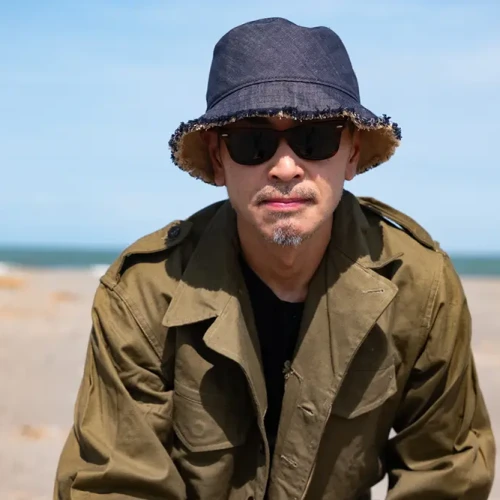
- Sunglasses: Ray-ban WAYFARER 90’s (BAUSCH+LAMB)
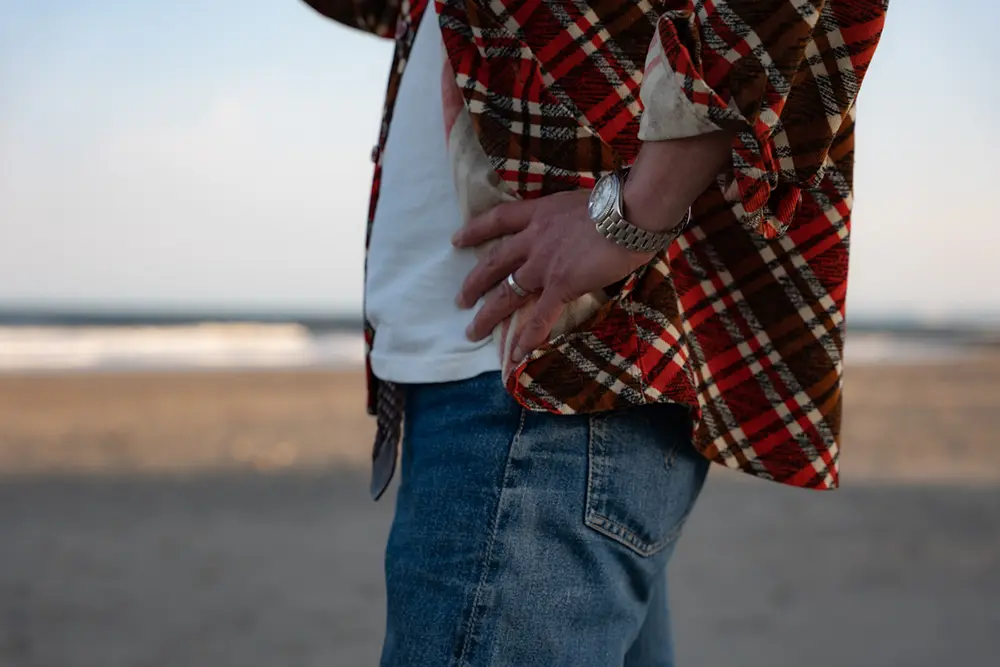
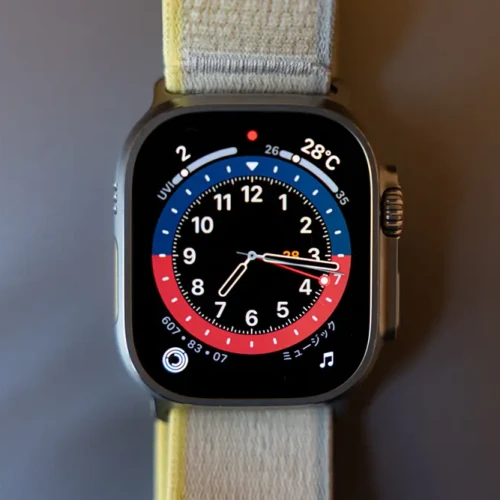
- Watch: Rolex Day Date (1803 1969)
Conclusion.
This time, I’ve styled the A-2 in a more universal combination. In my previous article, I softened the A-2’s rugged vibe by pairing it with slim-fit bottoms and a scarf, creating a modern, refined look. This time, I’ve styled the A-2 in a more universal way, likely a combination many people already favour.
Strictly speaking, the brands of the selected items may differ, but pairing the A-2 with chinos or a crew-neck sweatshirt is a standard way of wearing it, and I imagine many people were already practising this before my article.
The superiority of this standard combination, practised by many more than my own experiment with refinement, stems from an American approach to dressing – a highly rational way of thinking about clothing. It hints at the depth of American sartorial culture.
This approach to clothing – not overthinking it, simply picking items at hand and deciding combinations based on mood – is, in a sense, the ultimate coordination method. (It’s also fundamental to my own approach to clothing. One could say this is the origin of why I favour vintage and Americana styles.)
Originally, it was a style that emerged naturally, without any specific originator, by taking items commonly worn in America and combining them.
It began with combinations worn casually by service personnel issued with items like the A-2 jacket, military trousers, and sweats as training wear. Later generations, seeing this style in films and such, were naturally influenced, imitating it. This imitation then spawned further imitations, creating a cycle that ultimately led to the style becoming subtly widespread.
This time, when considering how to style the A2 flight jacket – a US military-issued item – the ultimate conclusion reaffirmed through this article and photoshoot was that the standard American style, born from incorporating the everyday looks of issued military personnel into regular fashion, is truly the best.
Finally, I should add that this standard, universal combination of an A-2 jacket and chinos is one answer to the question of how to wear a leather jacket without looking like an old man, which was one of the themes this time.
While chinos, a sweatshirt and trainers is a style anyone can pull off, when someone of a certain age wears this style, it makes them look younger in a good way and gives them a polished, stylish look.
Combining the A-2, chinos, a crew-neck sweatshirt as an inner layer, and ideally classic trainers – this standard approach using ubiquitous items – reaffirmed my belief that it represents the optimal way to avoid the “uncle-like leather jacket” look, which was the theme of my previous article and the very reason I purchased the A-2.
Shop
The introduction to Real McCOY’S shop is summarised in the previous article.