Note: This article describes a case with a Japanese hosting provider. If you’re working through a similar migration, please check the specifics with your own hosting company and confirm what applies in your region.
On May 11, 2026, Xserver — a major Japanese hosting provider — officially announced a server upgrade.
The plan I’m on, Business Standard, is included in the upgrade.
The existing plan uses MariaDB 10.5.x as its database. The new servers move to MariaDB 10.11.x.
This site is built on WordPress. I’m running the latest 6.9.x branch, and the official requirements published on the WordPress site are these:
WordPress requirements
PHP 8.3 or higher
MariaDB version 10.6 or greater OR MySQL version 8.0 or greater
The current server doesn’t meet the database requirement, so to satisfy what WordPress now expects, the server has to be upgraded.
According to Xserver’s announcement, all new sign-ups go straight to the new servers, but for existing contracts the handling depends on when the server was issued:
New sign-ups on or after May 11, 2026: new servers.
Shared servers issued on or after June 12, 2024, 11:00: Xserver will roll out the MariaDB 10.11 update from June 2026 onward.
Managed dedicated servers issued on or after June 26, 2024, 11:00: same — MariaDB 10.11 update from June 2026 onward.
I signed up in 2023, so none of the above applies to my server.
Shared servers issued before June 12, 2024: if you want to use a MariaDB 10.11 environment, you can move via the “New Server Easy Migration” feature (新サーバー簡単移行).
So the user does the migration themselves to move onto the new server.
I looked into the “New Server Easy Migration” feature and started the process.
The Actual Migration
I’ve written up the actual steps on my sister site, which is built with Drupal.
The articles cover running Xserver’s “New Server Easy Migration” and updating from MariaDB 10.6.x → MariaDB 10.11.x and Drupal 10.6.8 → Drupal 11.3.9 in the same pass.
Reading the articles, it might look like a lot of work, but the actual hands-on time was short.
Xserver automates the migration end-to-end — copying the data from the old server to the new one, all the way through the DNS switchover — so it really is straightforward.
What takes time is the data copy and the DNS propagation, both of which run a few hours each (about two hours in practice). When each step finishes, you get an email notification, so as long as you can come back to it when you have a moment, the workload isn’t heavy.
One thing to watch: the server hostname and IP address change, so any software on your local machine that points at them needs its settings updated. In my case, the only change was the incoming/outgoing server settings in my mail client.
The migration steps look like this:
1. Request the migration.
2. The migration runs. “This step takes several hours.”
3. Verify the site on the new server. “If anything’s wrong, you can roll back to the old server here.”
4. If everything checks out, commit the migration.
5. Switch over DNS.
6. Wait for DNS to propagate. “DNS propagation takes several hours regardless of this migration.”
That’s the flow. If something looks off at step 3, you can cancel the migration and keep running on the old server. (You can roll back to the old server for 14 days after the migration completes.)
In my case, I’d changed the system-level PHP version to run Drupal, and there was an issue with that symlink, so I had to repair it. I also did a major Drupal update at the same time, which added some work.
For a WordPress-only setup, the migration process is all you need to do.
Performance Improvements
With the newer database, things run faster across the board. The admin panel feels snappier and so does the front end, so there’s a clear case for migrating beyond just meeting requirements.
LTS
LTS stands for “Long Term Support” — a model where bug fixes and security updates continue to ship for a given version over an extended period.
MariaDB 10.11.x, the version this upgrade lands on, is supported through February 16, 2028.
WordPress will go through 6.9.x → 7.0 → 7.1 → 7.2 over the course of this year, and after this server upgrade the requirements are met for all of them.
* While writing this article, this site’s WordPress was updated from 6.9.4 to 7.0.
Roadmap
I couldn’t find a published roadmap from WordPress with concrete requirements for upcoming versions, so I’ll reference Drupal’s roadmap instead — Drupal lists requirements alongside its release plan.
WordPress hasn’t officially announced what 7.0.x will require, but with the current PHP 8.3.x and MariaDB 10.11.x in place, things should run without issue. PHP 8.4.x or 8.5.x may end up being required down the line, but the new server supports those too, so there’s no concern.
On the Drupal side, upgrading PHP from the current 8.3.x to 8.4.x covers the upcoming Drupal 11.4.x and 11.5.x releases, which keeps support running through December 2028.
For reference: the next Drupal major release, Drupal 12.x, ships in December 2026 and requires MariaDB 10.11.x. The major bump also raises the PHP requirement to 8.5.x or higher, so a PHP version upgrade comes with it.
I’ll wait to see how Civic Theme (the Drupal theme I’m running) handles the major upgrade before moving to it, so there will be some lag between Drupal 12.x’s release and when I actually switch over.
Extending the Support Window
Both WordPress and Drupal are developed with MariaDB 10.11.x’s EOL (End of Life) in mind, so by moving to the new server now, I have security support through February 16, 2028.
Xserver also supports PHP 8.4.x and 8.5.x, so a PHP version bump later isn’t an issue either.
Xserver Business Standard
This site runs on Xserver’s shared hosting plan, Xserver Business Standard. I don’t write operations or technical articles on this site, but I’ve covered some of this on the Drupal site I run for learning purposes.
That article is written from a Drupal angle, but one of the real strengths of Xserver Business Standard is how well it pairs with WordPress. It was originally built to host corporate sites, so it covers everything a business needs. (The feature set is more generous than the personal-use plans.)
Even without a dedicated tech person on staff, you can build a company site, register and manage the domain, set up SSL, and create staff email addresses — all from the admin panel.
What’s good about WordPress is that the server-side requirements — PHP, the database, Apache, SSL — are well-defined, and as long as the host meets them, the user can build and publish a site with WordPress without thinking much about the stack underneath.
Xserver wraps the functions you need to build and run a site into the admin panel, and the controls are simple to operate. With just Xserver’s admin panel and WordPress’s admin panel, you can build and manage a site end-to-end.
Easy to Operate, Flexible Enough to Extend
The Xserver + WordPress combination works really well in practice. Since almost everything is handled through the GUI, users without much technical background can take a site from setup through ongoing operation.
Worth noting too: there’s also reasonable flexibility for uses beyond WordPress.
Customization via the console isn’t officially supported and has to be done at the user’s own risk, but the same is true for other hosts — and even AWS or GCP — so it’s not really an issue.
Addendum
As an aside: on Xserver Business Standard, the PHP used by CMSs like WordPress and the PHP version that shows up when you run php -v in the terminal are different. I’d wondered why, so here’s my take.
Different PHP versions?
WordPress and Drupal are web-facing systems — in stack terms, they run in the web tier.
On Xserver, both WordPress and Drupal are installed under public_html, which is the web tier.
WordPress installation path:
$ home/../../hooked-on01.com/public_html/wp-content
— installed under the web tier.
Drupal is installed on a subdomain, so the path looks like:
$ home/../../hooked-on01.com/public_html/drupal.hooked-on01.com/[project name]/vendor (Drupal directory)
— same as WordPress, installed under the web tier.
Web tier PHP version
WordPress admin:
Site Health > Info > Server > PHP version 8.3.30 (Supports 64-bit values)
Matches the PHP version set in the Xserver admin panel.
System tier PHP version
$ php -v
PHP 8.0.3
Copyright (c) The PHP Group
Zend Engine v4.3.30, Copyright (c) Zend Technologies
Different from the version set in the Xserver admin panel.
The PHP version you select in the Xserver admin panel is the one called by the web tier.
The system-tier PHP runs the Xserver admin panel itself, processes cron jobs, and handles other server-side tasks. If users could change it freely, it would risk breaking the admin panel or other system processes, so general users are locked out of touching it.
The web tier PHP version isn’t dictated by the server side — it follows whatever the user’s application (WordPress, etc.) needs — which is why Xserver lets you set the PHP version from the admin panel.
If you need to raise the PHP version used outside the web tier (which Drupal does need), you can do it by creating a symlink to the PHP version Drupal requires, from among the versions installed on the server. (WordPress probably doesn’t need this.)
For details, see the Drupal articles linked at the top of this page.
WordPress and Xserver
What Xserver does well, if you’re building and running a WordPress site, is this:
It comes prepared to meet WordPress’s requirements from the start.
If WordPress’s requirements shift over time as new versions ship, you can bump the PHP version from the admin panel — no console knowledge required.
Common tasks come with simple templates.
Database setup can also be done from the admin panel.
Domain registration is straightforward, and the path from buying a domain to having a site online is almost entirely admin-panel work.
Security tools — WAF and CDN — can be turned on with a single click.
— all of which makes the platform very approachable.
What the GUI Gives You
If you’re running WordPress on Xserver, everything happens inside two admin panels — Xserver’s and WordPress’s. That’s a real benefit. WordPress powers about 43% of websites worldwide, and the infrastructure for running it has matured along with that adoption — Xserver’s infrastructure reflects that maturity and passes it on to its users.
In Closing
With Xserver Business Standard’s database upgraded, the EOL concerns I had about WordPress and Drupal are resolved.
The migration from the old server to the new one is straightforward, so if you’re running a WordPress site — personally or for a business — it’s worth considering.
This round of server updates is fundamentally a MariaDB upgrade, but beyond resolving EOL it also brings processing speed gains from the newer version.
As I touched on in the article, Xserver and WordPress pair together exceptionally well. Even first-time WordPress users can build and run a site without hitting a wall, thanks to a genuinely well-designed interface.
The Business Standard plan I’m on is comfortable not just for corporate use but for personal use as well, and it strikes a solid balance between cost and performance.
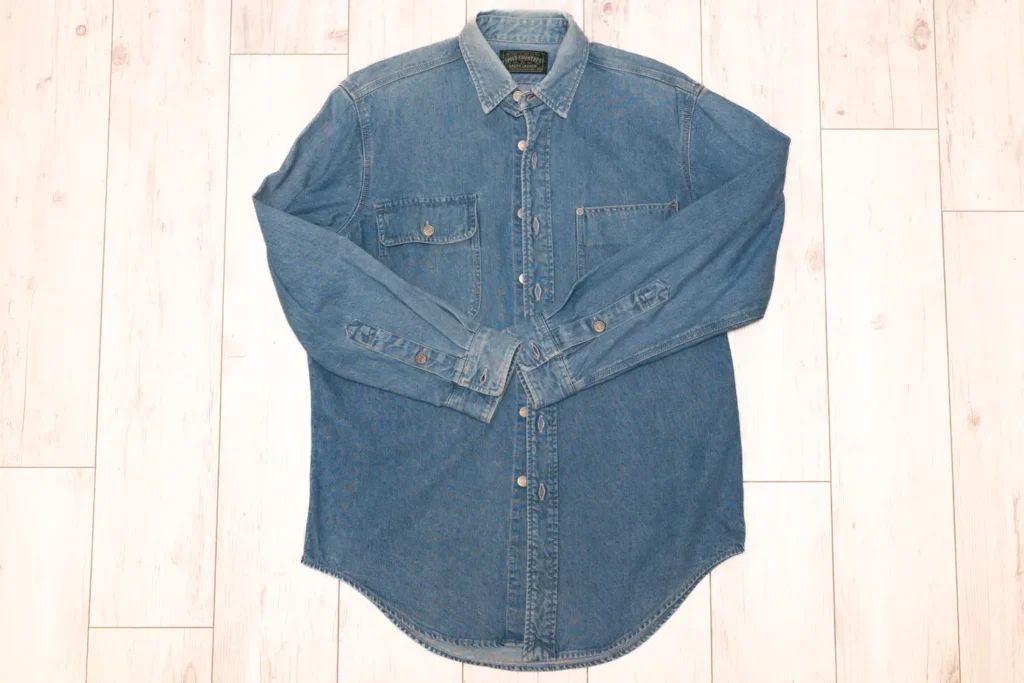
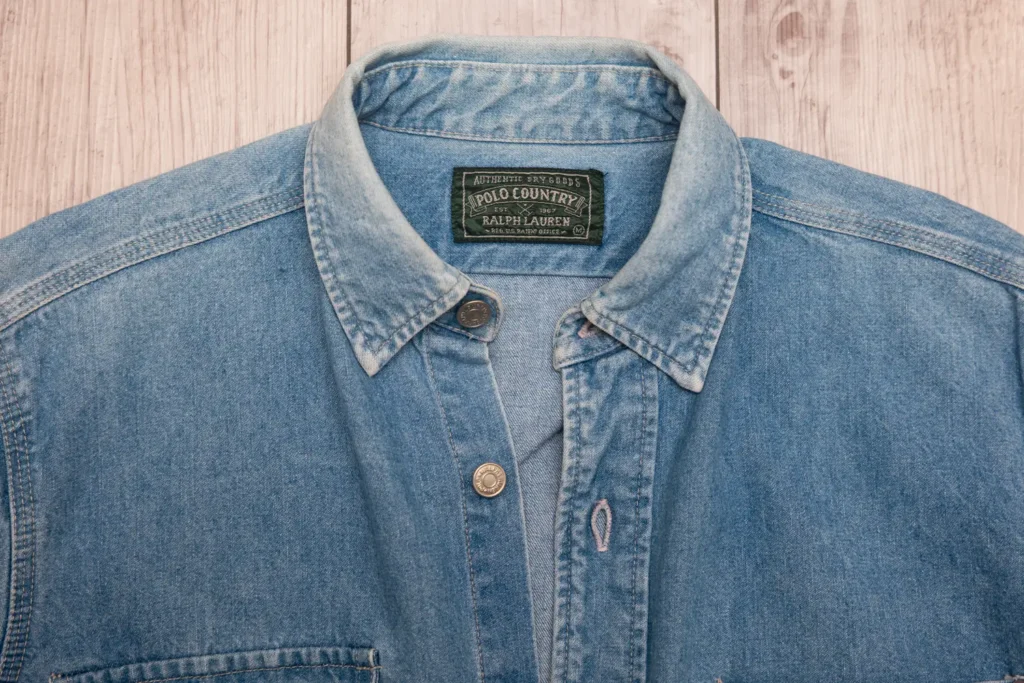
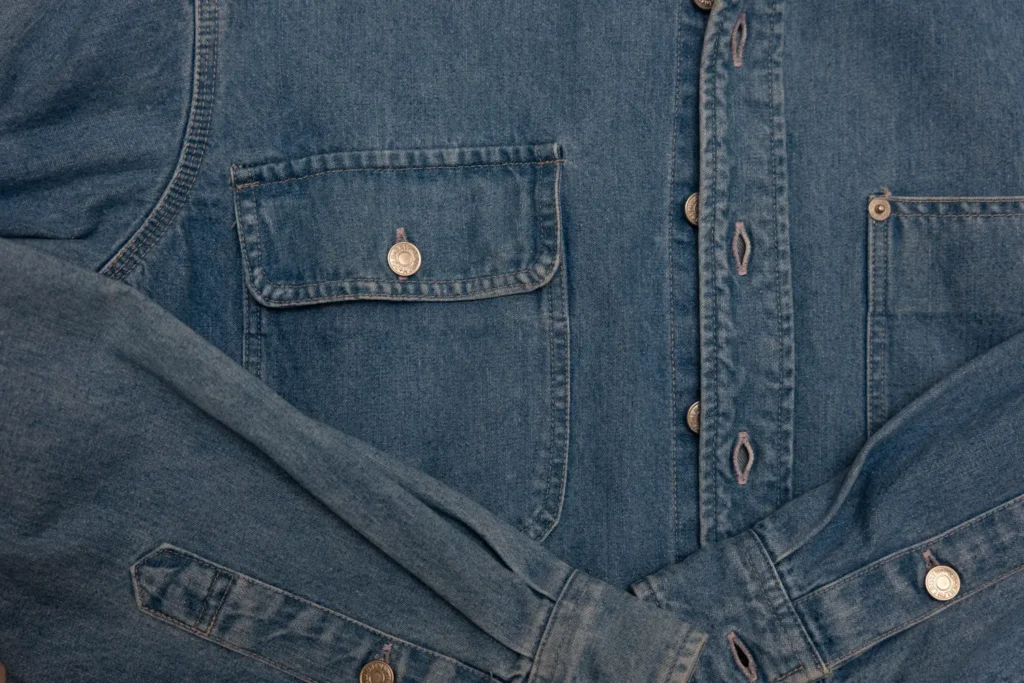
I started out loving vintage and gravitate toward the original American examples, but when it comes to styling, contemporary interpretations open up a wider range of looks. Like denim, the western shirt has evolved from workwear into a fashion item, and many brands now offer their own takes on it.
Among the many western shirts out there, I prefer the ones that bring a contemporary interpretation while keeping the original elements intact — fabric, construction, and all.
A representative example of this contemporary, easier-to-wear interpretation is Brunello Cucinelli’s western shirt. It uses the western shirt’s silhouette but is built from refined Italian fabric with the skill of Italian artisans, so it carries dress-shirt qualities and works well as the layer under a jacket.
Cucinelli’s western shirt is casual in style but constructed like a formal shirt, made from the kind of refined cotton the brand is known for. Compared to original western shirts built from lighter-weight denim — Wrangler and the like — it’s softer and more comfortable to wear, but it isn’t designed to age and develop character through long use the way an original western shirt does.
SOCIAL SCULPTURE SHIRT DMGD
The Visvim western shirt I’m covering here, the SOCIAL SCULPTURE SHIRT DMGD, uses heavyweight denim and carries forward the original silhouette and fabric character. It draws in the appealing patina of a vintage piece while sizing the cut in a more contemporary register.
Visvim draws on vintage clothing and, more broadly, American traditional dress as a source of inspiration. The brand also folds in Native American traditions, Japanese craft heritage, and other carefully preserved making methods from around the world — built into pieces that show real attention to detail.
This piece looks at the SOCIAL SCULPTURE SHIRT DMGD, a Visvim western shirt built with the brand’s strong eye and its deep respect for older craft methods.
1. Visvim’s Denim Texture
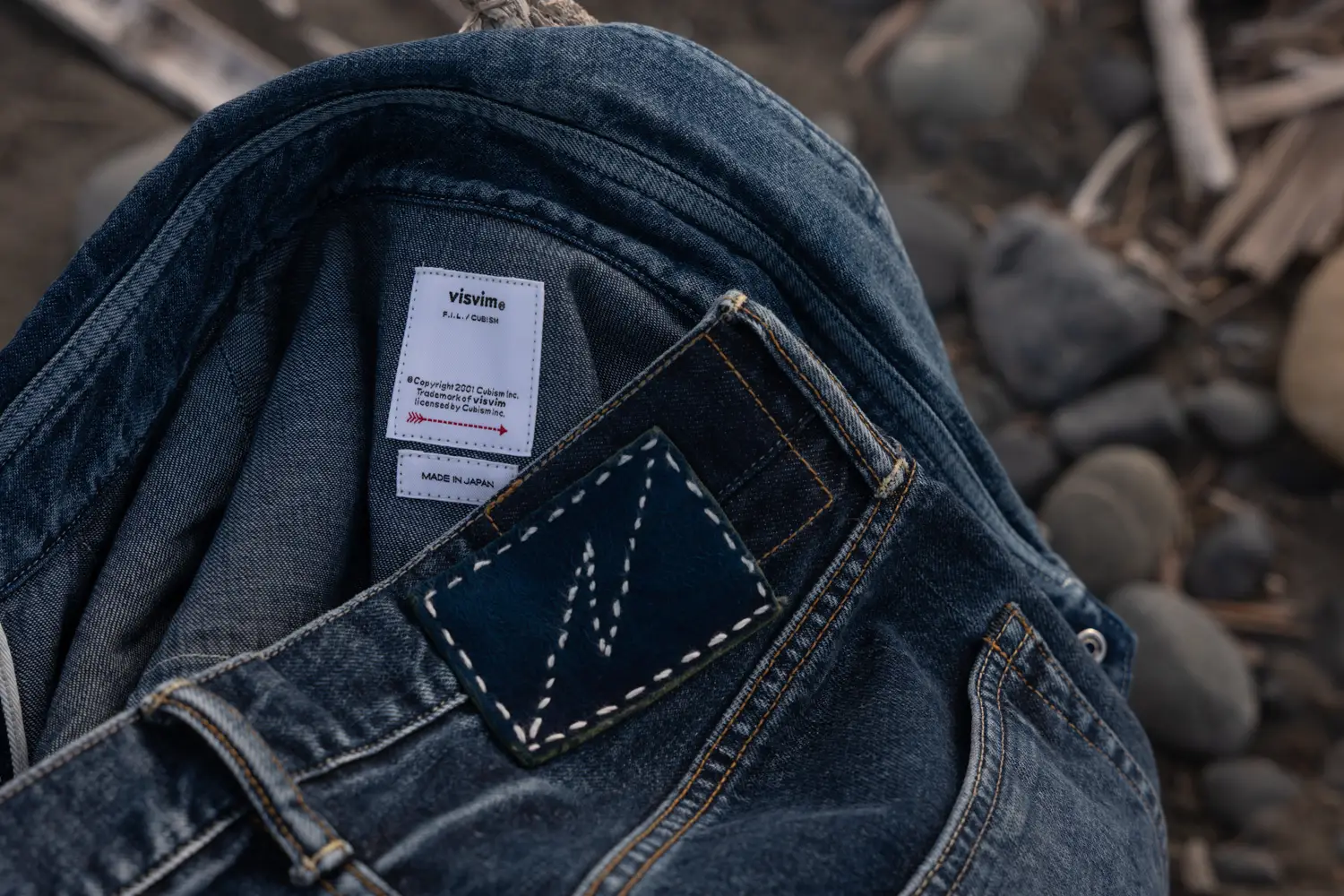
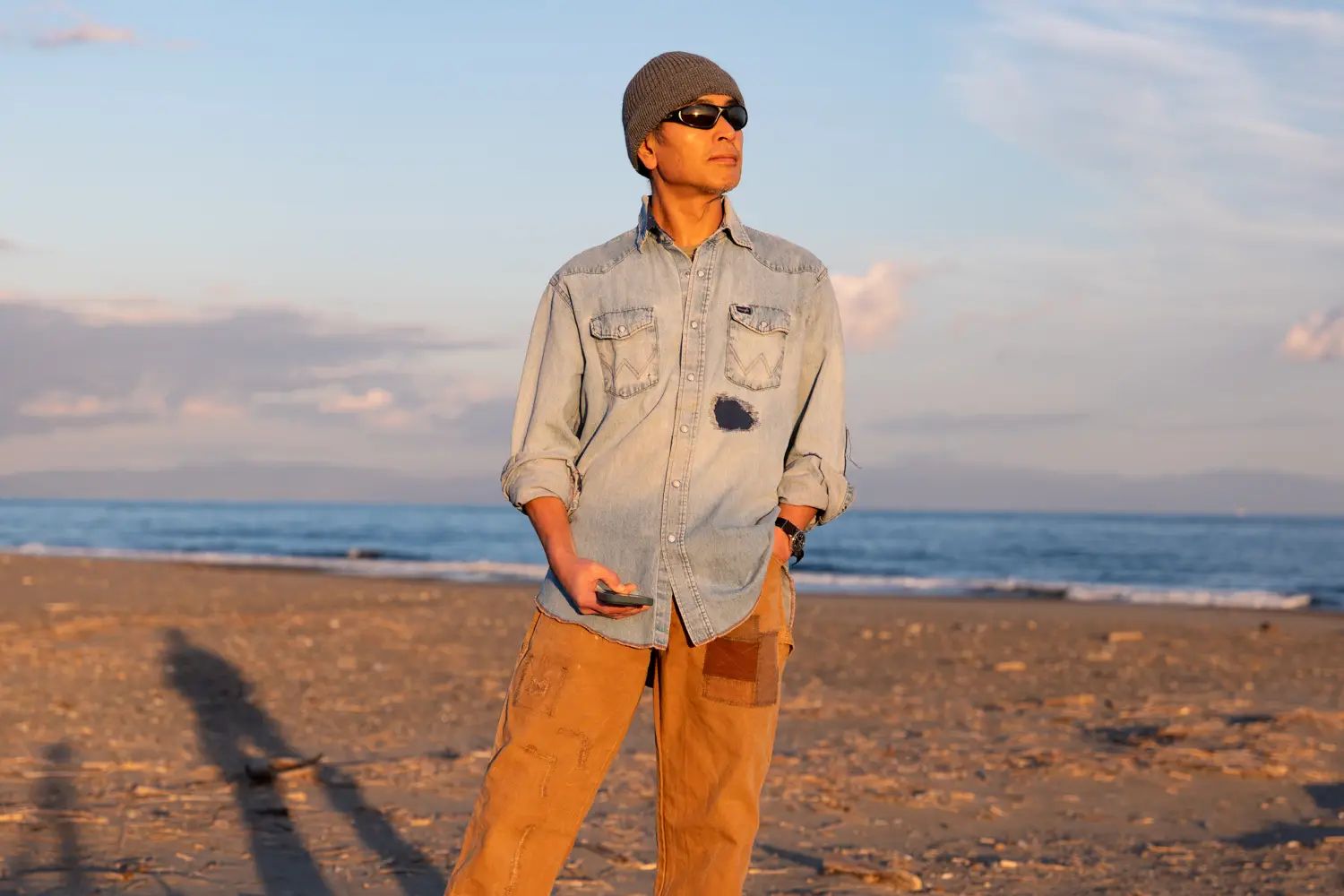
Visvim SOCIAL SCULPTURE SHIRT DMGD with SOCIAL SCULPTURE 01 SLIM DMGD-45
From the denim yarn itself, through the indigo dyeing methods and the texture of the cloth, to a vintage finish grounded in deep study of and respect for old garments — it’s a thoroughly Visvim take on the western shirt. The denim shown in the photo is the SOCIAL SCULPTURE 01 SLIM DMGD-45, one of Visvim’s regular slim-straight models.
2. Comparison: Brunello Cucinelli Western Shirt
Brunello Cucinelli — Western Shirt
Here’s the Brunello Cucinelli western shirt I cited earlier as a contemporary interpretation. As you can see, the shape is that of a western shirt, but the fabric is something else entirely — it’s a fine shirt that works for casual wear and also for dressing down a jacket and other tailored pieces.
3. Comparison: Wrangler Western Shirt
Wrangler Western Shirt — remade by New Air Vintage
This is the Wrangler western shirt remade by New Air Vintage that I wrote about previously. Just as Levi’s 501 is the original for jeans, Wrangler is the original for the western shirt, so this one looks the most natural of the three. The roomier shoulders and body, and the wider armhole, are where it diverges from a contemporary western shirt — but for casual wear, I find this kind of silhouette the easiest to use.
4. Visvim SOCIAL SCULPTURE SHIRT DMGD
Visvim SOCIAL SCULPTURE SHIRT DMGD
This is the SOCIAL SCULPTURE SHIRT DMGD, Visvim’s vintage-finished western shirt. The styling is more contemporary than the Wrangler above, but it doesn’t push as far in that direction as Cucinelli does, which puts it at a useful middle point. The vintage finish has its own character, so the shirt carries a complete look on its own.
Visvim
I covered the FLUXSUS 01 SLIM G.CORDS — a slim-fit straight trouser in German cord — in an earlier piece. Since it turned out to be easy to wear and easy to pair with a wide range of items, my interest extended to other Visvim pieces, and this western shirt is what I picked next.
Visvim takes iconic garments from fashion history and rebuilds them through its own lens. Other brands take similar approaches, but Visvim’s research runs unusually deep — they reach a more thorough understanding of each garment’s essence before reconstructing it in the form they consider best.
This reconstruction-as-remake works at a high level. The balance between what made historically respected vintage garments good and the feel of the present moment is unusually well judged. (The brand also factors in concerns that sit outside the trend cycle, like social responsibility and longevity.)
Visvim’s pieces hold the trend-aware element that clothing inevitably needs, alongside the more contradictory pair of universality and longevity that lets you wear them for years.
A Remake with Meaning
One example: the appealing aging found in vintage garments. Visvim chases the essence of that aging through careful material choices and finishing, which puts the work in a different category from straight reproduction of vintage clothing. (Vintage reproduction is a deeply rewarding world in its own right, but seen from a fashion standpoint, it sits a little outside the mainstream and edges into specialist territory.)
Visvim studies vintage garments closely and keeps wrestling with one particular problem: even with the same materials and the same methods, a modern reproduction doesn’t come out the same. The brand works through trial and error, builds an understanding of all the factors involved, and refuses to skip the small distinctions or the laborious steps that other makers might cut.
That consistency — never letting the process distract from the purpose of the making itself — is what gives the work its longevity and universality.
This is hard to put into words. Vintage garments, vintage culture, and pieces inspired by them all come with their own canon — staple items, keywords, value benchmarks everyone agrees on — and yet many of those pieces, once you actually put them on, don’t fully resolve as fashion.
Visvim works through that styling difficulty from its own angle, processes it into something that holds up as fashion, and presents the result. Picking up a Visvim piece feels like taking a shortcut around the trickiness of styling vintage clothing.
SOCIAL SCULPTURE SHIRT DMGD
SOCIAL SCULPTURE SHIRT DMGD is a long name, but distinctive names like this are typical of Visvim pieces.
SOCIAL SCULPTURE combines “Social” (everyday life) and “Sculpture,” and refers to the way denim takes on character through the wearer’s daily life and shifts over time the way a piece of sculpture does. The concept is that wearing Visvim denim long enough turns it into something with the feel of vintage denim down the road.
SOCIAL SCULPTURE SHIRT carries this same Visvim concept into a denim shirt — one that will, in time, age into something with vintage character.
DMGD stands for the distressed finish.
Styling
When I wear a western shirt or a denim jacket, I almost never pair it with denim on the bottom. Visvim’s pieces, though, are interesting enough to shift my usual approach, and here I’m wearing the Visvim western shirt with Visvim jeans.
The construction and vintage finish of the shirt and the construction and vintage finish of the denim — both pieces are brand new, but each carries something like a different point on the timeline. That offset is what does the trick: it pulls a same-color denim-on-denim outfit, which usually risks looking heavy-handed, over into something that reads as considered.
Putting together this kind of pairing with actual vintage or original pieces is hard to pull off, and the way Visvim handles it comes directly out of its long study of and affection for vintage clothing.
1. SOCIAL SCULPTURE SHIRT DMGD
SOCIAL SCULPTURE SHIRT DMGD — Front
Worn the orthodox way, with the buttons done up. Buttoning up makes the shirt’s silhouette easier to read.
The skill in the vintage finishing stands out, but so does the fit — the shoulders, body, length, and sleeves all sit at the right place. Down to the size of the collar and the patch pockets, the shirt projects Visvim’s world from any angle. It looks ordinary at a glance, yet the way it wears is anything but.
2. From Behind
SOCIAL SCULPTURE SHIRT DMGD — Back
The back is just as carefully worked out. The silhouette holds up cleanly without falling into the usual trap of an all-indigo, single-tone outfit.
3. Full Silhouette
SOCIAL SCULPTURE SHIRT DMGD with SOCIAL SCULPTURE 01 SLIM DMGD-45 — Setup
Worn as a setup, the difference between the vintage finish on the shirt and the one on the denim becomes obvious. One thing that gets across just how strong Visvim is at this: the aging on the shirt is precisely judged, and putting some space between the shirt’s aging and the denim’s aging is what solves the difficulty of a same-color setup with subtle color variation.
4. Worn Open
Shirt Worn Open
Opening the shirt and letting the white tee show through introduces a tonal shift into an otherwise all-indigo outfit.
5. Overall Balance
The white tee balances the overall look
The overall balance is on the trim side without going too narrow — the silhouette lands at a well-judged point.
6. Tied Around the Waist
Shirt Tied Around the Waist
I’ve taken the western shirt off and tied it around my waist. It’s a standard American casual move, but Visvim’s eye pulls it together cleanly and gives it some polish.
Detail
SOCIAL SCULPTURE SHIRT DMGD
8 oz
Distressed finish
100% cotton
Color: indigo
Size 1
Pairings
Western shirt: Visvim SOCIAL SCULPTURE SHIRT DMGD
Pants: Visvim SOCIAL SCULPTURE 01 SLIM DMGD-45
White T-shirt: Tom Ford
Hat: Borsalino
Sneakers: Visvim SKAGWAY LO
In Closing
The Visvim western shirt isn’t fully faded the way a true vintage piece like the New Air Vintage Wrangler is. Instead, it captures aging mid-process — fade and all — so that the buyer can take it from there and continue the aging themselves.
This matches the brand’s stated concept: offering each buyer their own personal vintage. The shirt isn’t as stiff as raw denim — Visvim uses a substantial 8 oz denim and gives it a measured wash, so the cloth keeps a moderate hand that softens through wear. With more washing and time, you end up with a one-of-a-kind aged western shirt.
Visvim resolves the difficulty of choosing and styling vintage garments from its own angle.
Visvim is well-regarded internationally, with a customer base that runs from ordinary clothing enthusiasts to well-known creators. One thing that sets the brand apart is how passionately devoted its fans tend to be compared with the followings of other brands.
On top of construction grounded in thorough research — materials and all — the brand has a particular eye and a particular sense of measure, and the essential elements of what makes clothes appealing are all there. And yet Visvim deliberately keeps any of that off the surface. The pieces ask the user to pick them up, wear them, and arrive at their value through experience, with attachment building over years of use. That consistent approach is what draws me to Visvim.
Shop
I bought the SOCIAL SCULPTURE SHIRT DMGD covered here at Visvim General Store in Nakameguro.
The shop occupies a renovated traditional Japanese house — a fitting space for taking in Visvim’s world.
For more on the shop itself, see the FLUXSUS 01 SLIM G.CORDS piece.
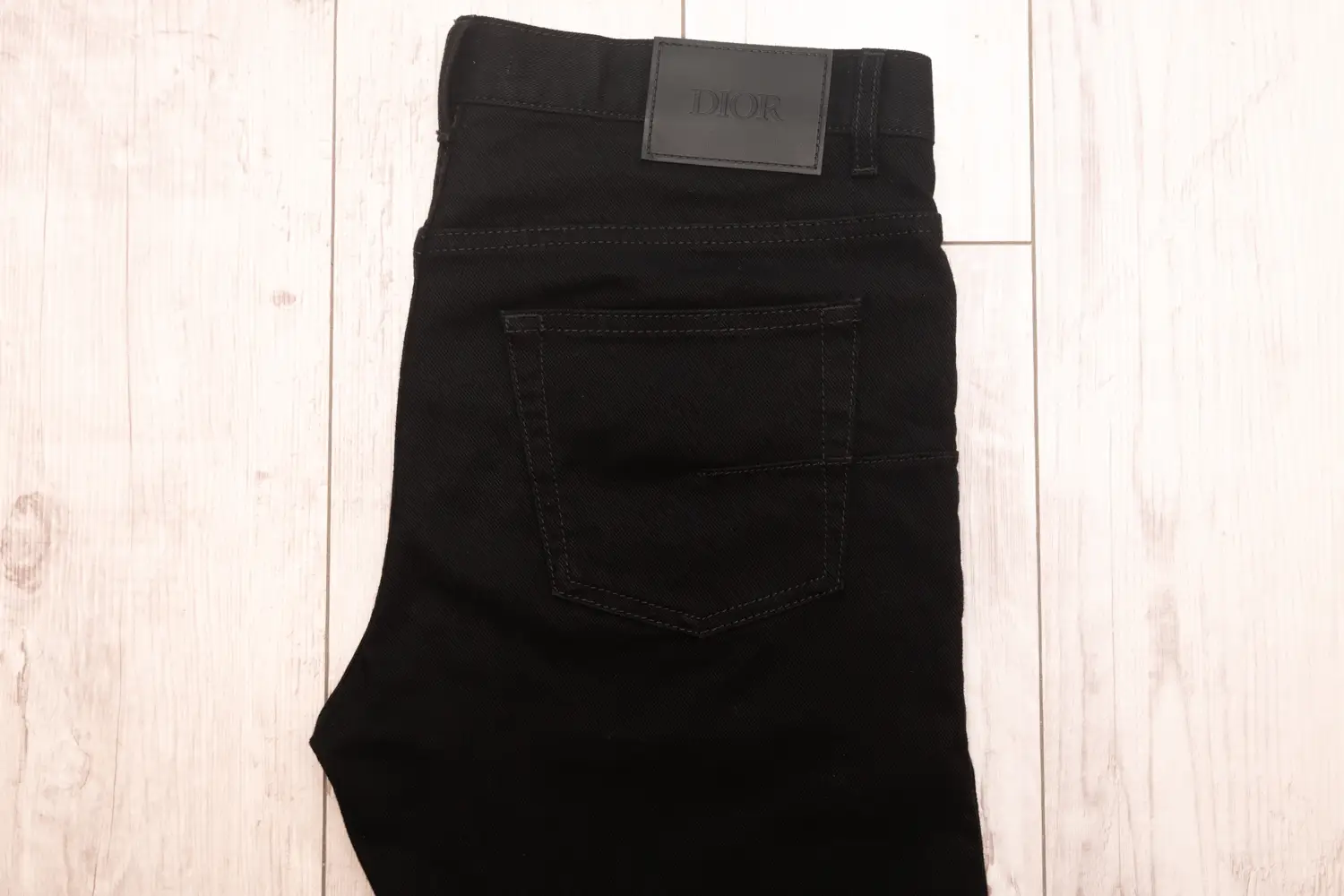
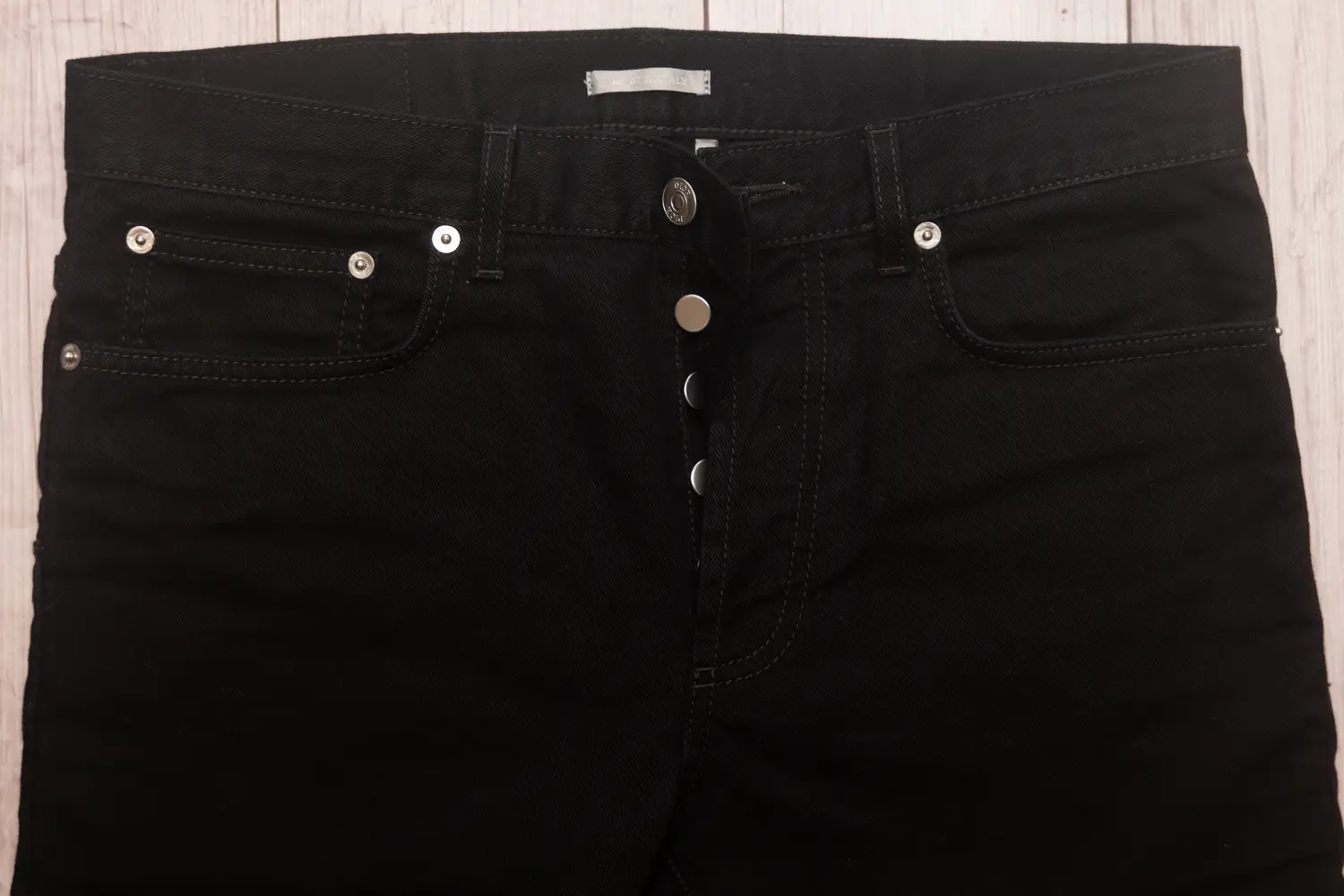
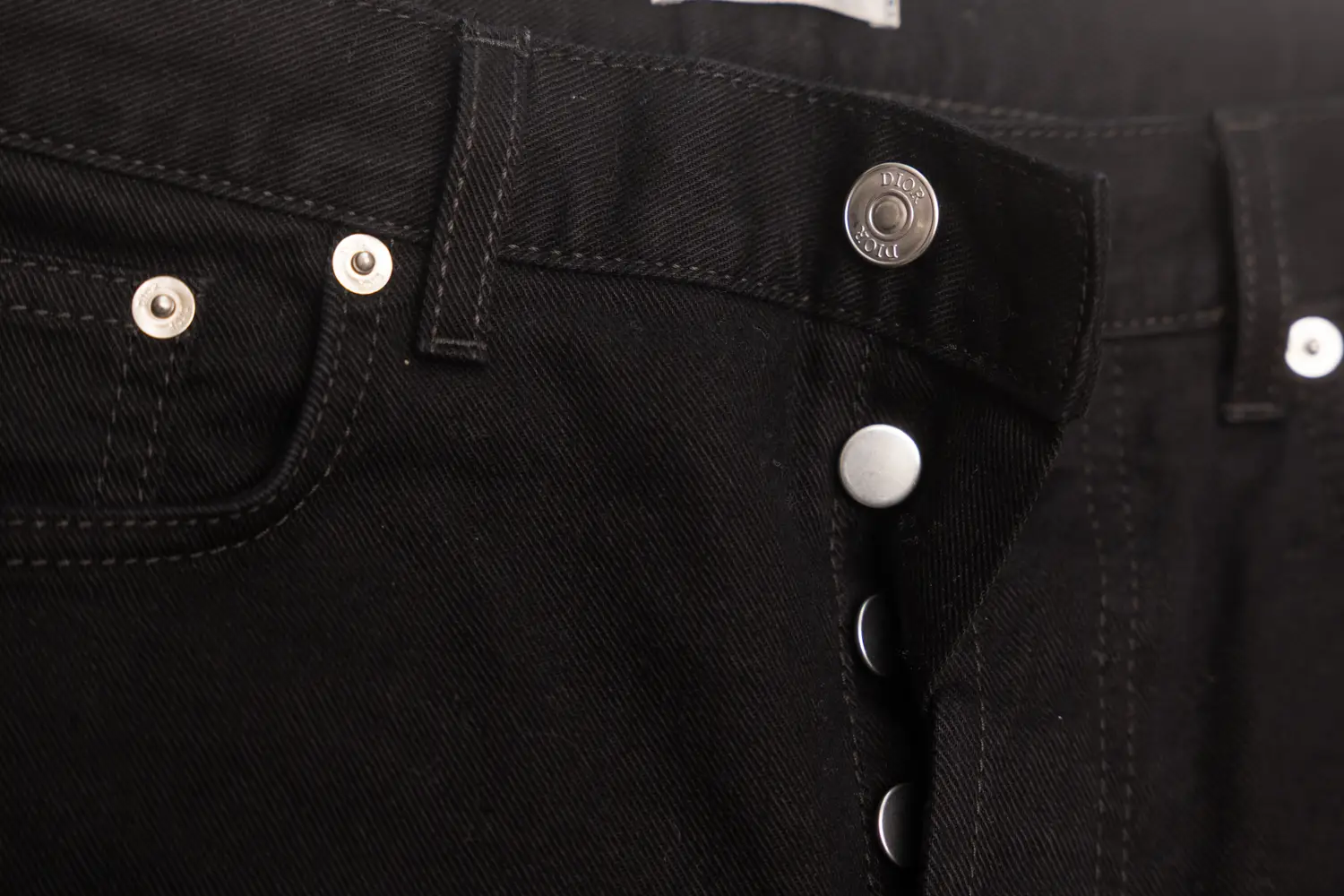
This past winter, after a younger colleague said something like, “It would be wonderful to wear Dior at sixty,” I picked up a few Dior pieces and have been enjoying a register of winter dressing that’s never quite been part of my usual style.
My image of the brands that drive the Paris collections — Dior among them — had long been that their design was excellent, but their material choices and tailoring fell short of what one finds in serious sartorie or in luxury houses that put materials first.
The cashmere peacoat I bought this winter overturned that image entirely. Its cloth and its tailoring hold their own against any sartoria or so-called luxury house.
I’ve always leaned toward American casual, and as casual wear I valued practicality over the rigor of materials and construction. The refinement and quiet authority that come from real fabric and real tailoring weren’t things I particularly looked for. But — as I’ve written in other pieces — getting older has begun to shift the way I think.
Dior, which I had always taken as the forward edge of mode (in the sense of contemporary fashion), turned out to carry pieces of genuine quality — pieces that could serve as enduring standards. The discovery itself has been quietly impressive.
I had thought of Dior’s clothes as something younger generations enjoy. To find pieces I could wear at my own age — middle-aged, on the older side — opened up a brand I’d not had much interest in before. It now reads as a brand worth looking at.
It was that shift of mind that led me to buy what Dior is offering this season — an oxford-cloth button-down shirt, and a slim, flat-front pair of chinos.
Beige chinos with a sky-blue button-down — the central composition of American Trad — is rebuilt here through Dior’s own lens. As a top maison whose center of gravity sits in mode, there’s an element of trend-handling in the way Dior treats Ametora, but the result is modern and clean, well-made and quietly refined: the kind of universal piece that’s easy to wear.
Dior’s traditional style
1. The Button-Down Shirt
Dior Button-Down Shirt
A button-down shirt made up in oxford cloth. The smaller collar and trim body are unmistakably Dior, but the quality of the cloth and the care of the stitching hold their own against shirt specialists like FRAY.
2. A Quiet Mark
Dior Button-Down Shirt — Embroidery
There’s a quiet Dior embroidery on the left side. The motif feels — to my eye — like it’s nodding to the made-to-order shirts at Brooks Brothers.
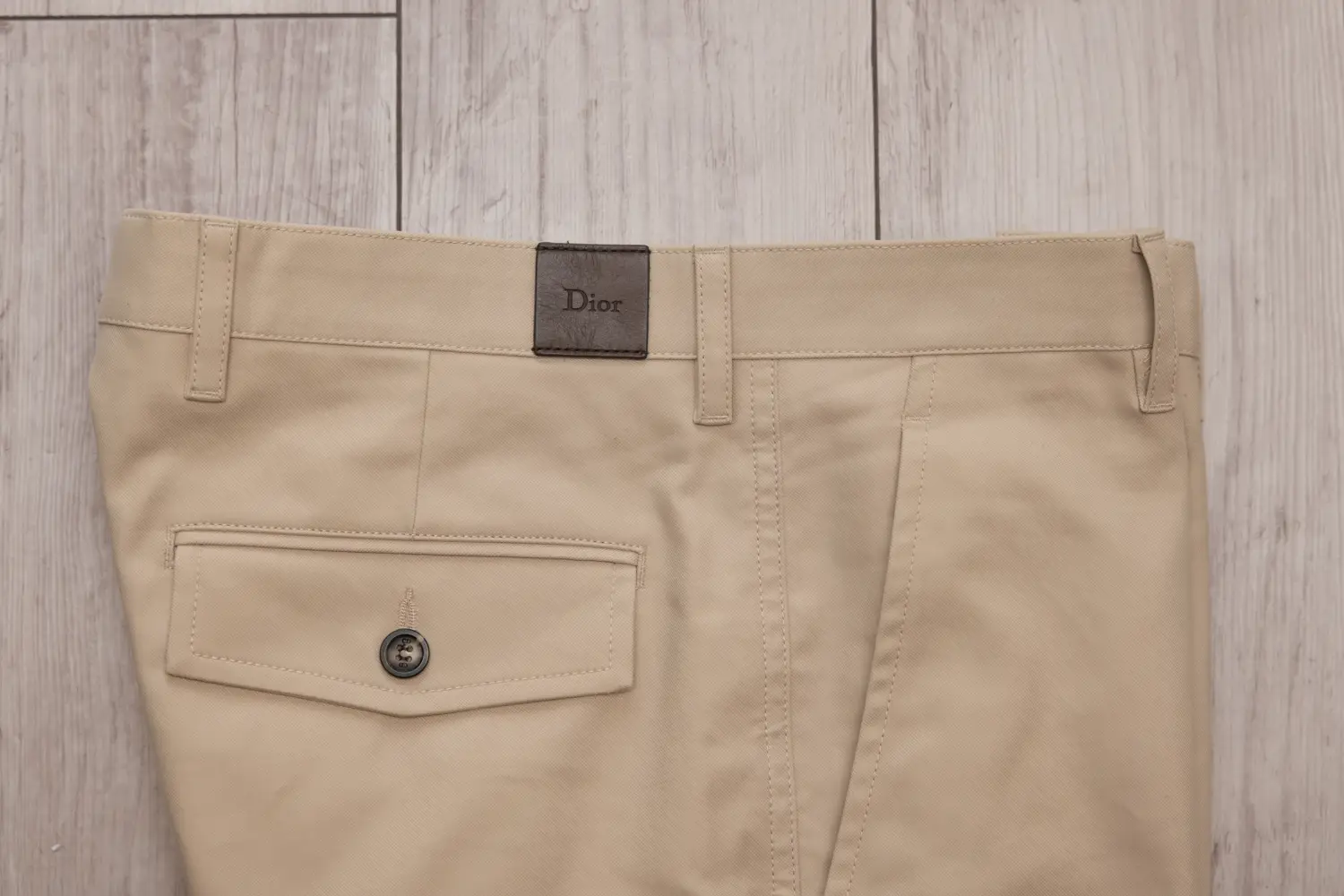
3. The Chinos
Dior Chinos
Slim, flat-front chinos without a pressed crease. Long a staple beyond Dior, this kind of trouser had quietly disappeared from the market in recent years. From this spring or so, I’ve started seeing them again at a handful of brands. A staple, yes — but here, cut with the slightly removed stylishness that Paris mode tends toward, and with the straight, linear construction that has carried through Dior since Hedi Slimane. The Dior of these chinos still recognizably belongs to that line.
Dior’s Chinos and Button-Down Shirt
Ametora (American Trad)
In my twenties, I was drawn to what’s known in Japan as Ametora (American Traditional) — chinos paired with button-downs or denim shirts. I wore a lot of clothes from a brand called TUBE back then.
From there I gravitated to Brooks Brothers and Ralph Lauren. Money was tight in my twenties and the number of pieces I could afford was limited, but I treated the few I had as cherished items and wore them carefully.
Looking back, that was the seed of how I dress now — Ralph Lauren chinos with a heather-gray Champion Reverse Weave on top, Stan Smiths or Superstars on my feet.
For shirts, I’d wear a Brooks Brothers button-down straight off the wash, or a Ralph Lauren denim shirt left open at the front over a Hanes tee. That was the silhouette of my style in those years.
The first place I ever bought Ralph Lauren chinos was Bloomingdale’s in New York. I was visiting on a trip. The staff treated me — a Japanese tourist — with real kindness, and that was what tipped me into buying.
I also stopped into Barneys’ flagship, though the prices were well beyond what I could afford then. The staff there were kind too, and I came away with a pair of Oliver Peoples sunglasses.
I have a tendency to buy when I encounter a salesperson’s enthusiasm and genuine attention (this hasn’t changed). The man at Bloomingdale’s took his time, looked carefully for what would suit me, and I bought those Ralph Lauren chinos out of how earnest and warm he was. That single pair of Ralph Lauren chinos has, in its own quiet way, shaped how I’ve dressed in the years since.
It was a music trip — that’s why I was in New York. I caught Johnny Griffin at the Village Vanguard, Leslie West at the Bottom Line, and the Anthrax / Public Enemy collaboration at the Ritz. The unexpected bonus was stopping by CBGB to pick up a hat I’d been asked to bring back as a souvenir, and finding Joey Ramone there for an event meeting. Seeing him moved me. That’s the trip I remember.
Dior’s Reading of American Trad
The oxford button-down and chinos that Dior is offering — the pieces I’m covering here — feel to me as though they have one eye on American Trad (Ralph Lauren and Brooks Brothers in the 1990s, that kind of register).
From around last year, Tom Ford and Brunello Cucinelli have been showing suits and jackets whose silhouettes seem to look back to late-1980s and early-1990s Armani.
There’s no direct connection between Dior’s reading of American Trad and Brunello Cucinelli’s reading of Armani, of course. But viewed in terms of period feeling, the Armani suit and American Trad — though running on different trend cycles in real time — both belonged to the late-1980s through 1990s mood, and I sense that several brands are now drawing on that era’s atmosphere.
Trends tend to circle back over time, and I get the feeling that what was current from the late 1980s into the 1990s is now entering its return cycle.
American Trad is a style I’ve always liked, but it’s been a long while since I’ve actually worn it, and now it feels fresh again.
The Button-Down Shirt
What caught my eye was the oxford-cloth button-down. Compared to Dior’s traditional formal shirts — cotton poplin, designed to live under a suit or jacket — this one keeps the slim cut that’s identifiably Dior, but uses a substantial, well-bodied oxford cloth, runs slightly shorter in the body, and is built on the premise of being worn untucked.
I owned and wore a few Dior shirts from the Hedi Slimane era. The button-down on offer this season still carries forward several elements of that iconic period — the small collar shape, the trim armhole.
Dior shirts carry their mode sensibility, and even tossed on over a pair of jeans, they bring a distinct atmosphere with them — though I’d say they sit more naturally with Dior’s slim denim than with a standard 501.
When I wear a button-down with denim, I usually leave it unironed and wear it straight from the wash; with chinos, I press it. The Dior oxford works differently — it leaves room for a more relaxed American Trad register too.
What surprised me about wearing this shirt was that — for all that the silhouette is Dior mode — there’s a hand-made quality to the construction, and the cloth choice gives it the air of something made up at an Italian camiceria.
The motif is the Brooks Brothers button-down, but the shirt itself isn’t an American industrial product. It carries the texture of an Italian tailored shirt, and that single garment ends up showing several different faces depending on how you wear it.
The Chinos
What caught my eye, alongside the oxford shirt, was the slim, flat-front, uncreased chinos. The fabric is a lighter cotton you tend to see in spring and summer collections — easy to wear, useful in daily rotation.
The slim chino with a pronounced taper, of the sort that Italian brands like PT Torino or Incotex offer, is easy enough to find. But the older American style — slim without a heavy taper — seems to have lacked a market in recent years, and I’d been unable to find a pair I wanted to wear, even when I went looking.
A pair of Visvim German-corduroy trousers I bought this winter turned out to be unexpectedly fine, so I broadened my search across brands, and in the Spring/Summer collection by Jonathan Anderson — who took over as Dior’s new designer this season — I found these slim chinos. They caught my interest, and once I tried them on, the cleanness of the line was exactly what I’d had in mind. I bought them.
The motif is the American chino, but cut to Dior’s signature slim line with a straight, almost geometric construction. The result is trousers that present the leg cleanly and read as an excellent piece of styling.
The combination above — button-down with chinos — is a staple American Trad pairing that I’ve always liked and that I find myself wanting to return to periodically. With Dior’s particular cleanness layered on top, it becomes a clean composition that holds several different registers at once.
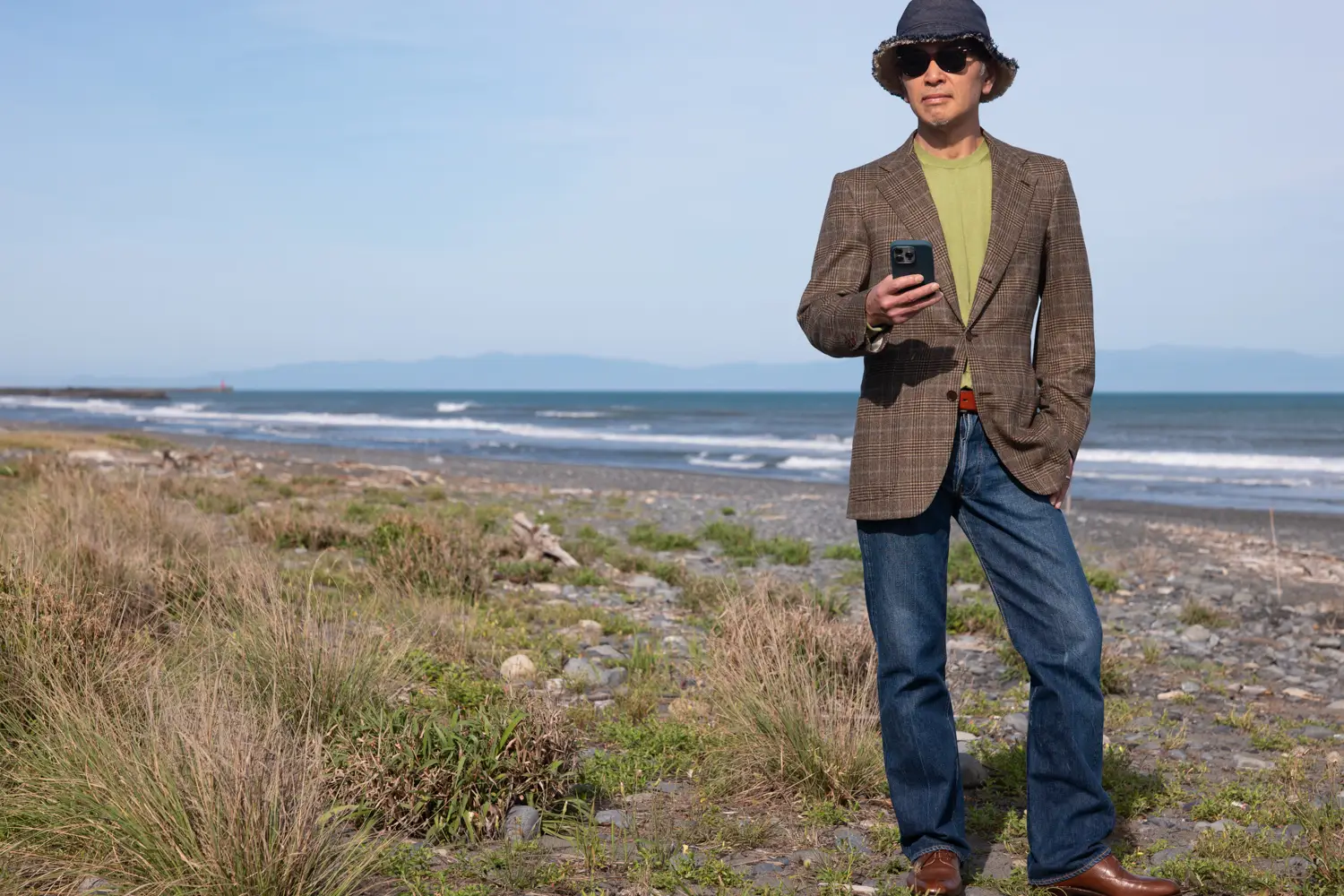
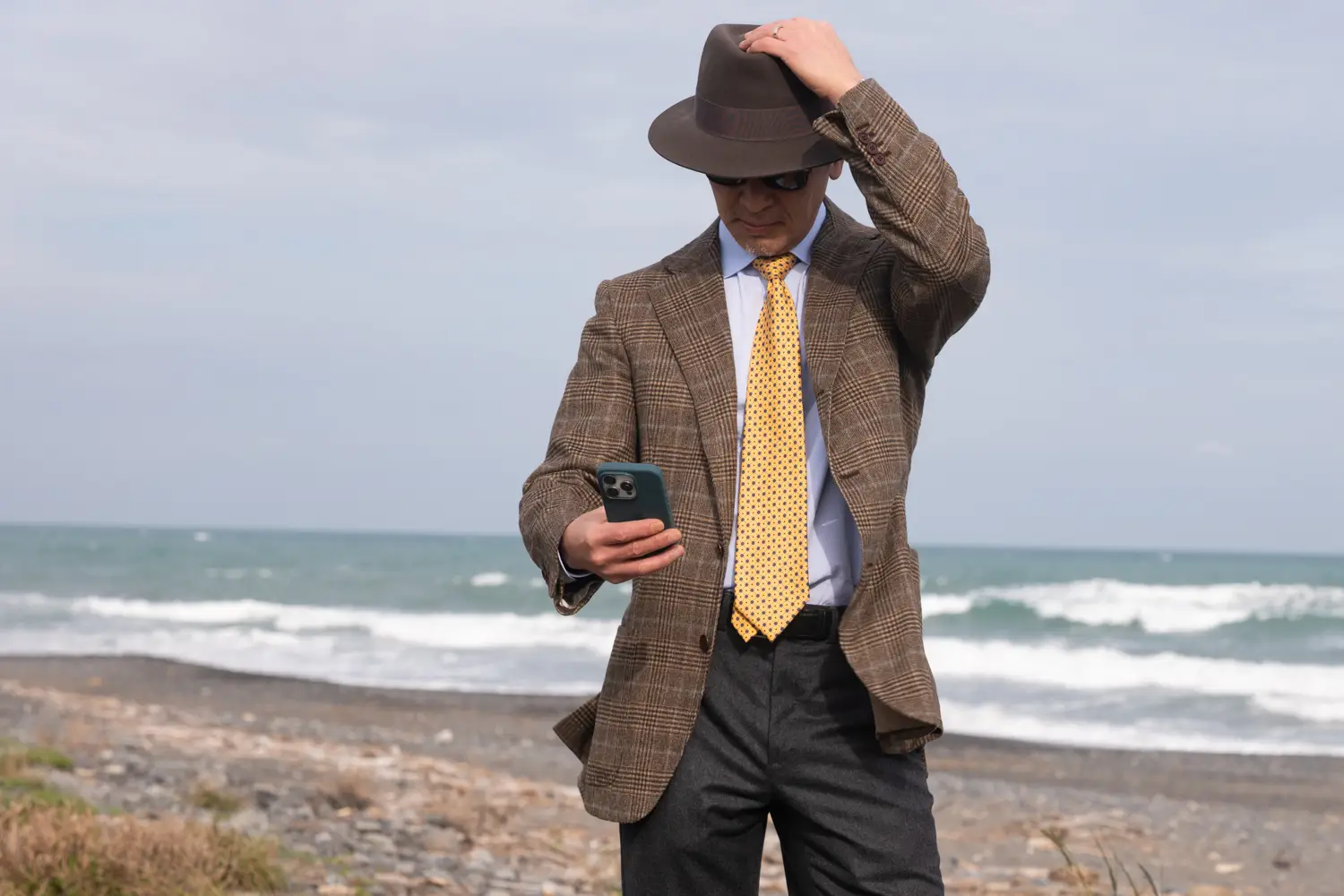
This season, alongside the casual pieces I usually reach for, I’ve found myself wearing suits and jackets that hadn’t seen daylight in some time. The Formosa cashmere jacket I’m introducing here pairs beautifully with my regular Levi’s 501XX and other denim, and because it’s tailored from cashmere, it earns its place in heavy rotation through the depths of winter.
Beyond the jacket itself, I’ve also written through what I take to be the deeper cultural side of Italian sartoria — a strictly personal reading. Working that out, in turn, has deepened my own understanding of what makes the Formosa jacket so quietly remarkable.
This piece runs long, so I’ve broken it across six pages.
Formosa
Formosa is not a fashion brand but a sarto — a Naples tailoring house. Its full name is Sartoria Formosa, and the workshop sits in the Chiaia district of Naples.
It is an old house. Mario Formosa founded the atelier in 1965, and he became one of the legendary masters who carried Naples tailoring through its “golden age.” Trained under Roberto Combattente, he stands in the legitimate line of succession of the Neapolitan style.
With Mario’s passing, his son Gennaro Formosa now carries the house forward in his father’s name. The atelier was historically bespoke-only, though it has begun offering ready-to-wear in modest quantities.
What’s worth noting is that even the ready-to-wear isn’t farmed out to an external factory — it is made in-house by Formosa’s own tailors, which means the off-the-peg pieces carry essentially bespoke-grade build quality. There is no Japanese distribution, but the line shows up at high-end North American department stores.
The Neapolitan suit is, in a sense, a philosophy born of Naples itself — lightness and softness, freedom rather than formality. Manica camicia (the shirt-sleeve construction), thin canvas, and a generous use of hand-stitching are its hallmarks. The warmth that only human hands can give a garment, and the rounded silhouette that follows the body in three dimensions — neither of which a sewing machine can replicate — soften the British-derived austerity of the suit and leave behind something refined, light, and easy to wear.
To this inherited Neapolitan craft and philosophy, Formosa adds its own techniques and judgment, producing a take on the Neapolitan style that feels easier to wear and more contemporary in everyday life.
The house places real emphasis on cultural transmission, and the workshop is notable for the number of young, promising tailors working in it.
Formosa carries the traditional Neapolitan techniques and thinking forward, but compared to other Neapolitan sartorie, it has a distinctive balance — a kind of restraint, a refusal to over-construct the form.
Like the rest of Naples, it works with minimal canvas and an exceptionally soft hand. What it does particularly well is build dimensional volume from the chest up through the shoulder — without forcing the body’s line through construction or stiffening, it arrives at a silhouette that fits the body cleanly, but no more than is needed.
This technical command produces a cleaner line than most Neapolitan tailoring, and Formosa’s jackets and suits are accordingly described as marrying the Neapolitan tradition with a contemporary modernity.
Because Formosa doesn’t lean on cloth weight to hold a jacket’s form, the house can work freely with light and soft fabrics that other tailors tend to avoid. The result is a Formosa hallmark — an excellent silhouette that nevertheless carries softness, an unusual lightness, an unforced ease in the wearing.
Not everything is built from light, soft cloth — at the customer’s request, Formosa will of course produce heavier, more structured suits with longer service in mind. But the customers who walk in tend to be there for the soft and the light.
The house’s cloth library — including vintage fabrics — is among the most extensive in Naples, and Formosa takes the matching of customer to cloth as a serious matter.
To my mind, Formosa is the workshop that has carried the legitimate Neapolitan techniques forward and, with its own native deftness and sense of balance, evolved the traditional style into something genuinely modern.
A Light, Soft Cashmere
Formosa Cashmere Jacket
When a breeze catches it, you can see — and feel — how light and soft the cashmere truly is.
The Neapolitan Curve from Shoulder to Chest
Formosa Cashmere Jacket — Shoulder and Chest Line
The signatures of the Neapolitan tradition are all in place — the high gorge, wide lapel, generous armhole, and a clearly built line running from shoulder to chest. What is most Formosa here is the choice not to overstate the body’s fit, and to let the overall balance carry the look. The result is decidedly modern.
A Measured, Three-Dimensional Back
Formosa Cashmere Jacket — Back Silhouette
The line that runs from the shoulder, down through the side suppression at the waist, then opens out toward the hip is shaped without being overworked. With the slightly longer length and the deep side vents, the back composes itself into a clean, uncluttered silhouette.
A High Gorge and an Open Lapel
Formosa Cashmere Jacket — High Gorge and Open Lapel
One of Formosa’s signatures is the slightly stronger curve cut into the lapel. Worn, that curve allows the lapel to fall open and lets the chest read as more powerful. It’s harder to see in photographs, but on the hanger that same curve causes the lapel to close inward rather than splay open — a small, deliberate detail.
The M.F. — Mario Formosa Label
Formosa Cashmere Jacket — M.F. for Mario Formosa
The label carries M.F. — the initials of Formosa’s founder, Mario Formosa.
What I’m covering here, then, is a Formosa cashmere jacket — modern and stylish in line, made from a vintage cashmere of measured weight, built by serious tailoring craft, and altogether light and easy on the body.
This winter, I have found myself frequently opting for slim-fit trousers, starting with a pair of black slim-fit denim from Dior. While my usual winter staples would typically be the Levi’s 501 or Lee 101, I have recently awakened to the allure of the refined, slim silhouette. This has allowed me to enjoy winter styling in a way that feels distinct from my previous aesthetics. Moving away from the ubiquity of indigo denim, I have been increasingly incorporating beige tones into my wardrobe.
Visvim
Among these choices, the pair I have likely worn the most is the Visvim FLUXSUS 01 SLIM G.CORDS, crafted from rugged German Cord fabric. Although categorized as beige, the stiff, dense texture of the German Cord gives it a subtle grayish undertone, resulting in a cooler, more sophisticated hue than typical beige. Despite being a slim-fit model, the silhouette leans toward a narrow straight cut, making it exceptionally versatile and indispensable for various pairings.
Visvim develops its collections by drawing inspiration from a broad spectrum of traditional American attire, extending beyond just vintage clothing. Their craftsmanship is deeply intentional, incorporating elements such as Native American heritage, Japanese traditional crafts, and time-honored manufacturing techniques from around the globe that deserve to be preserved for the future.
Allow me to introduce the FLUXSUS 01 SLIM G.CORDS—a garment that perfectly embodies Visvim’s impeccable taste and uncompromising dedication to detail.
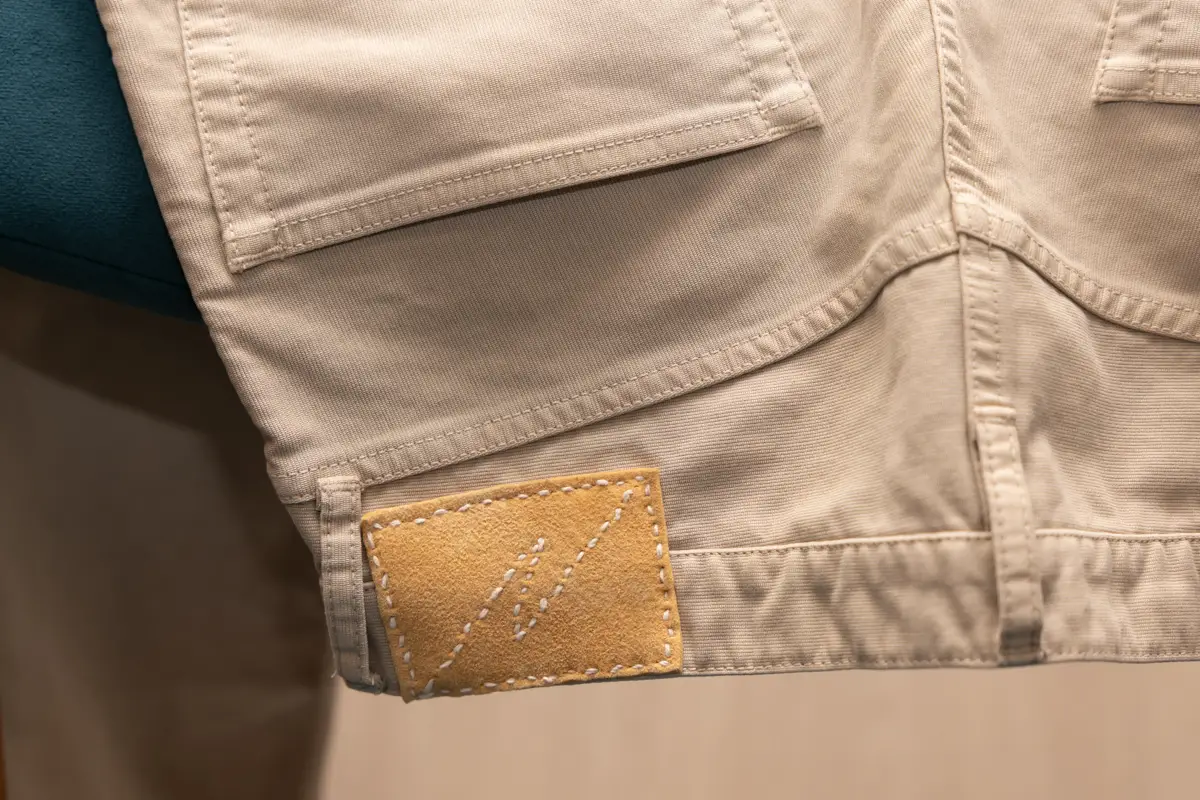
1.deerskin leather patch
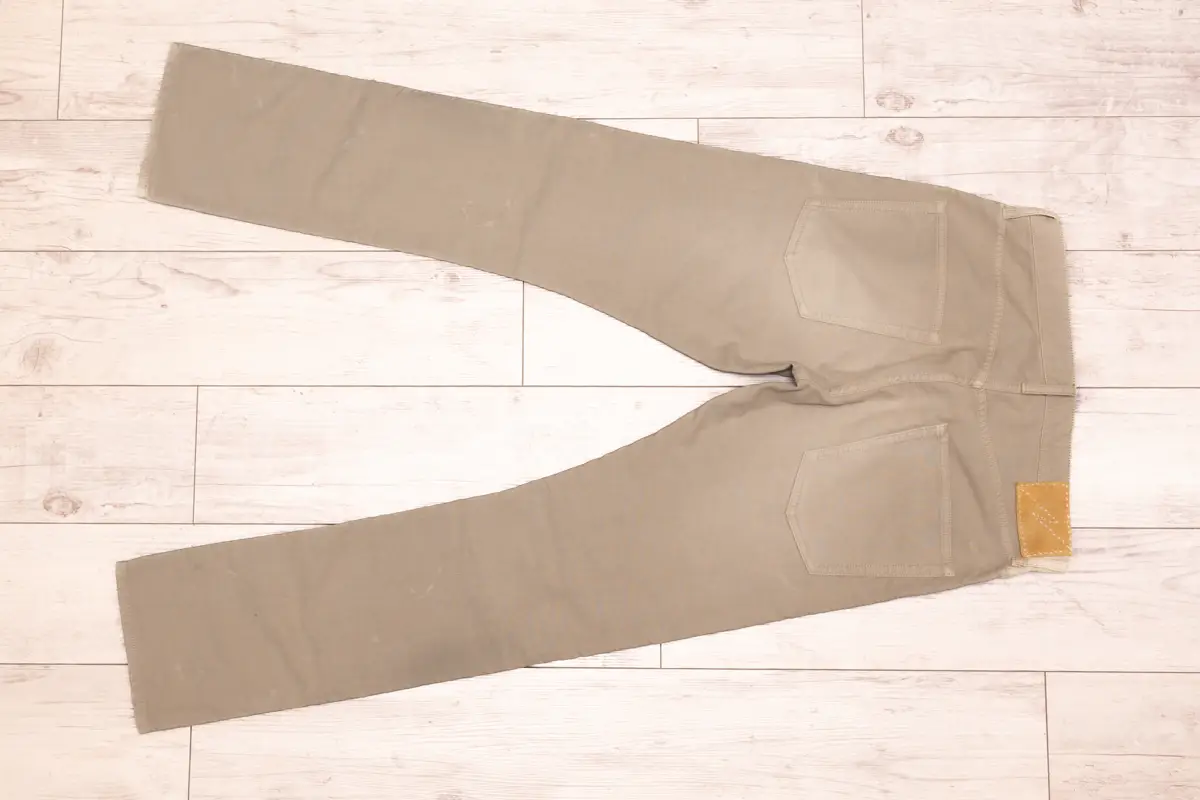
The deerskin leather patch of the Visvim FLUXSUS 01 SLIM G.CORDS.
The body is crafted from a stiff, high-density German Cord fabric, providing a rugged structure that contrasts beautifully with the remarkably soft deerskin leather patch.
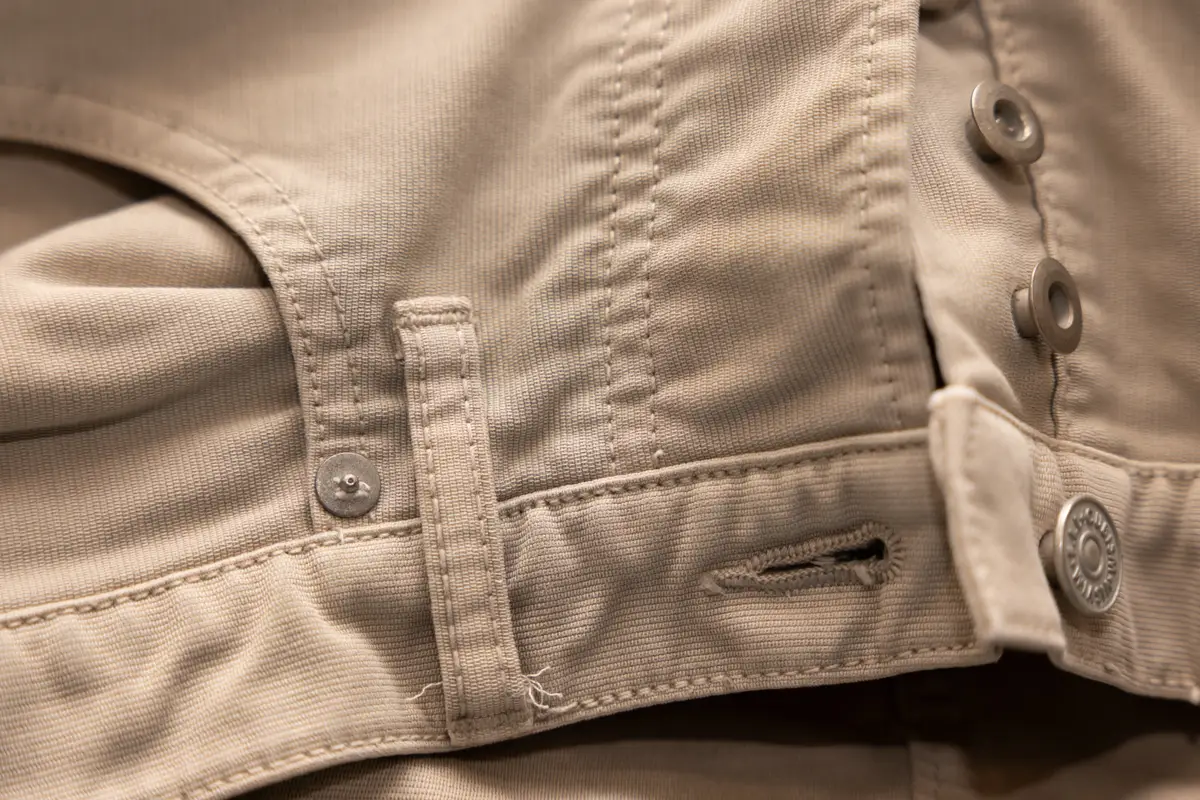
2.German Cord fabric.
Detailed texture of the Visvim German Cord fabric.
The fine vertical ribbing of the high-density German Cord creates a rich, tactile texture.
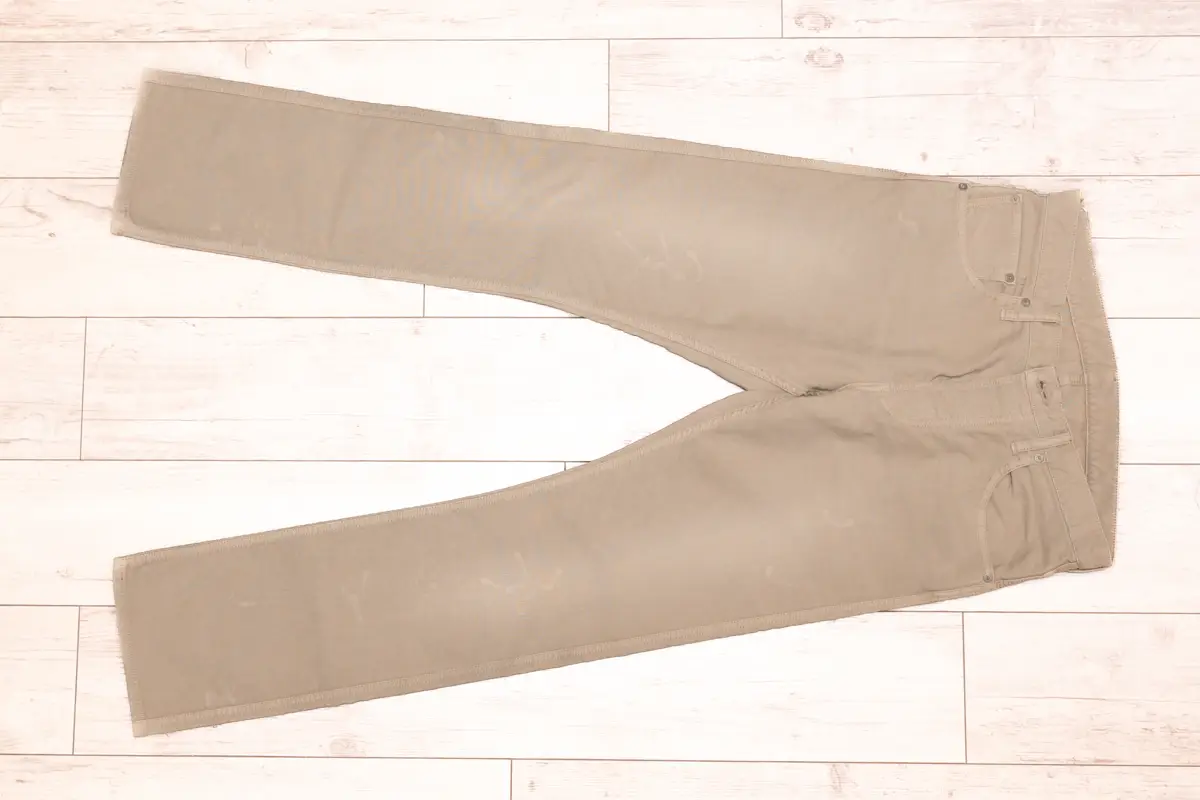
3.Front view
Front view of the FLUXSUS 01 SLIM G.CORDS.
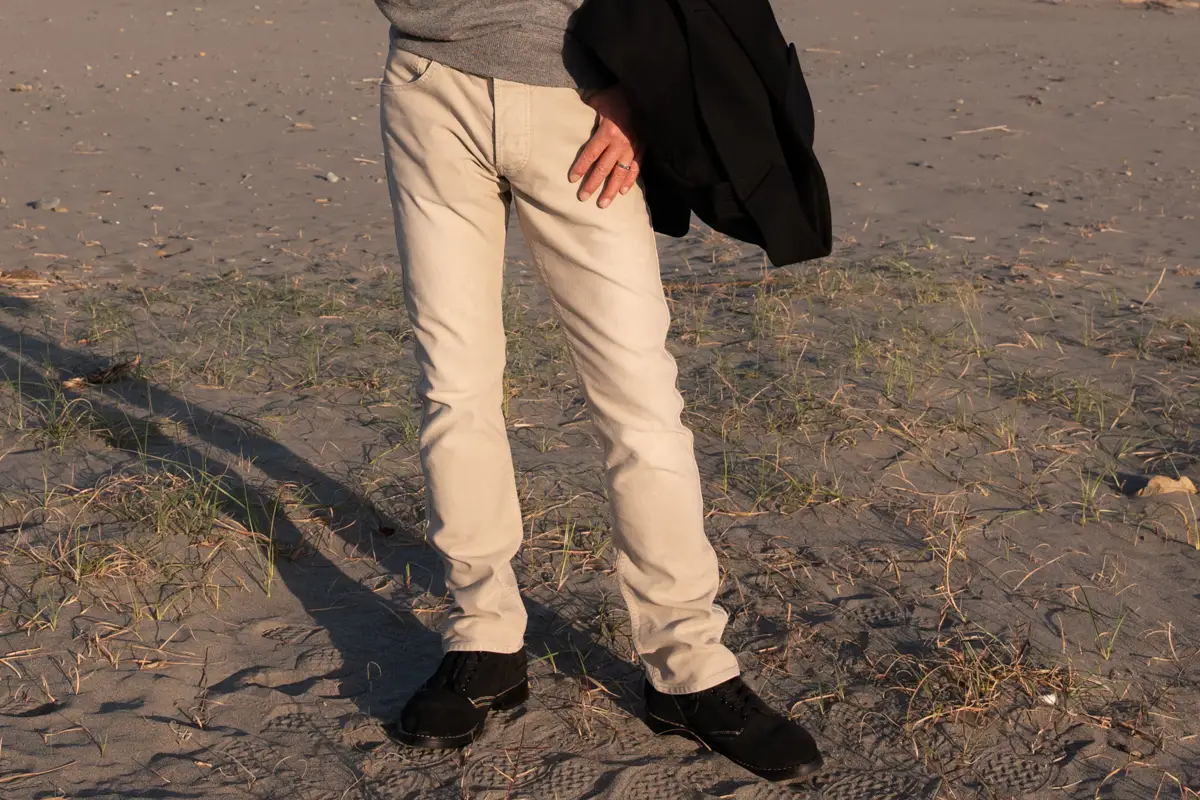
Despite the slim silhouette, the balance of the waist, rise, thigh width, and leg opening is masterful. Upon wearing them, they offer a surprising level of comfort that belies their sharp, narrow appearance.
4.Rear view
Rear view highlighting the distinct silhouette.
The rear pockets of the FLUXSUS 01 SLIM G.CORDS are positioned lower than usual. This design ensures the pockets remain accessible even when wearing a jacket, while also creating an exceptionally clean rear silhouette. It’s a motif inspired by vintage workwear—a design philosophy shared by brands like Tender Co.
Introduction.
Visvim
My initial perception of Visvim was that of a footwear-focused brand, known for their meticulously handcrafted shoes. However, that changed one day while strolling through Nakameguro with my wife. We came across an intriguing shop housed in a beautifully renovated kominka (traditional Japanese house), which turned out to be the “Visvim General Store.” Stepping inside, I found an impeccably curated collection of apparel and footwear, all reflecting an extraordinary level of dedication to detail.
Given my prior image of the brand, I first looked at their sneakers and boots. I was particularly drawn to a pair of sneakers inspired by the Converse All-Star and some work boots crafted from fine suede. As I explored the apparel, I noticed each piece possessed a unique texture while drawing inspiration from vintage garments. Speaking with the staff, I learned that they employ fascinating materials and dyeing techniques rarely seen elsewhere—such as natural Hon-Aizome (indigo) dyeing for denim, Mud Dyeing for jackets, and uniquely developed linen-wool blends.
It became clear that their manufacturing process is deeply rooted in a sense of handcraft and artisanal skill, which made every item on display appear incredibly alluring. From their collection, I eventually chose a pair of sneakers, boots, a denim shirt, jeans, and these slim German Cord trousers. Visvim’s items are conceived from a truly unique perspective on craftsmanship; since my purchase, they have become staples in my wardrobe for which I have a deep affection. I look forward to introducing their other exceptional pieces in future articles.
FLUXSUS 01 SLIM G.CORDS
This year, I have been leaning toward slimmer trousers compared to my traditional straight-cut denim. Since my wardrobe didn’t originally include many slim-fit options, I found myself wanting a pair in a refined beige. I began searching for slim, five-pocket beige trousers without creases or pleats, but I struggled to find anything that truly met my preferences.
While I was interested in the reproduction of the Lee Westerner—a classic five-pocket straight-cut white denim—my ideal was something with a warmer beige tone and a slimmer silhouette than the Westerner. When I shared this vision with the staff at Visvim, they introduced me to the FLUXSUS 01 SLIM G.CORDS, the subject of this feature.
Beige and White.
This year, I find myself reaching not only for my usual denim but also for trousers in shades of beige and off-white. This reflects a shift in my mindset—or perhaps an evolution in my fashion consciousness—as I feel a growing desire to embrace and enjoy styles I previously seldom wore.
To me, the combination of beige or white with brown exudes an aura of elegance and sophistication—a very “mature” palette. In the past, I viewed these colors as something to be worn as I grew older, which is why this combination had remained largely absent from my wardrobe until now.
When it comes to selecting beige or white trousers, options like chino-style trousers or work pants (closer to khaki) typically come to mind. Having long appreciated “Americana” style, I already own various work pants and chinos, yet none possessed the slim silhouette I was searching for.
I also own white denim, but the starkness of white is distinct from the specific beige I had envisioned. I searched for something that matched my mental image, but finding the perfect pair proved difficult.
G.Cords
The FLUXSUS 01 SLIM G.CORDS I purchased is crafted from high-density woven German Cord. Originally used for military purposes, German Cord is a slightly stiff, highly durable fabric.
I don’t recall owning many items made from this specific material before, but upon holding it, I felt a sense of nostalgia—as if I had encountered and touched this texture sometime in the past.
While it feels thinner than denim, the fabric is incredibly sturdy with a distinct firmness. It resembles a very fine-wrought corduroy, yet its rigidity is the complete opposite of corduroy’s characteristic softness.
FLUXSUS 01 SLIM G.CORDS
I explained to the Visvim staff that I was looking for something with a warmer tone than the Lee Westerner, but with a slimmer silhouette. They replied, “I’m not sure if it matches your exact image, but we have a slim five-pocket model in German Cord.
Would you like to take a look?”That was when they introduced me to the FLUXSUS 01 SLIM G.CORDS in beige.
The FLUXSUS 01 SLIM G.CORDS comes in three colors: Black, Navy, and the Beige I chose. Though it may be hard to discern in photos, the pants undergo a vintage treatment; the Black and Navy versions show exquisite fading. While the fading is less apparent on the Beige, it features subtle “stain-like” processing that removes the starchiness of a brand-new garment, giving it a seasoned, “broken-in” feel.
At first, I was unsure if the texture of German Cord would work for me, as it differs from typical denim or chino fabrics, but I decided to try them on. Despite the stiffness and unexpected thinness of the fabric, the fit was perfect—they didn’t feel as tight as they looked, providing a comfortable, well-proportioned size.
Due to the fabric’s unique combination of stiffness and thinness, the whiskers and creases form beautifully, creating a slimming effect on the legs. The length is just right, pairing well with both sneakers and heeled boots. After wearing them for a short while, the initial stiffness of the German Cord softened, revealing an even more beautiful silhouette than I had anticipated.
The silhouette, craftsmanship, and color were exactly what I had been searching for in a slim beige five-pocket pant, so I purchased them without hesitation. They are exceptional in color, texture, and design, and have become an invaluable asset to my various outfits.
The name “FLUXSUS 01 SLIM G.CORDS” is quite lengthy, but Visvim items often carry these unique designations.
Items labeled “Fluxsus” signify a deep focus on material and dyeing techniques—high-density German Cord being a prime example. These often undergo garment dyeing and aging processes.
“01 Slim” refers to a slimmed-down version of their signature “01” straight cut. It features a tapered silhouette and a slightly lower rise.
“G.CORDS” is simply an abbreviation for German Cord.
The Philosophy: From Paul Harnden to Comme des Garçons
In my personal view, the concept behind Visvim’s outerwear, such as their jackets, shares a common thread with Paul Harnden.
Furthermore—though it might not be immediately apparent from the items themselves—I feel that their brand philosophy and worldview resonate with Comme des Garçons. Given that Comme des Garçons stocks Paul Harnden, perhaps my intuition is picking up on that shared aesthetic lineage.
Wearing example.
Unlike my conventional style centered around straight-fit denim like Levi’s 501 or Lee 101, opting for white (beige) bottoms creates a more refined and sophisticated ensemble. While the overall silhouette is slimmer than that of straight-fit denim, the fabric creases so beautifully that it keeps the lower half of the body looking sharp and well-defined.
While Brunello Cucinelli is generally versatile and accommodating of various pairings, Dior’s outerwear possesses a distinct styling that demands the right choice of bottoms. The clean, slim profile of these Visvim trousers pairs exceptionally well even with the exacting silhouettes of Dior.
1.Brunello Cucinelli shearling biker jacket.
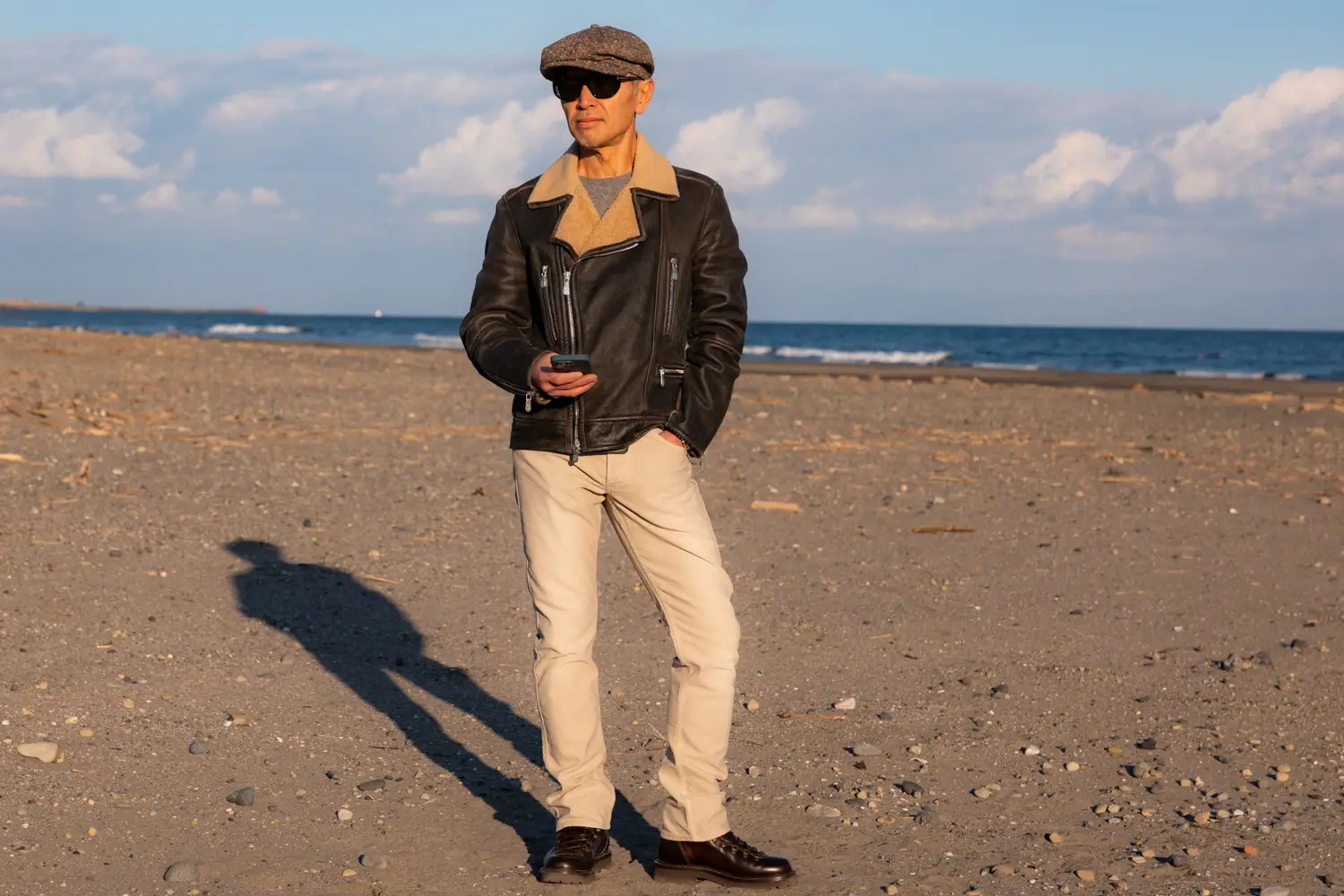
FLUXSUS 01 SLIM G.CORDS paired with a Brunello Cucinelli shearling biker jacket.
Paired with a Brunello Cucinelli shearling rider jacket. This year, I’ve been drawn to this specific color palette, which inspired my search for these trousers. The crisp wrinkles formed by the stiff German Cord enhance the overall aesthetic.
2.Dior peacoat.
FLUXSUS 01 SLIM G.CORDS styled with a Dior peacoat.
Combining white trousers with a black peacoat creates a sophisticated look when accented with green and brown. Even with a piece as characterful as a Dior peacoat, Visvim’s slim silhouette is an outstanding match.
3.Boncoura cashmere fisherman sweater.
FLUXSUS 01 SLIM G.CORDS with a Boncoura cashmere fisherman sweater.
A monochromatic beige look paired with a Boncoura cashmere fisherman sweater. This is a combination I wouldn’t have considered in the past, yet it comes together with great elegance. The hem width is exquisite—offering a narrow straight silhouette rather than a typical slim taper.
4.Low-set rear pockets
The low-set rear pockets, a vintage workwear-inspired detail.
There is a bit of extra room from the thigh to the knee, so they don’t feel nearly as restrictive as they might look. This photo also highlights the low-slung placement of the rear pockets.
5.side profile.
The clean, streamlined side profile.
The side profile reveals an exceptionally clean and beautiful line.
6.Visvim work boots.
Perfectly balanced pairing with Visvim work boots.
Paired with Visvim work boots, the look becomes balanced and effortlessly relaxed.
Detail
FLUXSUS 01 SLIM G.CORDS
Five-pocket trousers crafted from specially treated German Cord cotton fabric.
Garment Dyed
Damaged finish
Regular fit, slightly tapered silhouette
Medium rise
Button fly
Original zipper slider
Custom iron buttons
Rivets and a deerskin patch with natural dye and sashiko stitching
100% Cotton
Color: Beige
Size: 1
Combination
Trousers: Visvim FLUXSUS 01 SLIM G.CORDS
Cashmere Fisherman Sweater: Boncoura
Shearling Biker Jacket: Brunello Cucinelli
Cashmere Peacoat: Dior
Light Green Cashmere Knit: Tom Ford
Mountain Boots: Brunello Cucinelli
Suede Chelsea Boots: John Lobb
Derby Shoes: John Lobb
Suede Boots: Visvim
In conclusion
Since the beginning of this winter, I had been searching for a pair of slim beige five-pocket trousers that matched my specific vision, but to no avail—until I found the Visvim FLUXSUS 01 SLIM G.CORDS.
Crafted from German Cord rather than typical denim or chino fabric, these five-pocket button-fly trousers are exceptional.
The slim silhouette, the dense texture of the German Cord, and the exquisite beige hue—complete with subtle distressing—harmonize effortlessly with any jacket or footwear.
Their inherent elegance and ease of styling have made them my most indispensable piece this season.
I also purchased the washed and distressed denim versions in the same silhouette; they possess a distinct worldview that sets them apart from vintage Levi’s or Lee. While the fabric and coloring evoke a vintage spirit, the modern, slim fit significantly expands one’s styling possibilities.
What distinguishes Visvim from other vintage-inspired brands is their relentless obsession with materials and weaving techniques. They masterfully integrate artisanal skills and traditional heritage crafts, creating pieces that coexist naturally with contemporary fashion.
As someone who deeply admires craftsmanship and traditional arts, I hold profound respect for Visvim’s ability to subtly weave these elements into everyday wear.
While Visvim’s core following may belong to a younger generation, and some pieces might suit them better than me, I find their store displays utterly captivating. Speaking with the staff reveals the extraordinary level of dedication poured into the construction of every single item.
These high-density German Cord trousers are built for more than just aesthetic intrigue; they are incredibly durable, designed to be cherished for years as they develop a unique, vintage-like patina over time.
While brands like Boncoura are also renowned for their focus on aging, Visvim approaches this essence from a different perspective—one that I find truly fascinating. As many of their other pieces have also become staples in my wardrobe, I look forward to featuring them in future articles.
Shop
The Shop: Visvim General Store Nakameguro
I purchased these trousers at the Visvim General Store in Nakameguro. Housed in a fully renovated kominka (traditional Japanese house), the store preserves the architectural beauty of the original structure while displaying items in themed rooms with an artistic sense of space. This presentation echoes Visvim’s commitment to traditional Japanese craftsmanship; the atmosphere feels more like an exhibition of fine ceramics than a retail environment.
Due to its global acclaim, the store attracts enthusiasts from all corners of the world. During a conversation with the staff, I mentioned that the materials and construction of Visvim’s jackets reminded me of Paul Harnden. They shared an intriguing anecdote: John Galliano, a known admirer of Paul Harnden, once visited the store and spent a significant amount of time closely examining Visvim’s creations.
Every item is the result of immense dedication, not only in the excellence of its manufacturing but also in the brand’s tireless research into techniques and materials. Their goal is to ensure that the wearer enjoys the long-term journey of making the garment their own. It is easy to see why so many become devoted fans after their first purchase. While primarily a men’s label, many items possess a charming, unisex appeal, complemented by their women’s line, WMV. If you find yourself strolling along the Meguro River on a weekend, it is well worth a visit with your partner.
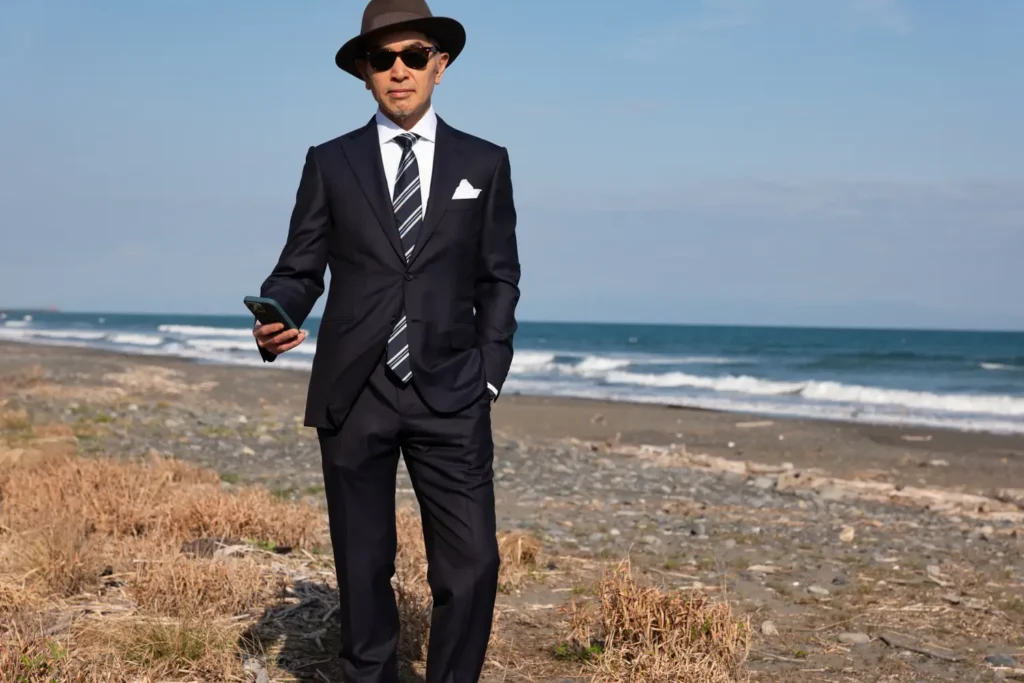
Recently, I found myself revisiting my wardrobe, pulling a Kiton suit from Tie Your Tie out of its long-standing place in the closet. It was an act that reignited a dormant ritual—the wearing of suits and jackets. As I have moved away from a life that demands a suit as a daily uniform, my collection has become lean, focused on pieces of true substance.
My preference has always leaned toward the steadfast simplicity of solid navy. Among the few I have retained, there is one that stands above the rest for its sheer versatility and presence: the solid navy suit from Brioni.
The Roman Benchmark: Brioni
When one contemplates the pinnacle of Italian tailoring, Brioni is invariably the first name to ascend. With a storied history and a client list that reads like a registry of the world’s elite, it remains the definitive house for men’s tailoring (and now, comprehensive sartorial lifestyle).
Based in Rome, Brioni’s aesthetic occupies a unique middle ground. It eschews the flamboyant flair of Milan or the soft, deconstructed signatures of Naples and Florence, opting instead for a style that is orthodox, balanced, and remarkably poised.
Tailoring is always a mirror of its environment. As the political heart of Italy, Rome demands a certain gravity. Brioni’s clientele is composed not only of Italy’s political class but also global leaders and public figures who seek the house’s worldwide prestige. I recall from decades ago, magazines highlighting how the late UN Secretary-General Kofi Annan favored Brioni—a testament to its status as the uniform of global authority.
Authority over Ostentation
While Brioni is undeniably expensive, its value does not lie in the loud, superficial “luxury” so often marketed today. Instead, its essence is rooted in formality and authority. It is a brand for those who prioritize social responsibility and a commanding presence over mere gorgeousness.
Though I own only one model—the Brunico, which serves as the cornerstone of the modern Brioni silhouette—it encapsulates the house’s philosophy. It represents a “correct answer” in the complex language of masculine dress. Consequently, a Brioni suit becomes an invulnerable ally, capable of navigating any environment, at any time, with anyone, without a single flaw in its composure.
The Global Standard of the 007 Aesthetic
From a purely “fashion” perspective, Brioni may lack eccentricity; it is conservative, perhaps even austere. However, the true value reveals itself only through the wearing: the impeccable fabric, the exhaustive hand-craftsmanship, and a comfort that feels like a second skin. It is a tangible philosophy of dress.
This is the suit that defined the James Bond of the Pierce Brosnan era—the global spy who required a world-standard suit to move effortlessly across continents. It is understated yet carries an unmistakable aura of quality.
Allow me to introduce the Brioni Brunico in Dark Navy—the ultimate versatile companion that balances modesty with the highest level of refinement.
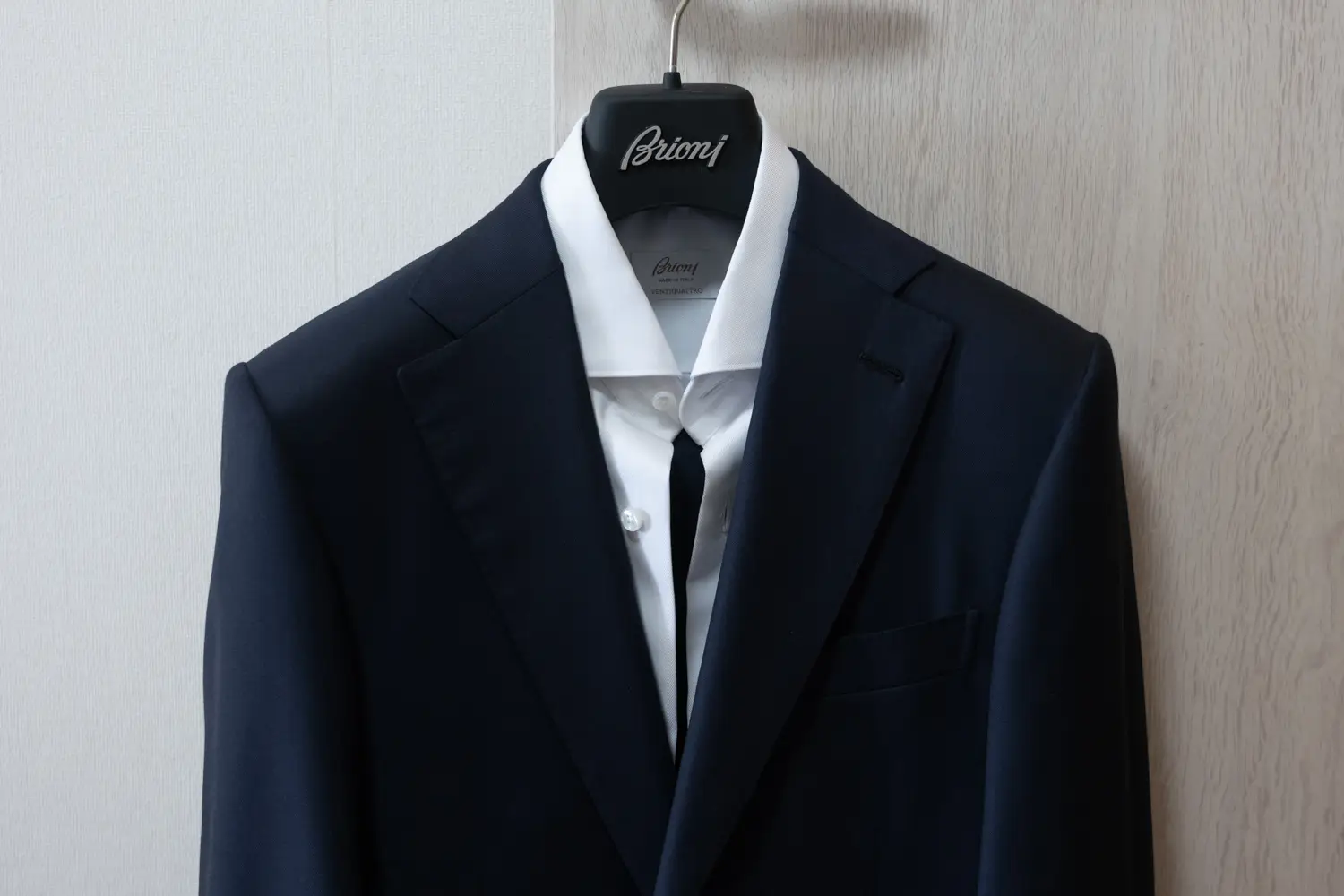
Brioni Brunico Midnight Blue – Upper body view
For my generation, a solid navy suit often evokes images of one’s first “recruit” or “freshman” suit—the uniform of a new beginning. To wear this color again in maturity brings a renewed sense of cleanliness and a youthful spirit; it recalls the untainted ambition of one’s first year in the professional world.
My own “freshman suit” was a two-button solid navy D’URBAN by Sanyo Shokai, which my grandfather bought for me at the Seibu Department Store. Returning to navy today feels like a dialogue with those origins.
The silhouette of the Brioni Brunico in Midnight Blue
Compared to more flamboyant Italian tailoring, the lapels on the Brunico are slightly narrower, featuring a subtly elevated gorge line. As a classic two-button model, the shoulders and chest are not aggressively emphasized by heavy padding, maintaining a “moderate” and balanced line. However, do not be deceived by its simplicity—this very moderation is where the most significant labor, craftsmanship, and cost have been invested. It is the hardest aesthetic to achieve perfectly.
Brioni Brunico Midnight Blue – Brand insignia
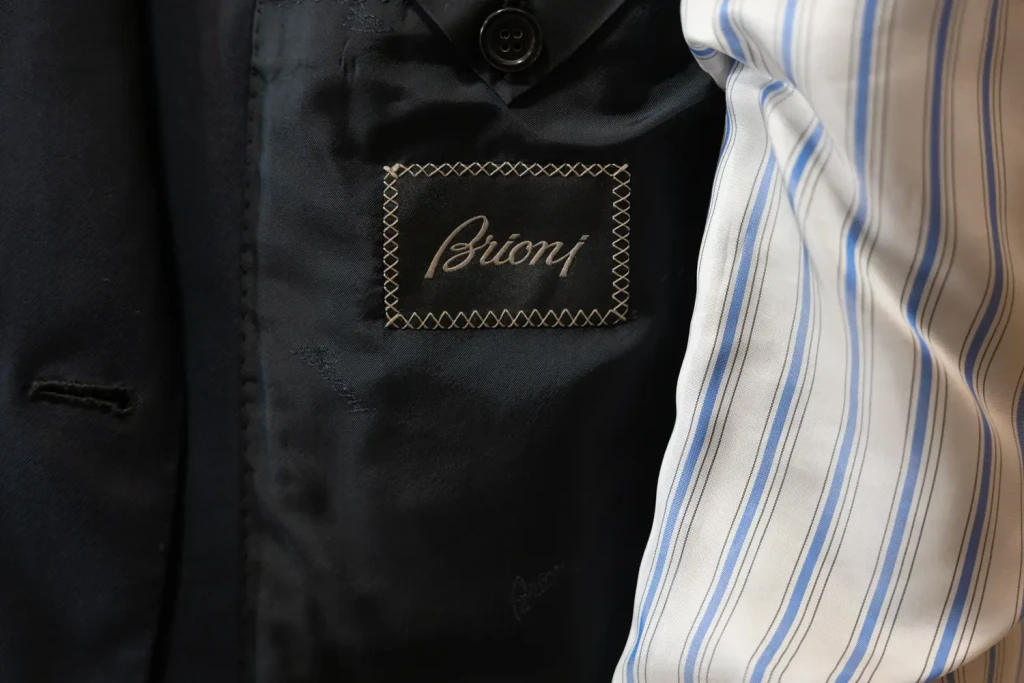
A simple, understated Brioni logo marks the interior. While this is an “all-season” orthodox suit, the details reveal the house’s uncompromising standards: it is fully lined, with a striking blue-striped silk fabric used for the sleeve linings. These discreet touches are the hallmark of Brioni—a commitment to excellence that only the wearer truly knows.
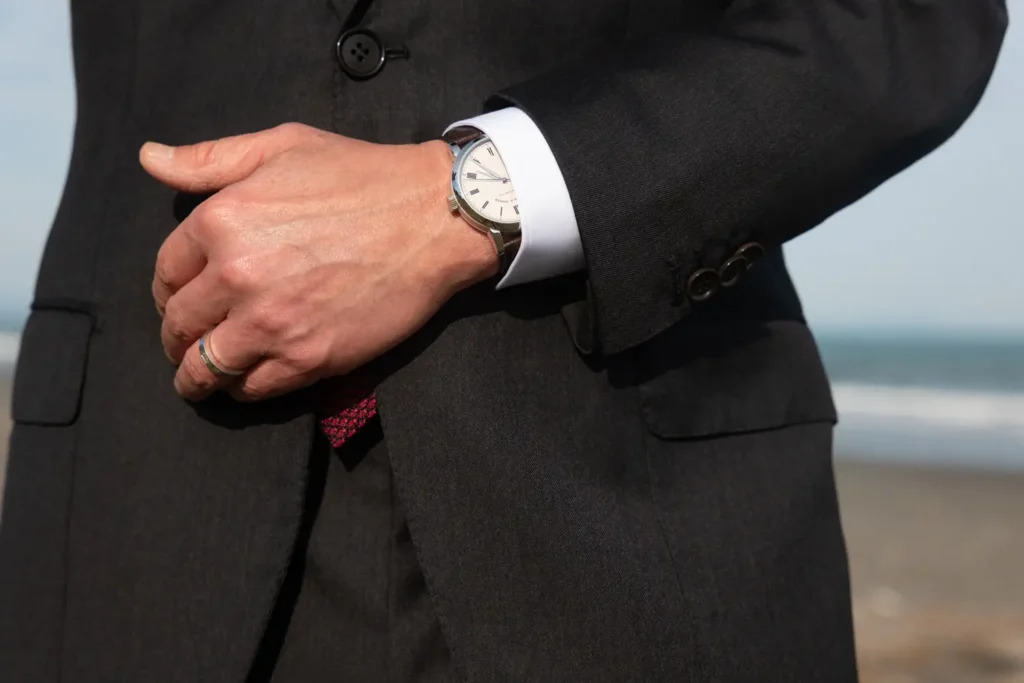
As briefly mentioned in our previous feature on TIE YOUR TIE—a piece that explored the effortless elegance of Kiton and the artistry of the Sette Pieghe—this 1990s Omega Seamaster has been a steadfast witness to my life for nearly three decades.
While the arrival of the Apple Watch eventually claimed its place as a daily utilitarian tool, this mechanical masterpiece remained my singular, unwavering choice for over twenty years, leading up to 2018.
Seamaster Professional 300
Formally christened the Seamaster Professional 300, it is a bona fide diver’s instrument, engineered with the rigorous water resistance and functional precision demanded by professionals beneath the waves.
Yet, its true brilliance transcends its technical prowess. Despite its robust and resilient soul, it possesses a rare versatility—transitioning seamlessly from spirited casual attire to the sharp, refined silhouette of a bespoke suit or jacket.
It is a testament to timeless design; a timepiece that remains indifferent to the changing tides of occasion, defined instead by its quiet, enduring strength.
OMEGA Seamaster Ref. 2532.80
A definitive tool watch that remains untarnished by the passage of thirty years.
The Buckle of the Seamaster Ref. 2532.80
Every mark on this clasp is a testament to three decades of reliability—a record of a life lived and time well-spent.
OMEGA Seamaster Ref. 2532.80
The Dichotomy of Time: Heritage vs. Resilience
The antique timepieces often featured on this blog are, by their very nature, delicate vestiges of the past. Their water resistance is no longer a guarantee, necessitating a cautious retreat from the humidity of midsummer or the sudden onset of rain. They are, in essence, not intended for the rigors of daily life.
Across the realms of horology, automotive engineering, and even the arts of guitar or camera making, the soul of an “antique” lies in the value of elapsed time.
The criteria for excellence often rest upon how faithfully the object has retained its original form—a concept rooted more in the stewardship of culture than in mere fiscal appreciation. While monetary value exists, it is a pity that modern discourse so often fixates solely on the price tag.
In the world of watches, the presence of original parts dictates its historical standing. While replacing worn components is technically “best” for maintaining peak performance, the rarity of period-correct parts often leads to the use of modern equivalents.
This creates a paradox for the collector: such maintenance, while functional, can diminish the antique integrity of the piece—a dilemma well-known to those navigating the official overhauls of Rolex dials or the hands of vintage Patek Philippe.
However, the OMEGA Seamaster Professional 300M (hereafter referred simply as the Seamaster) exists in a different realm. Purchased new and subjected to rigorous, periodic authorized maintenance, its functional integrity remains uncompromised.
With its sapphire crystal and modern construction, it is a timepiece that invites use rather than demanding sanctuary. One need not hesitate over part replacements or performance anxiety; it is a tool designed to be worn, maintaining its prowess through OMEGA’s prescribed care.
A Choice of Subtle Distinction: Ref. 2532.80
The Ref. 2532.80 graced the catalog from approximately 1993 to 2000. It is a formidable instrument, equipped with a helium escape valve and 300m water resistance—features that defined an era of professional diving.
This lineage produced icons: the “Bond” model worn by Pierce Brosnan’s 007, and the limited editions honoring the legendary free-diver Jacques Mayol.
At 41mm, it possesses the commanding presence expected of a diver’s watch. Yet, thanks to its stainless steel bezel and matte navy dial, it achieves a rare versatility, harmonizing with casual attire and formal tailoring alike.
Its sibling, the Ref. 2531.80, earned global fame on the wrist of James Bond, distinguished by its navy blue bezel. At the time of my purchase, however, I sought a silhouette that would slip seamlessly under the cuff of a suit without discord. My choice was the Ref. 2532.80, favored for its monochromatic stainless steel bezel.
While the blue-bezeled Bond model exudes a sporty, adventurous spirit—perfectly capturing the essence of a world-class spy—I felt that for a civilian life, the austere elegance of the steel bezel offered a more wearable sophistication.
Beneath the bezel, the DNA remains identical: the same case, bracelet, caliber, and helium valve. The only difference is the color of the bezel—a subtle nuance that defines its character.
Introduction
Introduction: A Reawakening of Purpose
The inspiration to chronicle this timepiece struck while revisiting a sartorial ensemble from two decades ago—a period defined by the bespoke silhouettes of TIE YOUR TIE.
In an effort to reconstruct the aesthetic of that era, I once again fastened this Seamaster to my wrist. What began as a nostalgic gesture quickly transformed into a profound rediscovery. The watch’s seamless blend of daily utility, its understated elegance that eschews ostentation, and its sheer versatility reminded me why it held its place for so long.
On this platform, I have curated several mechanical marvels, yet I must concede that my daily hours are predominantly claimed by the Apple Watch. Its pragmatic ease, bolstered by robust water resistance and the ability to quantify one’s physical state into digital clarity, is undeniably compelling. For more rigorous pursuits like running, I often turn to the specialized precision of a Garmin, relying on its granular data for Vo2max and peak heart rates.
Yet, this OMEGA Seamaster possesses a narrative that modern silicon cannot replicate. In years past, it was not merely a companion for formal affairs; it accompanied me on my runs, enduring the physical toll of exercise with a stoic resilience. Wearing it again after this hiatus, I find myself reaffirmed by its dual nature—a high-performance instrument with the soul of a classic, proving its enduring charm remains untouched by the passage of thirty years.
I. The Genesis: My First Mechanical Heartbeat
My journey into the world of mechanical horology began with this very Seamaster Professional 300, purchased alongside my wife. It was not a calculated acquisition but rather a spontaneous one, sparked by an article she had encountered in a fashion journal.
At the time, the model was undergoing a generational shift. I opted for the classic soul of the outgoing Ref. 2532.80 with its iconic dot indices, while my wife chose the contemporary “Bar” index of the mid-sized Ref. 2253.80.
Ref. 2253.80 & Ref. 2532.80: A Family Legacy
The beginning of a mechanical journey shared with my wife. These two models from the same era perfectly illustrate OMEGA’s commitment to legibility and pure functional beauty.
As my first mechanical timepiece, the simple physics of it fascinated me—the way the hands surged to life with a few turns of the crown, the tactile click of setting the date and time without a single volt of electricity.
It quickly became an extension of my arm. Because it was always there, it lacked the fleeting luster of a “special occasion” item; instead, it earned the profound status of a trusted tool.
Through three decades and regular authorized overhauls, it has never faltered—a living testament to the enduring bond formed when a husband and wife embark on their first horological journey together.
II. Robustness: A Stoic Companion in Motion
As alluded to in my previous writing on Kiton, I have maintained a discipline of running and walking since 2010. In those pre-smartwatch days, when the digital landscape was sparse, the Seamaster was my constant companion on the pavement.
While a standard 30m water-resistant watch might shudder at the salt and moisture of a summer sprint, this professional 300m diver remained indifferent. I would routinely rinse the sweat from its steel frame under a tap post-run.
My only concern was the repetitive vibration of the stride. However, when I finally submitted it to the Nicolas G. Hayek Center in Ginza for service, the OMEGA master watchmaker assured me the movement remained pristine.
It was a revelation: for my lifestyle, its resilience was absolute. It even accompanied me 40 meters beneath the waves of Oahu, where its Super-LumiNova dial cut through the Pacific depths with crystalline clarity.
III. Versatility: From the Abyss to the Atelier
Revisiting this watch today for a photoshoot with a suit, I am struck by its seamless adaptability. Though it is an uncompromising diving instrument, it betrays no awkwardness when paired with fine tailoring. Its monochromatic steel bezel and matte navy dial provide a muted elegance that refuses to clamor for attention.
We must credit Pierce Brosnan’s James Bond for validating this aesthetic; his pairing of the sibling Ref. 2531.80 with Brioni tailoring set a gold standard for the “suit-diver” look.
Yet, while the world chased the blue bezel of 007, I found my Ref. 2532.80 to be the more versatile civilian choice. Even after 25 years since its discontinuation, the bracelet remains remarkably taught, offering a “fit” that prevents the watch’s heft from shifting on the wrist—a balance of ergonomics and engineering rarely found in modern counterparts.
IV. Understatement: The Quiet Elegance of the 90s
Modern sports watches often lean into aggressive silhouettes—razor-sharp edges and high-polish surfaces that demand to be noticed. My preference, however, lies in the softer, more integrated lines of the 1990s.
This Seamaster is neither a fragile antique nor a shouting newcomer. It exists in a serene middle ground, unburdened by the hyper-inflated market valuations that plague modern “icons.”
Its charm lies in this very lack of notoriety. It does not “badly stand out” (as we say in Japan); it simply exists as a refined part of one’s person.
I have never been one for the possessive hoarding of objects; I frequently pass cherished items to friends when their chapter in my life closes. Yet, the Seamaster remains. It is more than an object of affection—it has become, over thirty years of shared pulse and quiet service, a fundamental part of my daily reality.
Examples.
A Sartorial Homage Captured here is a dialogue between two legends of craftsmanship. The crisp sax-blue shirt by TIE YOUR TIE meets the structured shoulder of a navy Brioni suit—an ensemble that directly evokes the cinematic elegance of the Pierce Brosnan era.
In this frame, the Seamaster ceases to be a mere diver’s tool and becomes the definitive punctuation mark for a gentleman’s silhouette. It is a visual testament to the “Bond Style,” where high-performance utility is cloaked in the absolute refinement of Italian tailoring.
1.On the cuffs of the Tie Your Tie shirt
The 41mm Silhouette
While the 41mm diameter felt substantial at the time of purchase, it sits with perfect contemporary relevance today—a testament to its enduring proportions.
2.On the cuffs of the Brioni jacket and shirt
A Diver in the Boardroom
Despite its professional diving pedigree, the watch harmonizes seamlessly with a navy suit and white shirt. The monochromatic steel bezel and matte navy dial offer a versatile understatedness that complements any formal attire.
3.On the cuffs of the Brioni jacket
Timeless Sophistication
While the “Bond” association established the diver-with-a-suit aesthetic, this watch stands on its own merit. Its exceptional design balance ensures it remains a universal choice for any sartorial occasion.
Technical Specifications & Personal Reflections
The Specifications: A Legacy of Precision
Feature
Details
Model
OMEGA Seamaster Professional 300 Ref. 2532.80
Certification
Swiss Chronometer Certified
Case & Bracelet
Robust Stainless Steel
Crown
Screw-in security
Crystal
Scratch-resistant Sapphire
Water Resistance
30 bar (300m / 1000ft)
Movement
Caliber 1120 (Automatic)
The Allure: Why It Endures
A simple three-hand automatic with a date—highly practical and easy to live with.
The colorless bezel and matte navy dial create a restrained design that works in any setting.
The functional beauty of a true diver’s watch.
A dial designed with excellent legibility in mind.
The oversized crown makes winding effortless.
Despite its 41mm case, it remains highly wearable.
Being a model from 30 years ago, it stays understated on the wrist.
Free from strict vintage constraints, parts can be replaced by the manufacturer without hesitation to maintain performance.
Maintained properly and worn continuously for over 30 years.
The Consideration
The Cost of Fidelity: As with any high-grade mechanical instrument, an official authorized overhaul commands a significant investment. Yet, when weighed against its daily reliability and the thirty years of service it has rendered, it is a price paid for enduring peace of mind.
Epilogue: Beyond the Passage of Time
Had I not sat down to pen this article, I might never have consciously realized the profound weight of this watch—the first mechanical timepiece my wife and I purchased together, still beating faithfully on my wrist three decades later.
It has become so integrated into my daily life that its presence felt almost like a natural extension of my own body. Even in this era where the Apple Watch claims my primary hours, I intend to keep this Seamaster close, allowing it to mark the rhythm of my time on those occasions that demand a soul.
In an age that often prioritizes the fleeting and the disposable, I have reaffirmed a vital truth: to invest in quality and cherish it over decades enriches one’s life and fosters a sense of “social grace”—an appropriate modesty in one’s attire.
OMEGA has historically stood not as a purveyor of mere “luxury,” but as a manufacturer of high-performance precision instruments, upholding the stern image of Swiss and German engineering.
It may lack the ostentatious flash of its rivals, but that very restraint is precisely what I find so magnetic. This reunion with a thirty-year-old companion has been so revitalizing that it has, perhaps dangerously, sparked a new curiosity in the Seamasters of today.
Shop
As this model is no longer available, I cannot recommend any shops where you might purchase it. However, the Seamaster models currently on sale are also excellent watches, so please do take a look at Omega’s official website.

Introducing the John Lobb Darby — a masterpiece that faithfully inherits the standards of traditional English footwear. When one envisions an English “Derby,” it is precisely this silhouette that often comes to mind. With its full brogue detailing, open lacing (derby), and robust double sole, it remains the most orthodox expression of the genre.
While its appearance is rugged and stalwart, the Darby is elevated by John Lobb’s unparalleled craftsmanship and the quintessentially British philosophy of shoemaking. Utilizing the world’s finest calfskin — a hallmark of the brand’s heritage under the Hermès group — this shoe achieves a rare harmony: it is universally sophisticated yet built with a tenacity that lasts a lifetime.
The Catalyst: A Reunion with Kiton
The impetus for my recent article on the Tie Your Tie Kiton suit actually began with this pair. In preparing to photograph the Darby, I reached into the depths of my closet for a suit that had long been resting: the Kiton. Putting it on again sparked a realization.
Like the suit, this Darby had been tucked away ever since I stepped back from wearing formal attire. However, after rediscovering the joy of wearing my Barros in a more casual context, I felt a rekindled desire to walk again in my Darby and Chambord. It has inspired me to once again embrace the art of coordination, bringing suits and jackets back into my daily life.
Reflections: Beyond Consumption
Reflecting on the memories associated with the Tie Your Tie suit while preparing this footwear chronicle was a fascinating exercise in time travel. The passing years have revealed layers of meaning I hadn’t noticed before. Although the suit article was published first for clarity, it was the Darby that truly set this journey in motion.
A pair of John Lobb shoes is a significant investment, yet if cared for with devotion, they truly serve for a lifetime. To wear them long-term is to understand the essence of value; it is an invitation to experience the depth of European and British culture.
The Heritage: A Lost Icon
Authentic English shoes offer a tangible gateway to the British ethos of “cherishing things for a long time”. My own pair belongs to the classic John Lobb line — a “Derby” with its roots in the rugged lifestyle of the Country Gentleman.
Though it possesses a masculine allure born from practical necessity, this traditional Darby has sadly been discontinued and is no longer available for purchase. It remains a vestige of a golden era of shoemaking.
The quintessential English standard: a full-brogue Derby featuring open lacing—a silhouette that defines the heritage of British footwear.
The John Lobb Darby, Side View
Though these shoes bear the creases of twenty-five years of wear, the sheer quality of the calfskin and the robustness of their construction ensure they remain remarkably preserved.
The Rounded Toe of the John Lobb Darby
The toe features the gracefully sharp round-toe profile that was the hallmark of 1990s shoe design.
The Original Box of the John Lobb Darby
An authentic shoebox from the 1990s to the mid-2000s. The model name, size, last, color, and leather type are all handwritten in marker—a charming vestige of the artisanal, small-batch spirit that defined the London bespoke workshops before the era of mass production.
It has been quite some time since I stopped wearing suits on a regular basis. Recently, however, a subtle change in my mindset has led me back to a pair of shoes I had long set aside — the John Lobb Barros.
Perhaps that small shift rekindled something. I found myself wanting to wear the black derby shoes that I used to pair with my suits, and before long I began to think about wearing suits again. Not in the way I did when I was younger, as part of everyday work attire, but rather as something to enjoy in daily life.
When I took a suit out of the closet — one that had been resting there for years — and tried it on again, it felt quite different from how I remembered it. Of course, my sensibilities have changed over time. Yet revisiting it also revealed details and impressions that I had never noticed before.
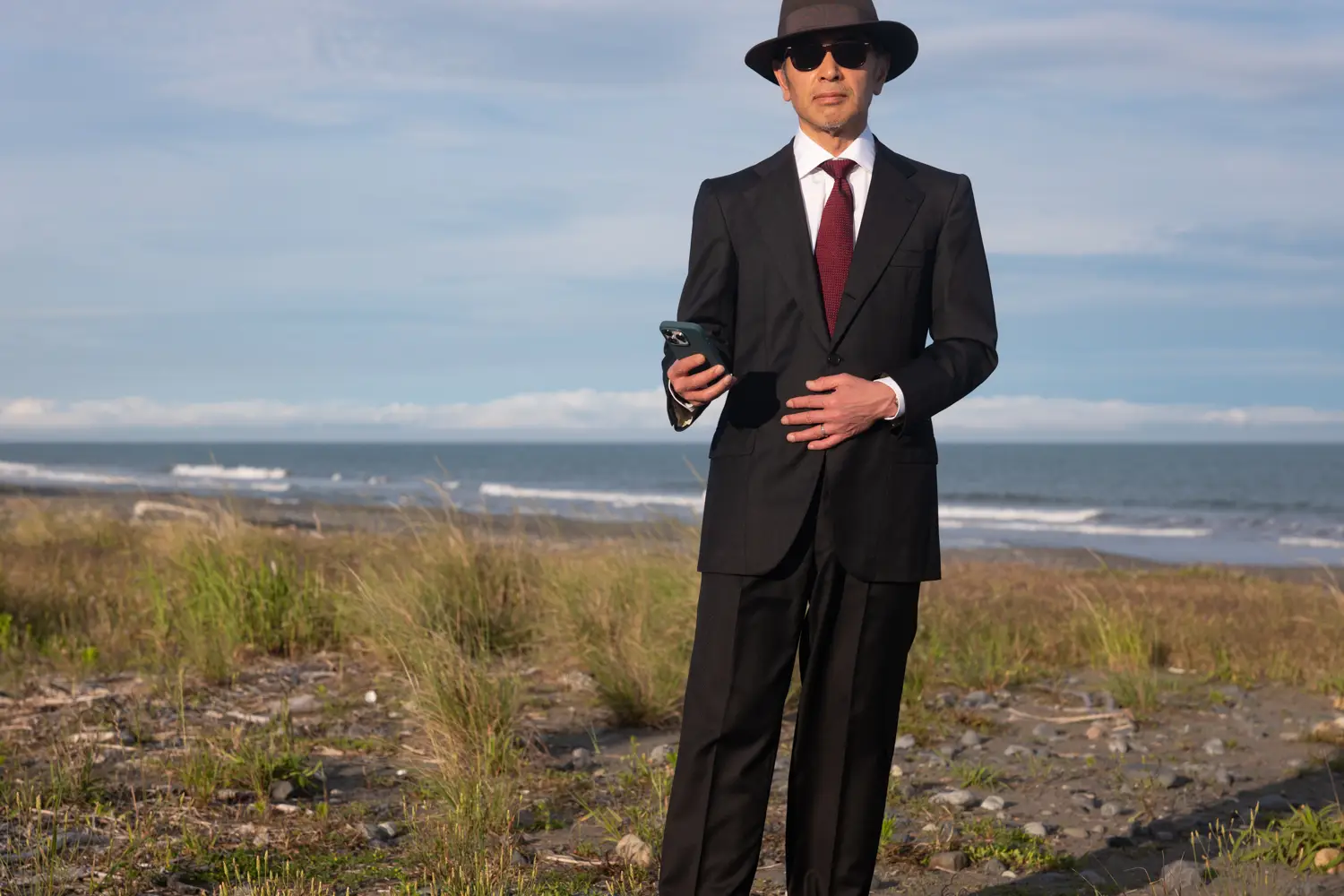
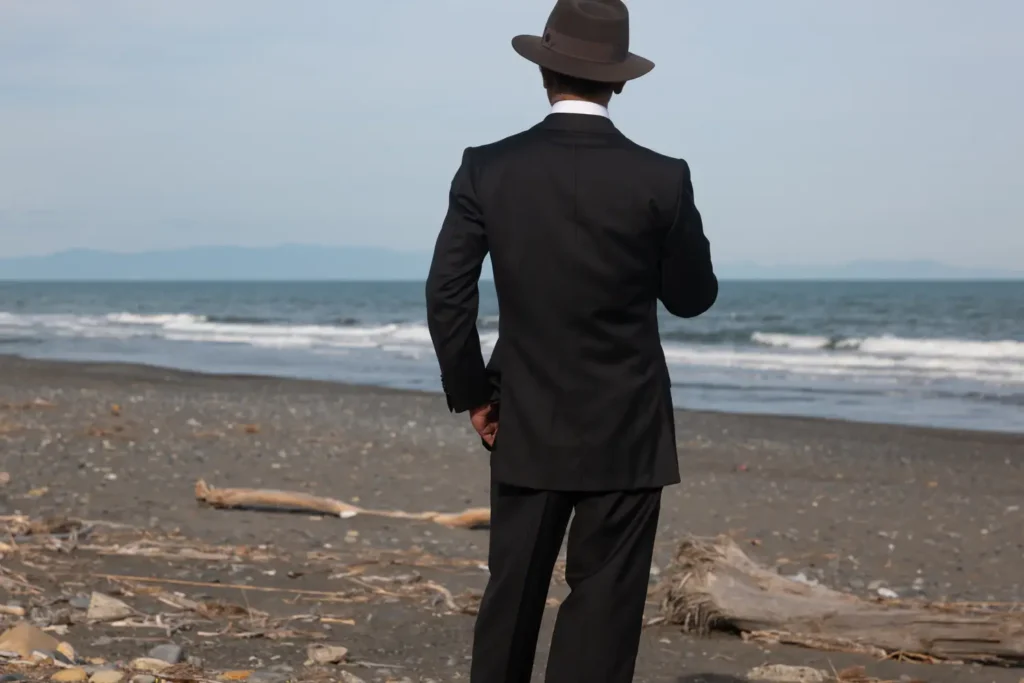
Today, I would like to introduce a Kiton suit that I purchased about twenty years ago at Tie Your Tie.
This time, I’d like to introduce a Kiton suit I bought at Tie Your Tie 20 years ago.
Tie Your Tie
For anyone with an interest in classic Italian tailoring, Tie Your Tie in Florence needs little introduction. The shop was owned by Franco Minucci, widely regarded as one of Italy’s most elegant men and celebrated as a true well-dresser.
Minucci curated an extraordinary selection of clothing and accessories, guided by his refined aesthetic and unmistakable point of view. The shop carried some of the finest names in Italian tailoring, including Kiton and Cesare Attolini, as well as shirts from Luigi Borrelli and Rigatti, trousers from Rota, and shoes from Marini and Il Micio. Ties and small accessories were also carefully selected and often subtly adapted to reflect Minucci’s personal vision of style.
Among the most notable offerings were bespoke garments from the Florentine tailor Seminara, as well as bespoke shoes from Marini of Rome. Tie Your Tie also introduced bespoke work by Hideaki Fukaya of Il Micio, long before he became internationally renowned. Even ready-to-wear pieces from houses such as Kiton and Attolini were often specially commissioned to reflect the distinctive aesthetic of the shop.
Perhaps most famous were the house ties, particularly the iconic sette pieghe — the seven-fold tie made without interlining. Yet the influence of Tie Your Tie extended far beyond ties. The shop did not merely represent classic Italian style; it helped shape the direction of modern menswear. Independent of passing trends, it proposed a timeless vision of masculine elegance, making it a place where true connoisseurs of style naturally gathered.
The world of products it presented was extraordinary. Guided by the uncompromising aesthetic of Franco Minucci, the offerings were unapologetically luxurious, with little regard for price. Yet the shop attracted admirers from all over the world. Among its well-known devotees was the Japanese footballer Kazuyoshi Miura.
In Japan, Tie Your Tie once operated boutiques in both Tokyo and Osaka. For a time it was frequently featured in influential fashion media and high-end men’s lifestyle magazines, so many readers may recognize the name.
Although the boutiques themselves disappeared following the passing of Franco Minucci, the ties that bear the Tie Your Tie name continue to be produced today.
Ciro Paone
The Tie Your Tie suit that I wear most often is a piece specially commissioned by the shop from Kiton in Naples. It is made from a slightly muted dark navy wool, a heavy fabric intended for autumn and winter, with a subtle Glen check running through it.
The details follow the familiar Neapolitan language of tailoring: a high gorge line, manica camicia sleeves, front darts, and side vents. The trousers sit high on the waist and feature double pleats with a gently tapered, slightly fuller leg. Yet the suit is not purely Neapolitan. The proportions — a comfortable body width and relaxed shoulders — together with the choice of fabric reflect a distinctly Florentine sensibility. In this way, the suit brings together the tailoring tradition of Naples with the quieter elegance of Florence.
A classic Italian tailored suit
For reference, Italian suit styles vary noticeably by region. To summarize in simple terms: Rome is represented by the urban refinement of Brioni; Milan tends toward a more fashion-driven aesthetic, exemplified by Armani or Tom Ford; Naples is known for its classic tailoring tradition, represented by houses such as Kiton and Cesare Attolini; and Florence is often associated with a slightly more relaxed elegance, typified by Liverano & Liverano.
Brands such as Armani and Tom Ford are widely known and easy to picture. However, it is helpful to understand the structure of the Italian tailoring world. Houses like Brioni, Kiton, and Attolini originally grew from traditional tailoring ateliers before expanding into larger manufacturers with their own production facilities. By contrast, figures such as Antonio Panico in Naples or Liverano & Liverano in Florence remain traditional sartorie — independent tailoring houses focused primarily on custom work.
When one becomes deeply drawn to the Neapolitan or Florentine tradition, the path often leads to the sartoria. Tailors such as Antonio Panico, Pirozzi, Ciardi, and Solito in Naples, as well as Liverano & Liverano in Florence, represent this world. These houses typically work on a bespoke basis, creating garments entirely by hand to the client’s measurements.
Each sartoria has its own distinctive style. When that style resonates with the wearer, it becomes possible to achieve a form of dress that ready-to-wear clothing simply cannot reproduce. At the same time, bespoke tailoring requires a certain level of experience — from understanding fabrics to navigating cost and delivery times. Without a clear image of how one wishes to dress, and without considering the entire composition of an outfit, the results can easily fall short of expectation.
Classic.
Italian tailoring is often collectively referred to as “Classico Italiano.” The word classic is well chosen. The suit and the tailored jacket originated as forms of uniform, and they still carry with them a number of implicit rules and enduring details. Within these fixed conventions lies the space for personal expression. In that sense, classic menswear has something in common with classical music: a composer’s score preserves the original intent, yet each performer interprets and expresses it differently through their own understanding and sensibility.
Tie Your Tie × Kiton Jacket Style
Kiton suits tend to feature a softer silhouette compared with other Neapolitan tailors such as Attolini and Panico, who are known for their more structured, British-influenced tailoring. The shoulders are slightly more relaxed, the body has a bit more room, and the overall silhouette sits somewhere in the middle. The special order made for Tie Your Tie makes the most of these characteristics, resulting in a relaxed Florentine style with a comfortable, elegant balance.
Tie Your Tie × Kiton with a Brown Tie
Tie Your Tie was known for pairing ties in muted tones—such as browns and purples—creating subtle yet sophisticated color combinations. In this photo the tie has flipped over in the wind, which was simply my mistake for not tying it properly.
Tie Your Tie — Ciro Paone
Although the label reads “Ciro Paone” instead of Kiton, it is the name of Kiton’s founder. Suits and jackets specially produced by Kiton for Tie Your Tie were labeled under the Ciro Paone name. The history and personal connections behind arrangements like this are part of what makes Italian classic style so intriguing.
Tie Your Tie × Kiton — Manica Camicia
The slight wrinkles visible when the jacket is hung reflect the “manica camicia” sleeve construction, a signature of Neapolitan tailoring. The fabric itself carries a faint Glen check pattern.
Tie Your Tie Original Oxford Shirt
I paired the suit with an original Tie Your Tie shirt, of which I own several. Made from Oxford cloth, the fabric is surprisingly soft and comfortable. I usually remove the plastic collar stays when I buy the shirt. A well-made shirt should produce a natural collar roll without the collar tips lifting, and Tie Your Tie shirts are known for their particularly elegant roll.
Tie Your Tie Sette Pieghe Tie
The tie features a brown irregular dot pattern and is made in the traditional sette pieghe construction, folded seven times without interlining. While Neapolitan house Marinella also produces sette pieghe ties, Tie Your Tie’s version uses a lighter fabric with a slightly more open weave, resulting in a softer, more relaxed look. I tend to choose Marinella for formal settings and Tie Your Tie when I want to introduce a more playful element.
I have a fondness for military items and am particularly fond of field jackets. The field jackets I’ve featured previously were either single-layer constructions (M43, M47, Brunello Cucinelli) or featured a thin liner (M65).
Due to the construction of field jackets, using them as a primary outer layer in the depths of winter presents challenges in terms of warmth. The A-2 Deck Jacket I’m introducing this time serves as a slightly warmer military-style outer layer.
The A-2 Deck Jacket was adopted by the US Navy as cold-weather protection for deck work at sea, utilising acrylic fleece as its lining. Consequently, it blocks wind even in the depths of winter, and the acrylic fleece provides excellent insulation and warmth, making it an outer layer frequently worn during the colder months.
The A-2 Deck Jacket introduced here is an improved version of the N1 Deck Jacket developed by the US Navy in the 1940s for deck work, adopted in the 1960s. The major difference between the N-1 and A-2 Deck Jackets lies in the materials: due to the developmental stage of nylon and polyester in the 1940s, the N-1 Deck Jacket was made from natural materials – cotton fabric with an alpaca lining.
By the 1960s, when the A-2 Deck Jacket was developed, material advancements had led to the increasing use of nylon and polyester. Initial production runs retained the cotton outer fabric but changed the lining from alpaca to acrylic fleece. Subsequent modifications saw the cotton outer replaced with a cotton-polyester blend fabric, offering improved maintenance properties and durability.
1970s A-2 Deck Jacket
My beloved A-2 deck jacket dates from 1978, crafted from cotton-polyester fabric with an acrylic fleece lining and brass zips.
Much like the M65, it is a genuine military garment, highly functional, and its stoic form, devoid of excess, is profoundly masculine. It is an exceptionally versatile outer layer; simply throwing it over denim creates an instant, effortless look.
The difference from a field jacket lies in the thickness of the fleece lining. This results in a tighter fit and a silhouette that tends to puff out more easily. Compared to a field jacket, choosing a thinner inner layer ensures greater comfort and prevents the silhouette from becoming distorted.
A-2 Deck Jacket
The Navy adopted it for deck work, so its purpose was as military workwear; its details differ from the field jacket, such as the shape of the pockets and the absence of epaulettes.
A-2 Deck Jacket with Inner Boa Lining
The inner fleece lining is substantial, and the thick cotton-polyester blend fabric is windproof, keeping you warm even in winter.
Introduction.
A-2 Deck Jacket
The A-2 deck jacket was officially adopted by the US military from the early 1960s until the 1990s.
Its defining characteristics lie in the simplification of features found on the Field Jacket, such as epaulettes and flap pockets, which were designed to maximise freedom of movement for both hands in combat zones. Instead, it incorporates only the essential functionality required for naval deck operations, which was its intended purpose.
As it is designed for work at sea, where temperatures are typically lower than those encountered in the Field Jacket’s intended environment, its lining features acrylic fleece to provide enhanced warmth.
In contrast to the M65, designed for combat wear and built on the premise of infrequent donning and doffing to adapt to changing environments, this deck jacket is intended for continuous wear during deck work. It is designed to withstand the cold of deck duties, hence the acrylic fleece lining.
Compared to field jackets, its origins as workwear for cold conditions mean it features thicker inner layers, making it slightly bulkier. It also has simpler details, incorporating functional pockets similar to those found on field jackets.
As I wrote in the M65 article, the M65 has a relatively relaxed fit, meaning it retains its silhouette well even when layered with thick innerwear. In contrast, the A-2 deck jacket features a fleece lining, and wearing thick innerwear restricts movement. Its bulky form also makes the silhouette appear puffy when worn.
Compared to the M65, the A-2 Deck Jacket hasn’t inspired as many fashion industry followers, though some brands do offer reproductions. However, while the original N-1 has become iconic and sees many reproduction items, reproductions of the A-2 – designed as an evolution of the N-1 and for mass production – are less common.
The A-2 Deck Jacket, being genuine military wear, carries a rugged image. Designed as workwear for cold weather, it provides warmth even with thinner layers underneath, making it a valuable outer layer for the colder winter months. Its thick, sturdy construction means the A-2 Deck Jacket’s distinctive character comes through regardless of the inner layers worn; it is recommended to style it by embracing this inherent character.
DecK Jacket.
I’ve always admired the functional beauty of field jackets and rarely had occasion to wear deck jackets. However, come midwinter, a field jacket proves insufficient against the cold, so I’ve chosen the A-2 deck jacket as a military alternative.
As I mentioned in my M65 article, the M65 has a generous armhole, allowing me to layer thick knits underneath to combat the cold. I enjoy opting for the A-2 deck jacket on days when I feel like wearing something warmer than the M65.
Rather than being an outerwear choice, I tend to wear the A-2 deck jacket more often on days when the temperature makes me want to wear slightly thinner layers underneath.
The characteristics of deck jackets, including the N-1, lie in their thickness due to the inner lining and their extremely simple form, stemming from their adoption as workwear. The absence of accessory parts like flap pockets and epaulettes, which are part of the M65’s functional beauty, means they have a less distinctive appearance. Compared to the M65, they also give a less pronounced sense of wearing military wear.
The substantial inner lining resists creasing when worn, contributing to a somewhat flat appearance and a slightly puffed silhouette. This creates an item that divides opinion.

Middle70s.Model
The A-2 deck jacket featured here is a 1978 model. The form of the A-2 deck jacket, much like the M65, shows little variation over the years. The primary change in early materials was the shift from cotton twill to a cotton-polyester blend, whilst the fundamental form has remained consistent.
The A-2 deck jacket features a tag attached to the inner neck area. Examining this tag reveals details such as the year of US military issue and the size. The number DLA-100-78-C-9882 shown on the tag image below is the contractor information (delivery details), where the “78” in 100-78 indicates the year of manufacture.
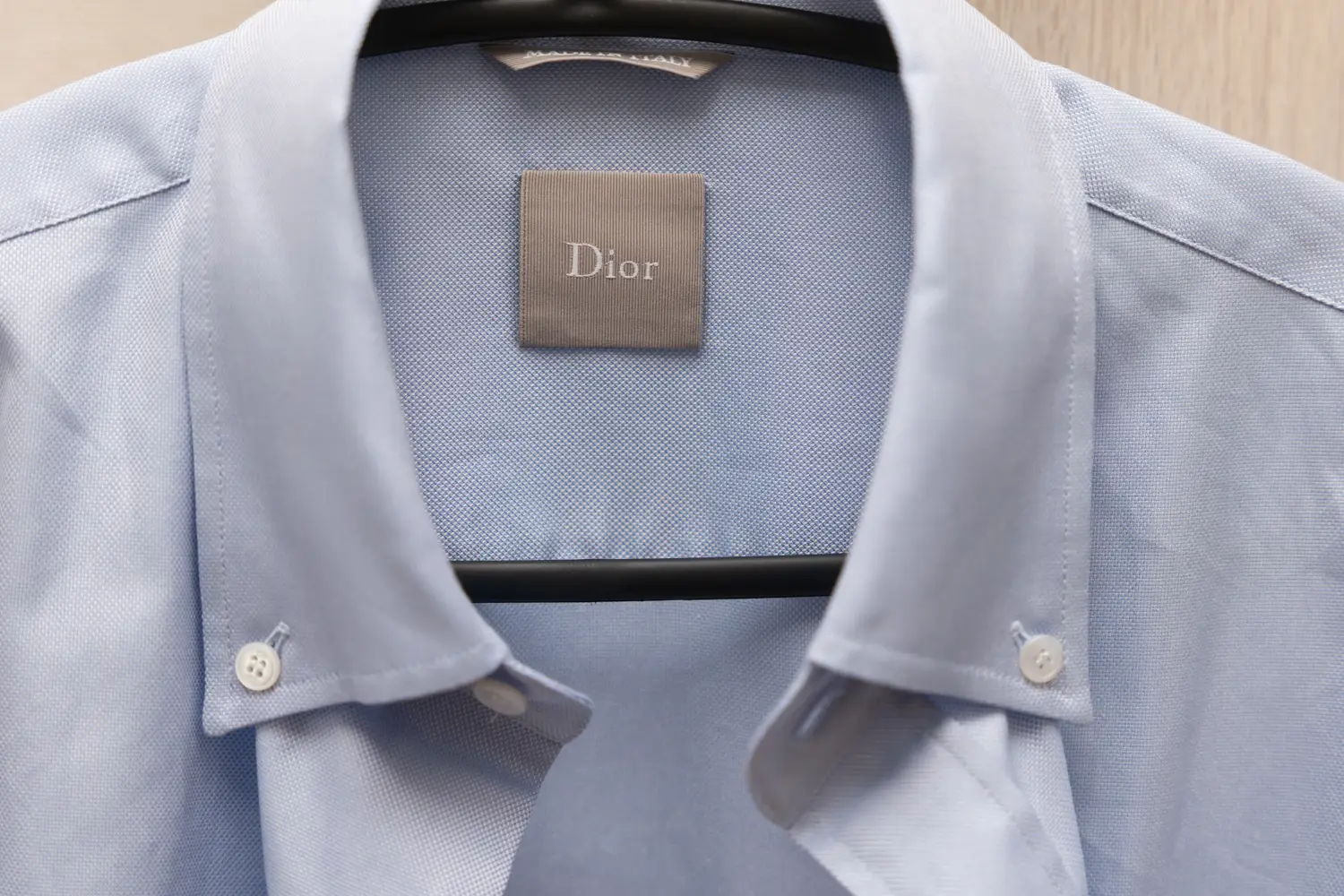
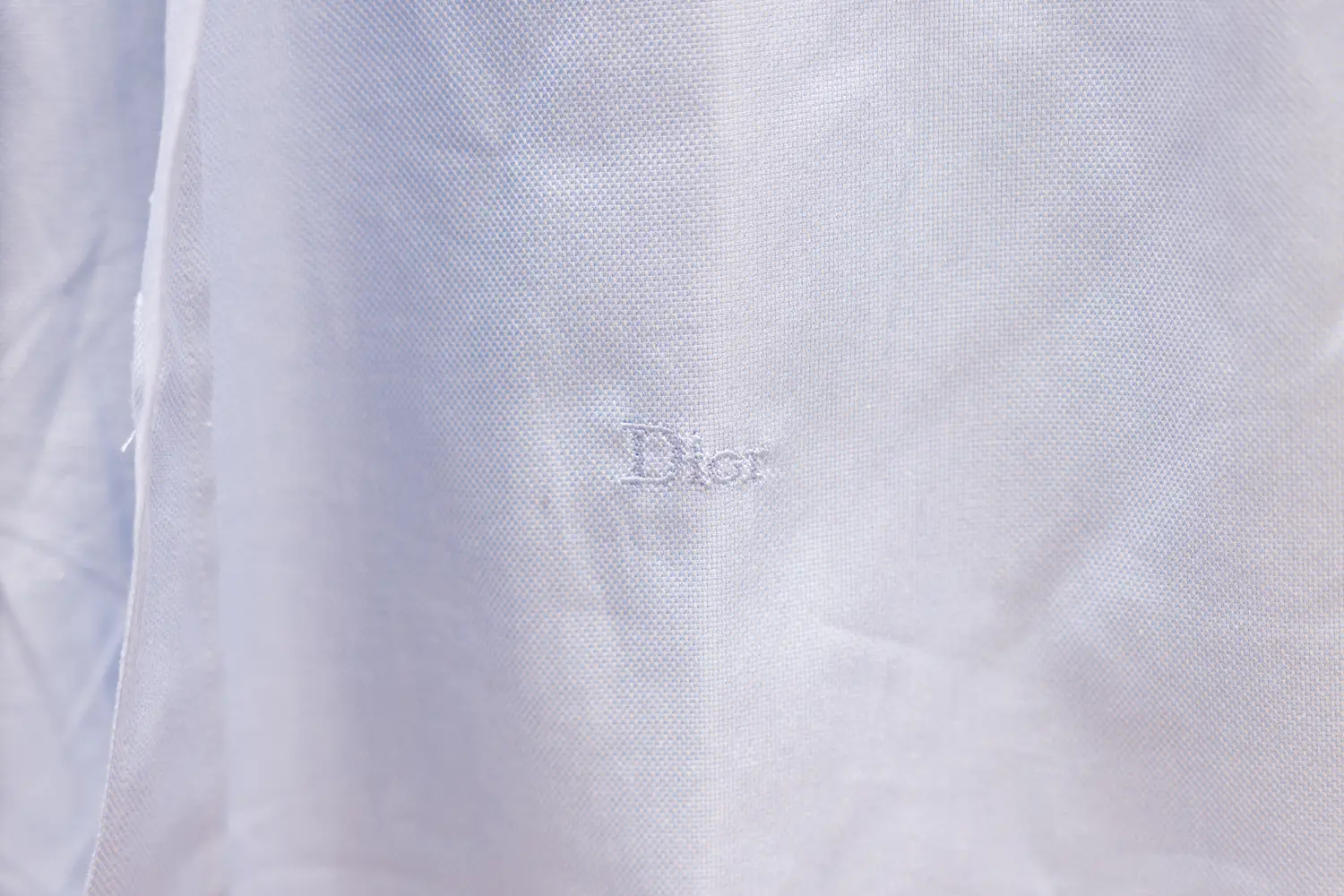
These are the characteristics.
A simple collar
Three pockets
Fastening with zip and buttons
Brass zip
Acrylic fleece lining
Cold-weather cuff ribbing
Side adjusters at the hem
Stencil print on the back (marked USN: issued by the US Navy)
The A-2 deck jacket, 1978 model, features:
A-2 Deck Jacket Tag
The tag displays washing instructions, size, management number, contractor number, and contractor name. The “78” in DLA-100-78 denotes the year of manufacture.
Ribbed Cuffs of the A-2 Deck Jacket
The sleeves feature ribbing for the purpose of keeping out the cold.
Brass Zipper of the A-2 Deck Jacket
The fasteners are made of brass and feature Talon fittings.
Side Adjusters on the A-2 Deck Jacket
Adjustable fasteners are provided under both arms to alter the width.
Back Stencil on the A-2 Deck Jacket
A-2 deck jackets feature stenciled markings to identify the unit to which the wearer belonged. While various patterns exist, my A-2 deck jacket has been sprayed to obscure the stencils. I suspect this was done by either the original owner or a subsequent owner to prevent the stencils being identified. The upper USN marking remains legible, confirming it was issued by the US Navy.
Combination
A-2 Deck Jacket features a fuller silhouette compared to field jackets, as it is designed as workwear for cold conditions. It also has a shorter length than field jackets.
The khaki colour pairs exceptionally well with denim, and it can be enjoyed not only with denim but also with various inner layers and bottoms.
The most noticeable difference from field jackets is that, due to the acrylic fleece inner layer, both the body width and armholes feel narrower.
Consequently, wearing thick inner layers can restrict movement and create a bulky appearance.
For inner layers, military-style thermal T-shirts pair most naturally. I favour the US Army-adopted thermal T-shirts, now reissued by Real McCoy’s. Their fabric thickness and honeycomb structure trap air, providing knitwear-level warmth. Being cotton, they also resist static electricity.
Despite being made from thick cotton fabric, the military thermal T-shirt has a fairly tight silhouette, allowing you to wear an A-2 deck jacket without looking bulky.
Paired with a sweatshirt, it creates a classic Americana style. However, modern sweatshirts often have wider armholes, so wearing one under an A-2 deck jacket can feel constricting around the shoulders and arms. Personally, I don’t mind and enjoy pairing it with items like Champion’s Reverse Weave.
Being khaki in colour, it pairs easily with denim or chinos. Provided you pay attention to the thickness and size of the items worn underneath, it’s quite forgiving in terms of colour coordination. Thanks to the acrylic fleece lining, even just the thermal T-shirt and A-2 deck jacket provide sufficient warmth during the daytime in winter.
This time I’ve paired the Champion Reverse Weave with a military-style thermal T-shirt, but the thermal T-shirt wins in terms of comfort and styling. If you don’t fasten the front, you can enjoy it as a sweatshirt too.
I don’t do this myself, but if you plan to wear sweatshirts or similar as inner layers, choosing a size one step larger than your usual will alleviate any feeling of tightness or bulkiness.
In early spring or late autumn, you can even wear it over a short-sleeved T-shirt. Rather than using it solely for deep winter warmth, enjoy it as a light outer layer for early winter or early spring. This way, you can wear it comfortably without feeling bulky or constricted.
The A-2 deck jacket boasts a long service life of over 30 years in US military issue, meaning a large number of second-hand items are available, making it a relatively easy piece to acquire. As genuine military wear in khaki, it is an excellent outer layer that effortlessly creates a rugged or stoic look simply by throwing it on.