
Styling
For this piece, I’ve kept the styling to the button-down with the chinos. Pairing the shirt with denim, or pairing the chinos with a different shirt or a summer knit, would be worth exploring too — I’ll write about that if the chance comes.
I’m showing the silhouette with the front buttoned all the way, and the more relaxed version worn open. The cloth and silhouette of the shirt, and the silhouette of the chinos, are both striking — that’s what’s worth noting.
At the end, for reference, I’ve put together a more traditional American Trad outfit — a 1990s Ralph Lauren denim shirt with a pair of Boncoura chinos whose form is close to the chinos of that era.
The contrast between the older American Trad style and Dior’s proposal — really, an American-Trad-inflected Dior — should come through clearly. Both have their pull; I find it hard to call one above the other.
1. With the Shirt Buttoned Up

Dior’s shirt styling tends not to follow the body’s line but to compose a more rectangular form. On me, the shoulders read a touch tight and the midsection looks slightly fuller than it actually is. A slimmer build than mine would probably wear it better.
(Note: the wind is pressing the shirt against the body in this shot. In reality the silhouette is a little cleaner than it appears here.)

The slim chino and the slightly shorter shirt length together compose a clean overall line and lengthen the leg visually.

The shirt’s oxford cloth is genuinely fine, with a particular crispness and a quiet sheen to it. Despite the weight and substance of the fabric, it’s comfortable to wear, and the way it creases as you move falls cleanly.
2. Worn Open, More Relaxed

Dior’s proposal is to wear the front buttoned, but in my case, leaving it open seems to suit me better — partly because closing the front makes the shoulders look a bit constricted.

For my build, leaving the shirt open also gives the whole silhouette a cleaner line.

It reads as an orthodox button-down at first glance, but Dior’s signature details are tucked throughout.
3. The Chinos in Silhouette

The hem opening is judged precisely — not the heavily tapered slim of recent years, but a slim straight line. The rise is shallower than the wider trousers currently in fashion, and the seat reads cleanly.

Paired with a white tee, the cleanness of the chinos’ line shows through clearly.

The judgment of fit through the seat and thigh, and the line below the knee, present the leg beautifully.
4. The Watch
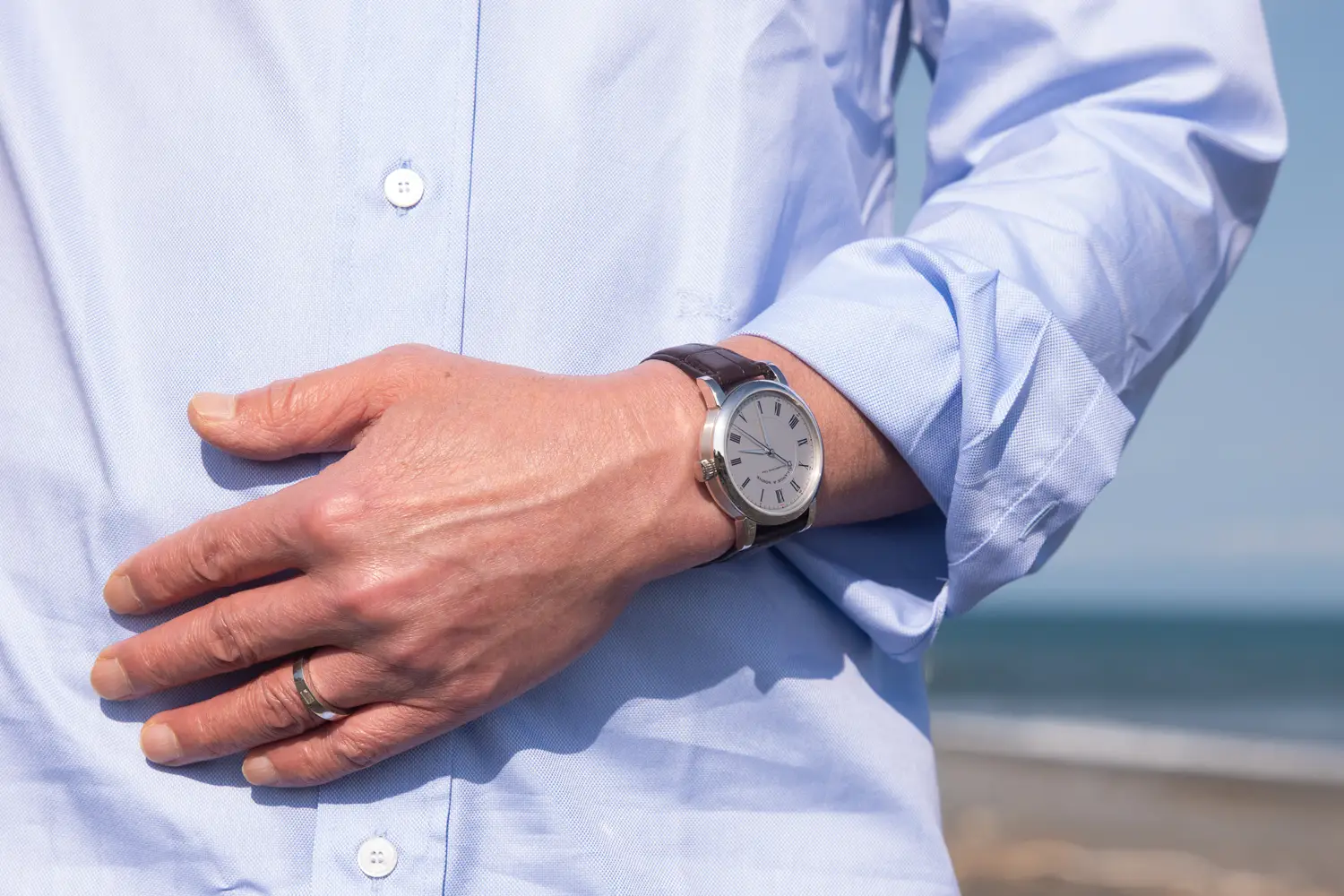
Because the shirt carries less of Dior’s mode image and more the feel of something made up at an Italian camiceria, I’ve worn it with a leather-strap watch — the Richard Lange.
5. Roots

Here I’ve paired a 1990s Ralph Lauren denim shirt with Boncoura chinos, whose classic shape is close to the chinos of that era. By contemporary styling standards, the silhouette reads slightly fuller — but looking at this shoot, I’m reminded that this is genuinely how the proportions ran in the 1990s.
It’s the kind of measured fullness that softens the body’s line a little, and as casual dressing for someone my age — middle-aged, on the older side — it’s a comfortable combination. I’d recommend it to readers of similar age.

Compared to the Dior styling, this is the more relaxed silhouette. The older me would have chosen this one without hesitation.
Detail
(The specifications below are drawn from Dior’s official site.)
Button-Down Shirt
- Dior embroidery
- Button-down collar width: 7.3 cm
- CD mother-of-pearl buttons
- Shirttail hem
- 100% cotton
- Made in Italy
- Oxford cloth
Chinos
- Leather Dior patch
- Belt loops
- Buttoned zip closure
- Side slip pockets
- Back piped pockets with button flaps
- 100% cotton
- Made in Italy
- Standard silhouette
- Regular fit
- Mid-rise
- Hem opening: 20 cm
Combination
- Regular-fit chinos: Dior
- Button-down shirt: Dior
- White tee: Tom Ford
- Belt: Real McCoy’s
- Hat: Borsalino
- Leather shoes: John Lobb Barros
- Sneakers: Visvim
- Watch: Richard Lange — A. Lange & Söhne
In Closing
Dior takes two American Trad staples — the button-down shirt and the chinos — and rebuilds them through a contemporary eye. Rather than the American industrial product, what emerges is something built within the Italian tailoring tradition — and that constitutes a genuinely new register.
Sky-blue cotton shirt with beige cotton trousers — the colors and the details are about as classic as it gets, and almost anyone wearing this combination ends up looking cleanly put together.
Layered onto that with Dior’s contemporary styling and the cleanness of the silhouette, the result is a piece of American-Trad-inflected dressing that no one else is offering.
Something I noticed while writing this: if you take the words seriously, the motif may be American Trad, but what emerges from the workshop isn’t American Trad. French Trad, in the Dior sense, may be the more accurate label.
The styling is slim, but not the extreme slimness Hedi Slimane built into Dior’s iconography — the silhouette is clean rather than narrow, and consequently easier to wear. For readers thinking of stepping into Dior’s world for the first time, I’d recommend these pieces.
A Shift in the Industry’s Mindset
Jonathan Anderson, Dior’s new designer, has proposed a line built on a Dior reading of American Trad — and beyond the trend-aware element of it, I find myself hoping it might shift the larger flow of fashion to come.
User preferences have become so varied that this is no easy thing to attempt. But the move can be read as part of a broader pattern — at Dior and elsewhere — of returning to an older idea of brand identity, one in which users choose by genuine preference rather than by trend, and in which collections settle back into the older rhythm of putting forward what the house actually stands for, with an eye on building repeat customers rather than chasing newcomers.
Over the past thirty years, the spread of the internet and the smartphone has expanded the market enormously. The fashion industry, like others, has begun to take stock of what that expansion has given and what it has cost — and this latest move feels like part of that reckoning.
The quality of Dior’s oxford shirt prompts me to think that the older boundaries between brands — design houses, tailoring houses, fabric specialists, each with its own history and field of strength — are being crossed in both directions. Brands seem to be raising one another’s quality through that mutual encroachment.
The benefit is that more pieces of genuine quality, made to be enjoyed over time, are becoming available. The cost is reflected in the price tag — materials and tailoring at this level mean items run higher than they once did. I suspect that price rise becomes acceptable to users in the same measure as they’re released from the obligation to chase a new trend each season.
Shop
I bought the button-down shirt and chinos covered here at House of Dior Ginza, located in Ginza Six.
From this season, Jonathan Anderson takes over as designer, drawing on the great motifs running through fashion history and translating them deftly into Dior’s own world. Beyond the minimalist dark tones of the past, the lineup now includes more pieces in actual color.
It’s the first collection from a new designer, so whether the current direction will define the Dior of years to come remains an open question. But the collection has enough impact to genuinely shift the Dior image, and what comes next will be worth following.
The Dior world that Hedi Slimane built twenty years ago left an enormous impression — a mode world pursued through minimalism, the brand for those who chose that particular vision. What I see now is a more universal sensibility being layered on top of that, deftly.
Kris Van Assche raised the height of what Slimane had built, making a Dior that was a little easier to wear; Kim Jones followed by enriching the brand with collaborations attuned to his moment. Anderson arrives after that, and the question of what world he will build is being watched closely. But the way he’s broadened the lineup beyond the runway-as-spectacle to include pieces that can actually be enjoyed in daily life — that, to my mind, is the kind of evolution that Dior’s wearers will receive as the right one.
The staff at House of Dior who help me understand my own style, recognize what suits and what doesn’t, and put new discoveries in front of me each time — it’s the kind of shop where every visit brings a small revelation.
The quality I’ve felt in everything from the peacoat to the shirt and chinos I’ve covered here, I now realize, is precisely what the official site captures in this passage:
Dior Tailoring
Epitomizing the art of couture, tailoring has been at the heart of the virtuoso skills of the Ateliers since the House was founded.
Beyond the image of seasonal fashion and trends, what I feel now is the depth and quiet capacity of a maison that holds its place at the top of the Paris collections. That, more than anything, is what Dior is.