
Introduction.
A Sense of Time Travel
The Tie Your Tie–commissioned Kiton suit introduced here is one that I actually wore during the 2000s. Putting it on again after more than twenty years brings with it a feeling of nostalgia, and in some ways, it feels almost like stepping back in time.
I first took the suit out of the closet while preparing photographs for an article about my John Lobb derby shoes. The suit had been resting there for many years. Since I was going to photograph the shoes anyway, I thought it would be interesting to recreate the style I wore at the time. I therefore paired the suit with the same John Lobb derbies and wore the Omega Seamaster that I used to wear daily in those days, documenting the look through photographs and a short article.
I have long believed that truly well-made things retain their value over time. Even if the circumstances in which we wear them change, and even if years pass without wearing them, their essential qualities remain unchanged. Through this small photo session, I was reminded once again that when something is chosen with care — including the philosophy and craftsmanship of its maker — the beauty it holds does not fade with time.
The Philosophy Behind Kiton and Tie Your Tie
Fit, Proportion, and the Context of Its Time
When I put this suit on again after many years, the first thing I noticed was the sense of scale. By today’s standards, it feels slightly larger and more relaxed. The reason is simple: when I bought the suit, the size was chosen primarily to accommodate my shoulders and chest. Although I normally wear a size 46, I selected a 48, which results in a somewhat roomier body and fuller trousers.
At the time, suit silhouettes were not as slim as they often are today. Classic houses such as Kiton tend to maintain a conservative approach to proportion, so choosing a size 48 — with a little extra ease — felt perfectly natural both to me and to the staff at Tie Your Tie.
Seen from today’s perspective, bringing a style from twenty years ago into the present gives the suit a distinctly classic character, which I find quite interesting.
a modern silhouette
My physique has not changed much since then. In terms of modern fitting standards, however, a size 46 would probably be the most balanced choice. That said, unless the garment is constructed with a strong three-dimensional cut, a smaller size can easily feel restrictive around the shoulders and chest.
If I were to determine my ideal measurements more precisely, the shoulders and chest would correspond to a size 48, while the body width and trousers would fall closer to a 44 or 46. (Well-made suits can sometimes achieve a perfect shoulder and chest fit even in a size 46.)
A suit that fits the body precisely can certainly look impressive. However, if the construction is not sufficiently refined, comfort may suffer. Moreover, a suit that appears perfect when standing still may develop awkward creases when the wearer begins to move. One of the defining characteristics of excellent Italian tailoring — whether from manufacturers like Kiton or from traditional sartorie — is the highly three-dimensional structure of the garment.
Viewed not only from the front but also from the side or from behind, the silhouette is entirely different from the suits I had worn previously. The line from the shoulders through the back and down to the seat forms a natural curve. Simply wearing the suit creates a sense of masculine strength in the silhouette, and this was one of the decisive reasons I chose it.
Kiton is also a fabric merchant, and the house maintains an exceptional archive of cloth. The suit I own is made from a beautifully muted navy wool with a softly toned Glen check. Although the cloth is a heavier wool suitable for autumn and winter, it remains remarkably soft to wear.
At the time, Tie Your Tie often proposed wearing a cashmere cardigan with front buttons in place of a traditional waistcoat, rather than a formal three-piece suit. To accommodate this style, the body of the jacket was cut slightly fuller. I purchased the cardigan together with the suit, and on colder winter days I still wear it as a layer underneath.
a perfectly judged balance of ease
In my thirties at the time, the suit often felt somewhat beyond what I deserved. Yet after purchasing it, I quickly realized how different it was from the suits I had worn before. The particular sensibility of Tie Your Tie was also evident: compared with original Kiton or Brioni suits, the shop’s special commissions had a subtle ease — a certain relaxation in their expression. Because I have never been drawn to clothing that projects luxury too obviously, this understated balance suited my own taste perfectly, and I found myself wearing the suit often and growing increasingly attached to it.
My first visit to Tie Your Tie came through an introduction from a senior colleague at work. Truly exceptional objects — the kind that inspire genuine enthusiasts — often become a topic of conversation and even a means of communication between people. Buying this suit taught me that a purchase can offer value beyond the object itself. It was, in many ways, a rare and meaningful experience.
John Lobb Derby
At the time, I had a particular preference for derby shoes with open lacing and double soles. Every pair of John Lobb shoes I owned followed that pattern — all were double-soled derbies.
From a strict dress-code perspective, a closed-lacing Oxford would probably be considered the more traditional choice to wear with a suit. In practice, however, I never paid too much attention to that rule and often paired my suits with derby shoes.
a low, elegant instep that creates a clean silhouette
One characteristic common to many John Lobb shoes is the way the vamp appears low and clean when worn. The impression of the shoe on the foot can be quite different from how it looks when simply viewed in a shop or in photographs.
A similar quality can also be found in the shoes of Edward Green, another classic English maker, where the elegance of the last becomes even more immediately apparent. Although I ultimately chose John Lobb as my English shoemaker of preference, Edward Green produces equally outstanding shoes. Given the opportunity, I would certainly like to experience wearing a pair someday.
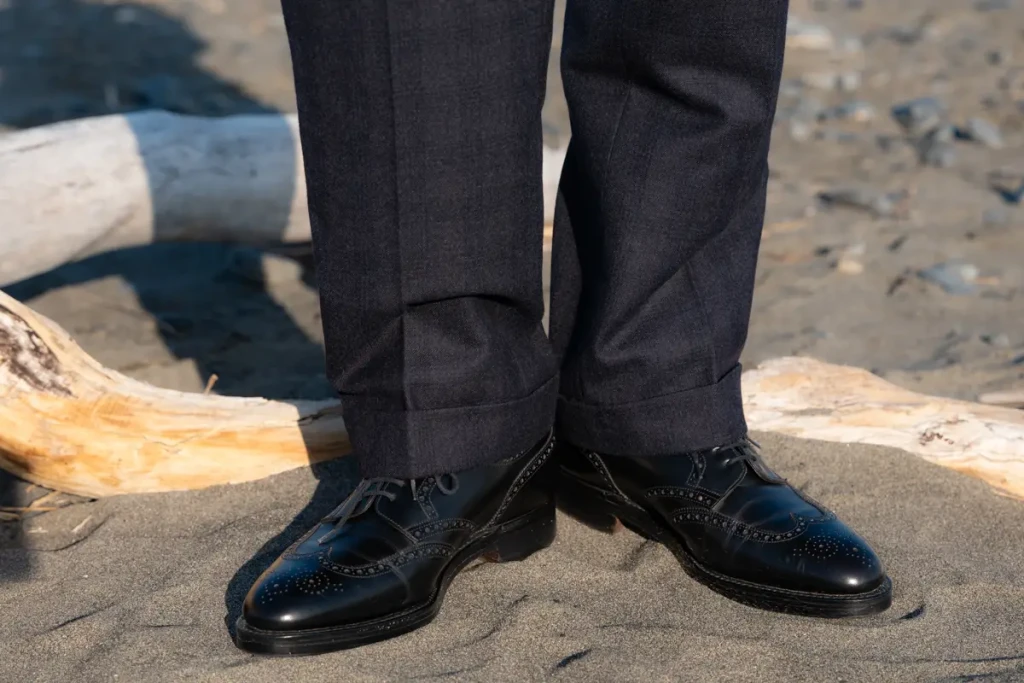
Creases have developed across the vamp, but even after more than 25 years the shoes still retain the remarkable durability that defines John Lobb. The double sole gives them a slightly more casual impression, yet their design reflects the functional beauty of traditional British shoemaking, with a strong, grounded stance.
well-broken-in open lacing that sits naturally
John Lobb’s calf leather is very firm at first, but with wear it gradually molds to the foot. As body heat spreads through the leather it softens to a comfortable balance, and the leather soles have shaped themselves to my feet so that the open lacing closes cleanly without spreading too much.
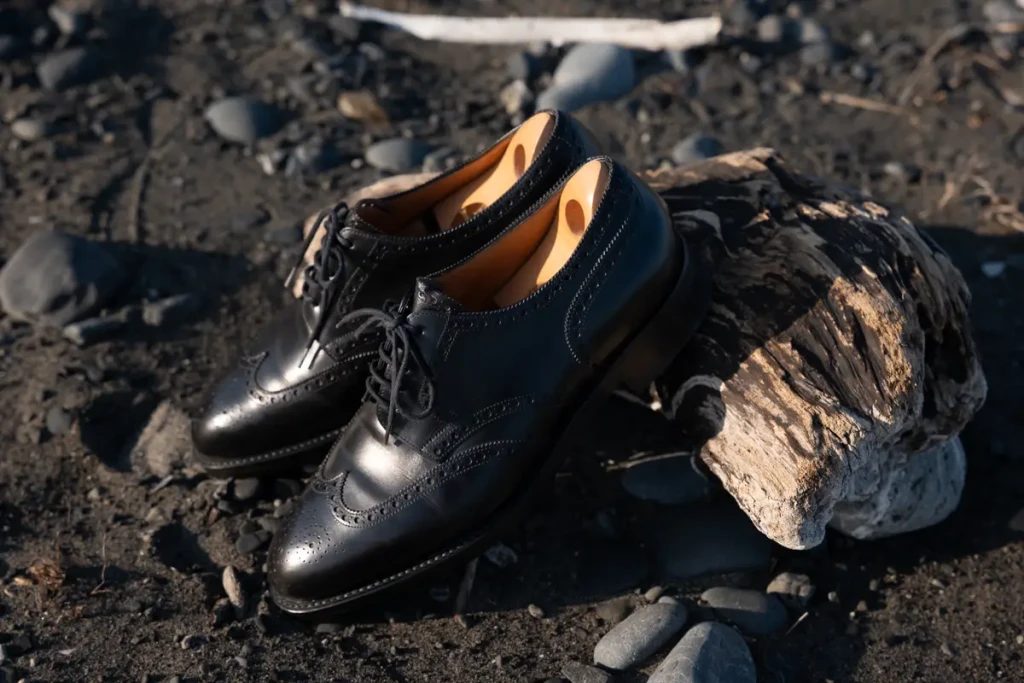
Looking at the photograph again, the overall balance of the shoe becomes very clear. When viewed on their own, the instep may not appear particularly sleek, but once worn it sits lower and looks far more refined. In my view, this is the result of the quality of the last and the craftsmanship behind the shoe.
[ John Lobb Darby: The Soul of an English Standard | 25 Years of Heritage ]
Omega Seamaster Ref. 2532.80
Since the introduction of the Apple Watch, I too have come to rely on its convenience and now wear one regularly. Before the arrival of the smartwatch, however, my everyday watch was the Omega Seamaster.
It has been nearly thirty years since I first purchased this watch, yet it remains remarkably robust. Its water resistance and mechanical accuracy have held up extremely well over time. It was also the first mechanical watch I purchased together with my wife, which gives it a special sentimental value. If I were ever forced to keep only one watch for the rest of my life, I would choose this Seamaster without hesitation.
a refined sense of everyday ease
Naturally, a watch of this age has required servicing over the years. I have had it overhauled several times at Omega in the Nicolas G. Hayek Center in Ginza. Thanks to this careful maintenance, the watch continues to perform much as it did when it was new, both in terms of water resistance and accuracy (although some degree of natural aging is inevitable).
Another noteworthy point is the bracelet. Even after decades of use, it shows virtually no stretch, which makes the watch extremely comfortable to wear. The finely segmented links also allow for precise adjustment, giving the bracelet an almost perfect fit on my wrist.
When I chose the Seamaster in the 1990s, several things appealed to me. It was a highly capable diver’s watch with strong water resistance, yet it maintained an understated appearance suitable for everyday wear. The 41mm case felt quite large at the time, but the bezel was free of bold color accents, and the matte blue dial — almost navy in tone — gave the watch a restrained elegance.
Because the bezel was not brightly colored and the dial remained a subdued navy blue, the watch worked equally well with casual clothing and with a suit. That versatility was one of the reasons I chose the Seamaster.
a robust yet refined diver’s watch
On a personal note, from the late 1990s through the early 2000s — before the events of September 11, 2001 — I occasionally visited Hawaii, where the wife of a friend I was indebted to lived. She was an experienced diver with advanced certification, and on several occasions she took me diving. With her guidance I even descended to fairly deep waters, and the Seamaster performed flawlessly. Its legibility underwater confirmed that it was indeed a true diver’s watch.
In terms of durability and functionality, the watch has also accompanied me in everyday activities. Since around 2010 I have maintained a routine of light running and walking, and at the time I often ran distances of up to twelve kilometers while wearing the Seamaster.
Running in the summer heat means sweating heavily. Although that might raise concerns for many watches, the Seamaster’s diver-level water resistance makes it completely worry-free. After returning home I would simply rinse it under running water. Even the repeated vibrations from vigorous arm movement during running never caused any issues.
At one point, when sending the watch for overhaul at the Nicolas G. Hayek Center, I asked Omega whether the vibrations from running might affect the movement or damage internal components, since such use might fall outside the manufacturer’s intended conditions. In practice, however, there were no problems at all.
Today, watches like the Apple Watch or Garmin have taken over many of the practical roles once filled by traditional watches. Yet before the era of smartwatches, the Seamaster served me faithfully in countless situations and proved itself to be an outstanding everyday watch.
During runs or walks, I would sometimes rotate the bezel to track elapsed time — much like measuring dive time underwater. Using it in this simple, tool-like way added another layer of practicality, and that sense of functional design is part of what makes the watch so endearing to me.
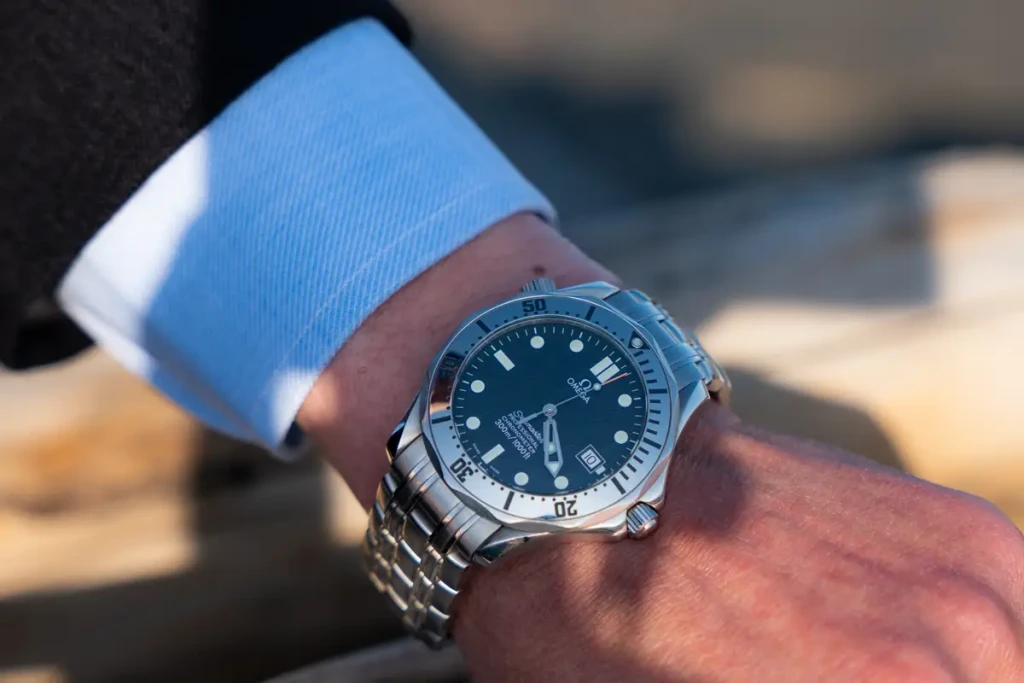
At the time, the 41mm case felt quite large to me. Today, however, with dress watches generally becoming larger, the size no longer feels unusual.
Because the bezel has no color and the dial is blue, the watch avoids looking overly sporty. As a result, it pairs naturally with a suit while still retaining a subtle sense of sportiness.
[ Omega Seamaster Ref. 2532.80 ]
The style I put together this time is:
- Kiton suit: Tie Your Tie special order
- Sax blue Oxford shirt: Tie Your Tie original
- Brown irregular polka dot tie: Tie Your Tie original
- Shoes: John Lobb Darby
- Watch: Omega Seamaster
- Brown hat: Hermes Balthazar
This is the combination I put together. Except for the hat, this is a combination I actually wore in the mid-2000s.
Combination
The outfit itself is quite orthodox: a dark navy suit paired with a sax blue shirt, a brown tie, and black full-brogue derby shoes.
the relaxed elegance of Tie Your Tie
One thing I was told at Tie Your Tie at the time was that pocket squares were generally not used. Franco Minucci himself rarely wore one, and the shop considered it unnecessary. Perhaps because of that influence, I also seldom wear a pocket square. Instead, I sometimes place a fountain pen in the breast pocket, or in winter I slip a pair of leather gloves there after taking them off. This natural use of the functional elements of clothing is another sensibility I learned from Tie Your Tie.
Franco Minucci’s philosophy of dressing
One of the essential aspects of Franco Minucci’s style was the idea of slightly relaxing what might otherwise be considered too formal. The balance is subtle — and that subtlety is important. Personally, I feel that behind this approach lies a certain spirit of consideration for others.
A simple way to understand it might be this: when escorting a woman, a gentleman should remain the supporting presence. In other words, one should avoid dressing more flamboyantly than those accompanying him. It is a form of elegance rooted in restraint, and it is something I naturally keep in mind as well.
To me, the essence of Tie Your Tie lies precisely in this philosophy. The shop gathered exceptional items — chosen with the finest sensibility — that allowed a man to enjoy dressing well while maintaining a quiet elegance that never overwhelmed those around him.
In many ways, this reflects the deeper essence of men’s dress. Buying a suit at Tie Your Tie made me far more aware of that idea, and the influence has remained with me ever since. One could say that it taught me how to enjoy clothing without allowing it to become ostentatious.
Since the passing of Franco Minucci, the extraordinary items once offered at Tie Your Tie — each imbued with his philosophy — have disappeared. Looking back, I regret that, given my circumstances at the time, I was only able to purchase a single suit from the shop. Writing this article has helped me put into words why Tie Your Tie was such a remarkable place, and in doing so I feel that I may finally have come to understand its true value.