
I have a fondness for military items and am particularly fond of field jackets. The field jackets I’ve featured previously were either single-layer constructions (M43, M47, Brunello Cucinelli) or featured a thin liner (M65).
Due to the construction of field jackets, using them as a primary outer layer in the depths of winter presents challenges in terms of warmth. The A-2 Deck Jacket I’m introducing this time serves as a slightly warmer military-style outer layer.
The A-2 Deck Jacket was adopted by the US Navy as cold-weather protection for deck work at sea, utilising acrylic fleece as its lining. Consequently, it blocks wind even in the depths of winter, and the acrylic fleece provides excellent insulation and warmth, making it an outer layer frequently worn during the colder months.
The A-2 Deck Jacket introduced here is an improved version of the N1 Deck Jacket developed by the US Navy in the 1940s for deck work, adopted in the 1960s. The major difference between the N-1 and A-2 Deck Jackets lies in the materials: due to the developmental stage of nylon and polyester in the 1940s, the N-1 Deck Jacket was made from natural materials – cotton fabric with an alpaca lining.
By the 1960s, when the A-2 Deck Jacket was developed, material advancements had led to the increasing use of nylon and polyester. Initial production runs retained the cotton outer fabric but changed the lining from alpaca to acrylic fleece. Subsequent modifications saw the cotton outer replaced with a cotton-polyester blend fabric, offering improved maintenance properties and durability.
1970s A-2 Deck Jacket
My beloved A-2 deck jacket dates from 1978, crafted from cotton-polyester fabric with an acrylic fleece lining and brass zips.
Much like the M65, it is a genuine military garment, highly functional, and its stoic form, devoid of excess, is profoundly masculine. It is an exceptionally versatile outer layer; simply throwing it over denim creates an instant, effortless look.
The difference from a field jacket lies in the thickness of the fleece lining. This results in a tighter fit and a silhouette that tends to puff out more easily. Compared to a field jacket, choosing a thinner inner layer ensures greater comfort and prevents the silhouette from becoming distorted.
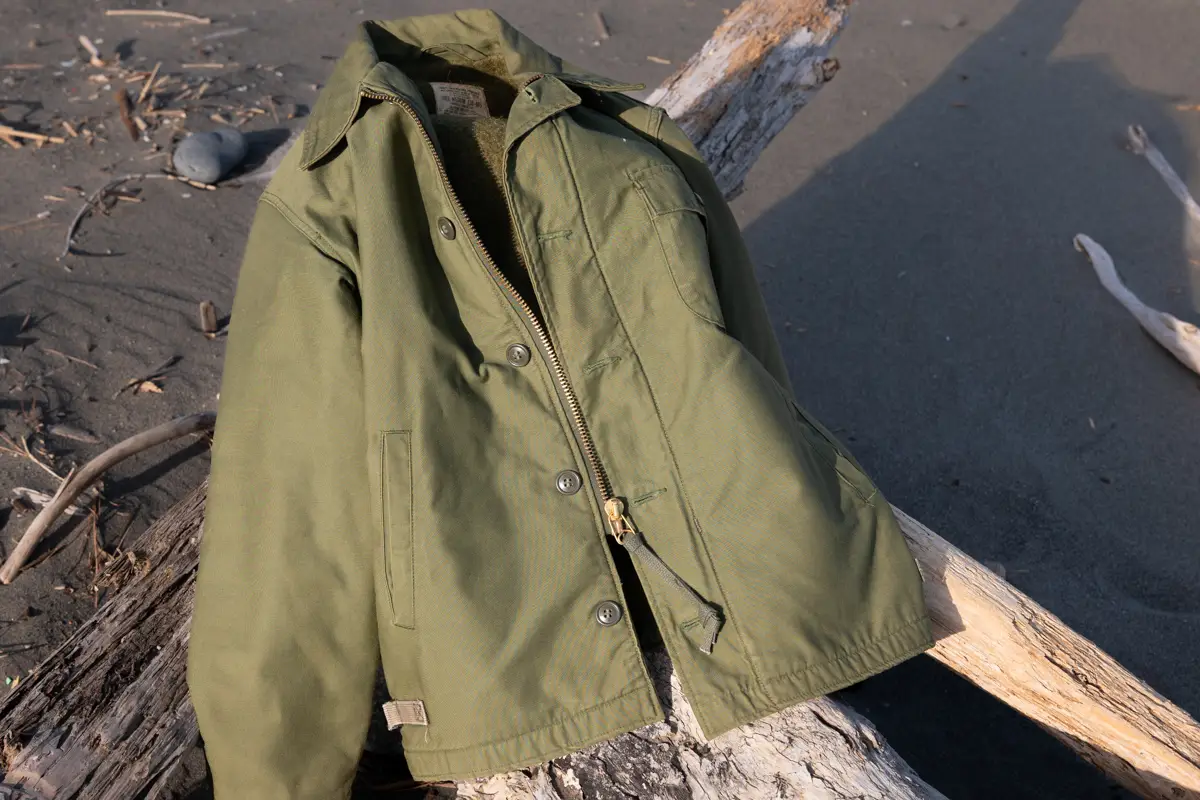
The Navy adopted it for deck work, so its purpose was as military workwear; its details differ from the field jacket, such as the shape of the pockets and the absence of epaulettes.
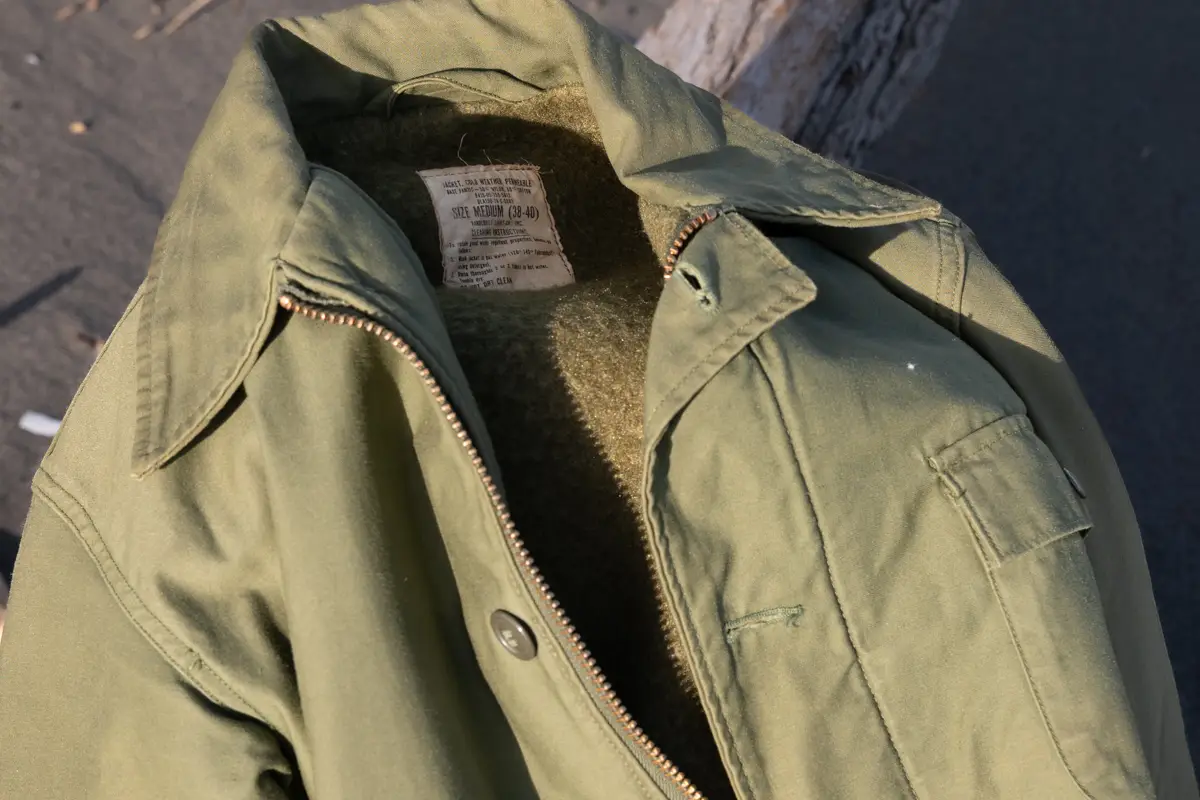
The inner fleece lining is substantial, and the thick cotton-polyester blend fabric is windproof, keeping you warm even in winter.
Introduction.
A-2 Deck Jacket
The A-2 deck jacket was officially adopted by the US military from the early 1960s until the 1990s.
Its defining characteristics lie in the simplification of features found on the Field Jacket, such as epaulettes and flap pockets, which were designed to maximise freedom of movement for both hands in combat zones. Instead, it incorporates only the essential functionality required for naval deck operations, which was its intended purpose.
As it is designed for work at sea, where temperatures are typically lower than those encountered in the Field Jacket’s intended environment, its lining features acrylic fleece to provide enhanced warmth.
In contrast to the M65, designed for combat wear and built on the premise of infrequent donning and doffing to adapt to changing environments, this deck jacket is intended for continuous wear during deck work. It is designed to withstand the cold of deck duties, hence the acrylic fleece lining.
Compared to field jackets, its origins as workwear for cold conditions mean it features thicker inner layers, making it slightly bulkier. It also has simpler details, incorporating functional pockets similar to those found on field jackets.
As I wrote in the M65 article, the M65 has a relatively relaxed fit, meaning it retains its silhouette well even when layered with thick innerwear. In contrast, the A-2 deck jacket features a fleece lining, and wearing thick innerwear restricts movement. Its bulky form also makes the silhouette appear puffy when worn.
Compared to the M65, the A-2 Deck Jacket hasn’t inspired as many fashion industry followers, though some brands do offer reproductions. However, while the original N-1 has become iconic and sees many reproduction items, reproductions of the A-2 – designed as an evolution of the N-1 and for mass production – are less common.
The A-2 Deck Jacket, being genuine military wear, carries a rugged image. Designed as workwear for cold weather, it provides warmth even with thinner layers underneath, making it a valuable outer layer for the colder winter months. Its thick, sturdy construction means the A-2 Deck Jacket’s distinctive character comes through regardless of the inner layers worn; it is recommended to style it by embracing this inherent character.
DecK Jacket.
I’ve always admired the functional beauty of field jackets and rarely had occasion to wear deck jackets. However, come midwinter, a field jacket proves insufficient against the cold, so I’ve chosen the A-2 deck jacket as a military alternative.
As I mentioned in my M65 article, the M65 has a generous armhole, allowing me to layer thick knits underneath to combat the cold. I enjoy opting for the A-2 deck jacket on days when I feel like wearing something warmer than the M65.
Rather than being an outerwear choice, I tend to wear the A-2 deck jacket more often on days when the temperature makes me want to wear slightly thinner layers underneath.
The characteristics of deck jackets, including the N-1, lie in their thickness due to the inner lining and their extremely simple form, stemming from their adoption as workwear. The absence of accessory parts like flap pockets and epaulettes, which are part of the M65’s functional beauty, means they have a less distinctive appearance. Compared to the M65, they also give a less pronounced sense of wearing military wear.
The substantial inner lining resists creasing when worn, contributing to a somewhat flat appearance and a slightly puffed silhouette. This creates an item that divides opinion.
Middle70s.Model
The A-2 deck jacket featured here is a 1978 model. The form of the A-2 deck jacket, much like the M65, shows little variation over the years. The primary change in early materials was the shift from cotton twill to a cotton-polyester blend, whilst the fundamental form has remained consistent.
The A-2 deck jacket features a tag attached to the inner neck area. Examining this tag reveals details such as the year of US military issue and the size. The number DLA-100-78-C-9882 shown on the tag image below is the contractor information (delivery details), where the “78” in 100-78 indicates the year of manufacture.
These are the characteristics.
- A simple collar
- Three pockets
- Fastening with zip and buttons
- Brass zip
- Acrylic fleece lining
- Cold-weather cuff ribbing
- Side adjusters at the hem
- Stencil print on the back (marked USN: issued by the US Navy)
The A-2 deck jacket, 1978 model, features:
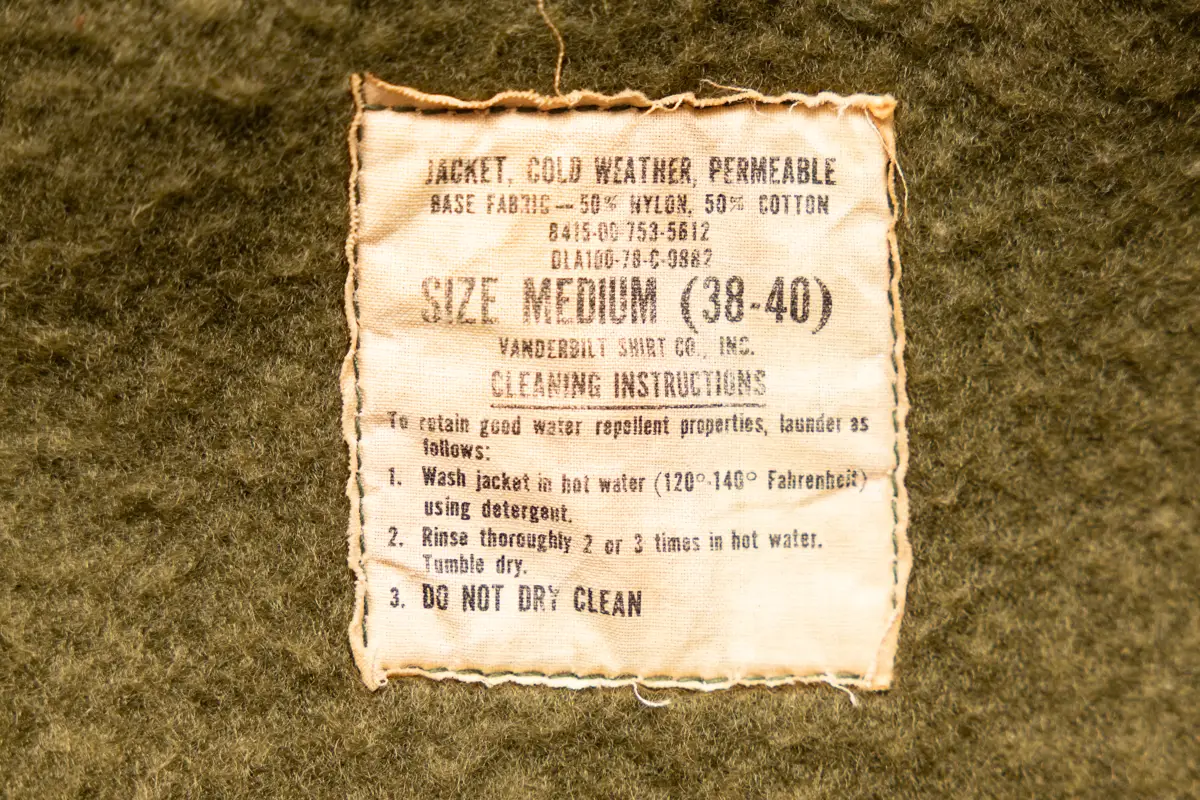
The tag displays washing instructions, size, management number, contractor number, and contractor name. The “78” in DLA-100-78 denotes the year of manufacture.
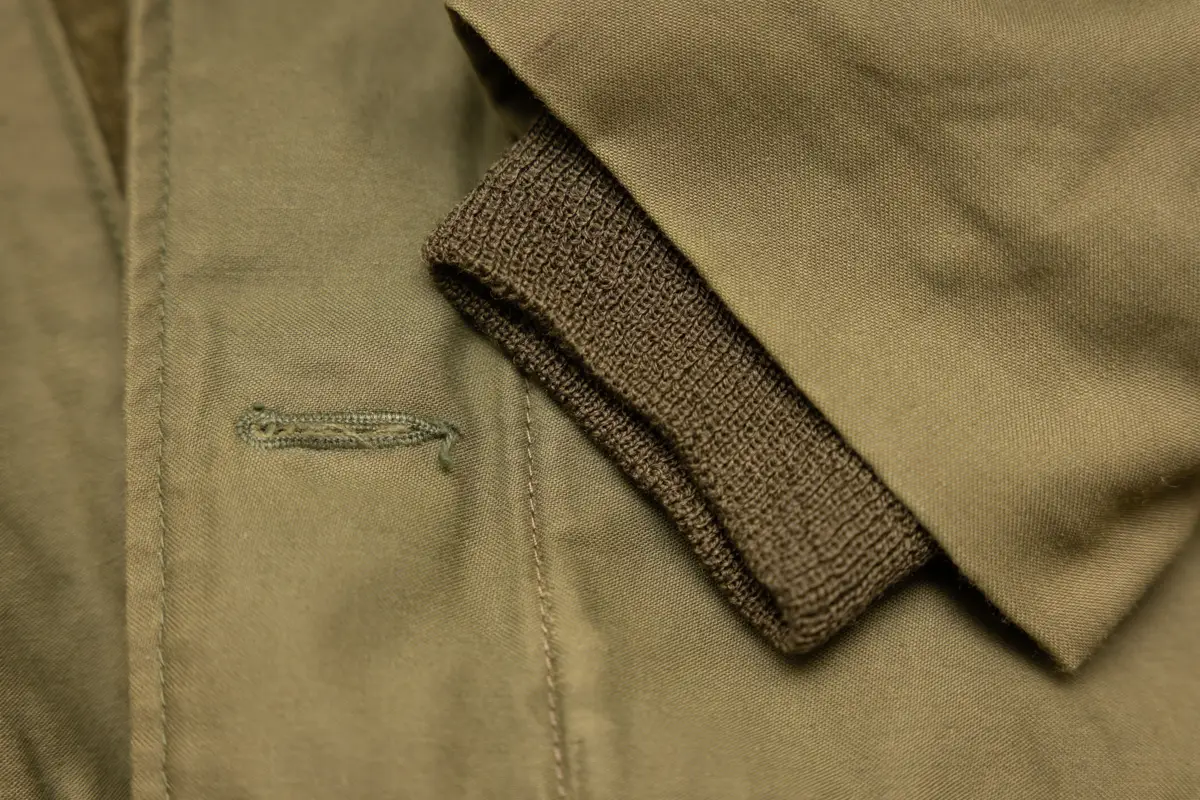
The sleeves feature ribbing for the purpose of keeping out the cold.
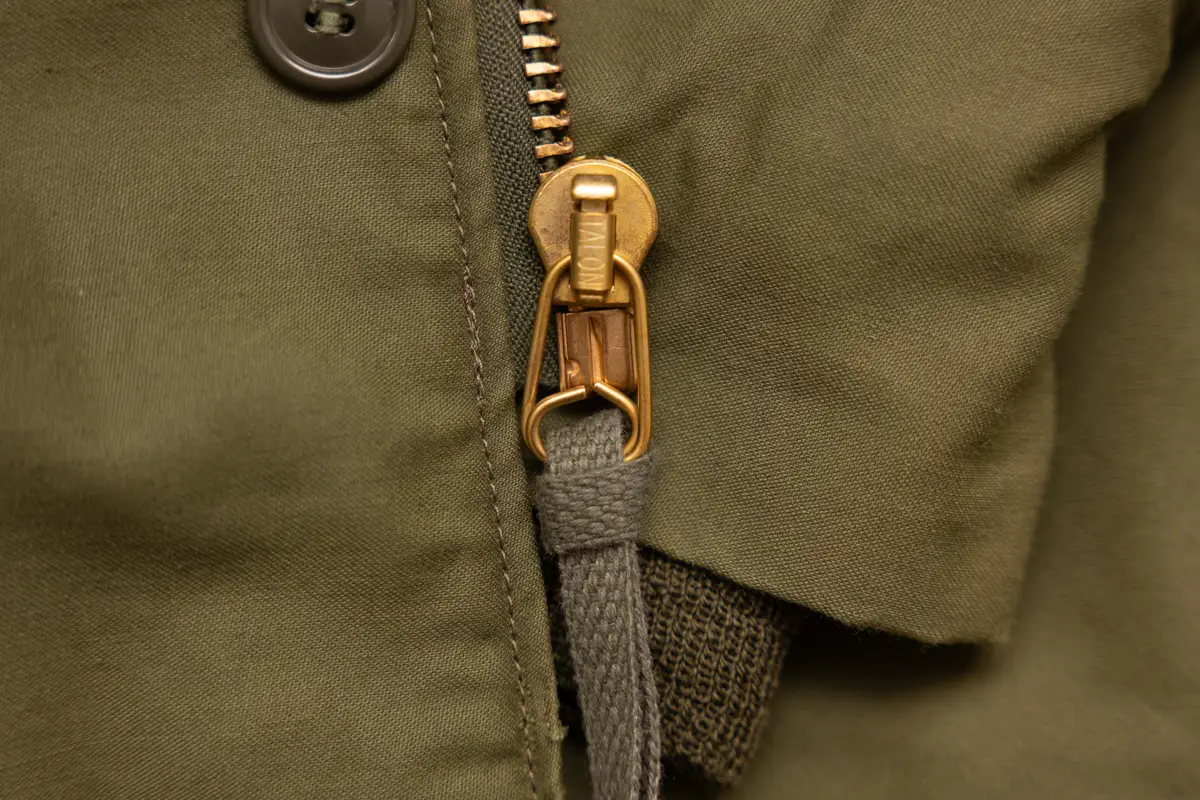
The fasteners are made of brass and feature Talon fittings.
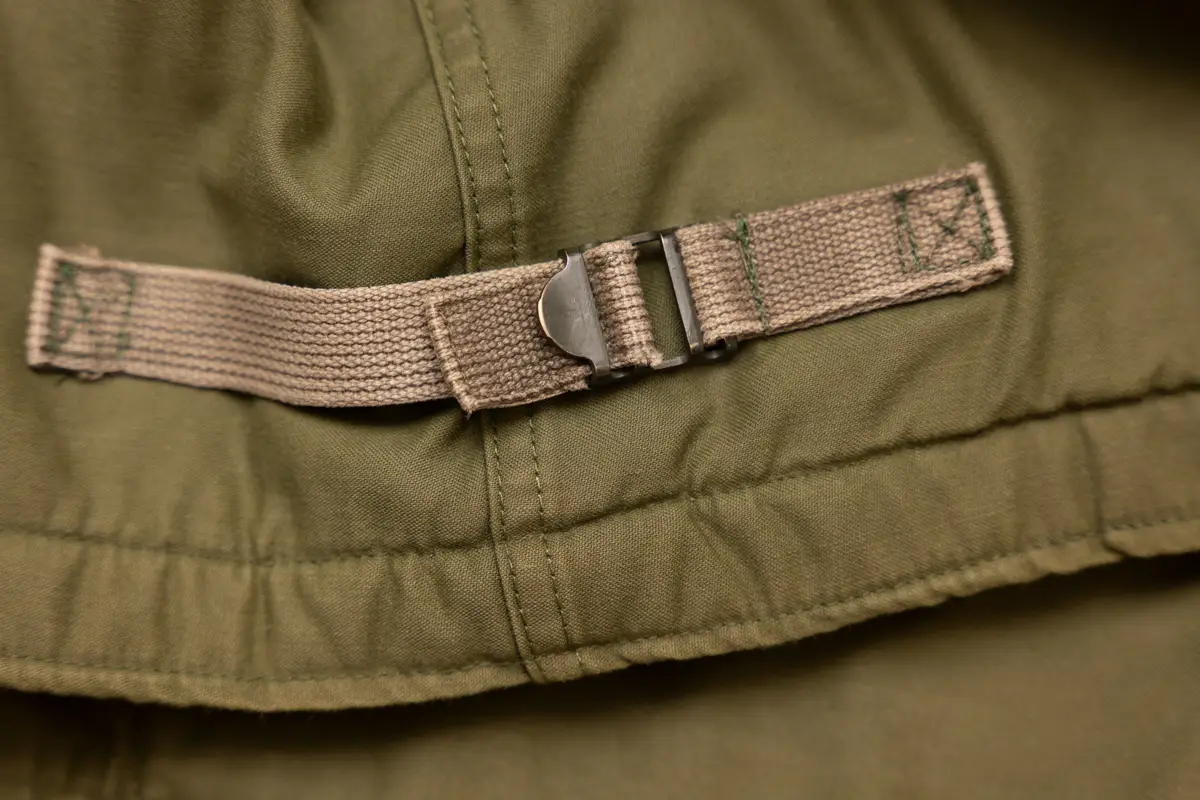
Adjustable fasteners are provided under both arms to alter the width.
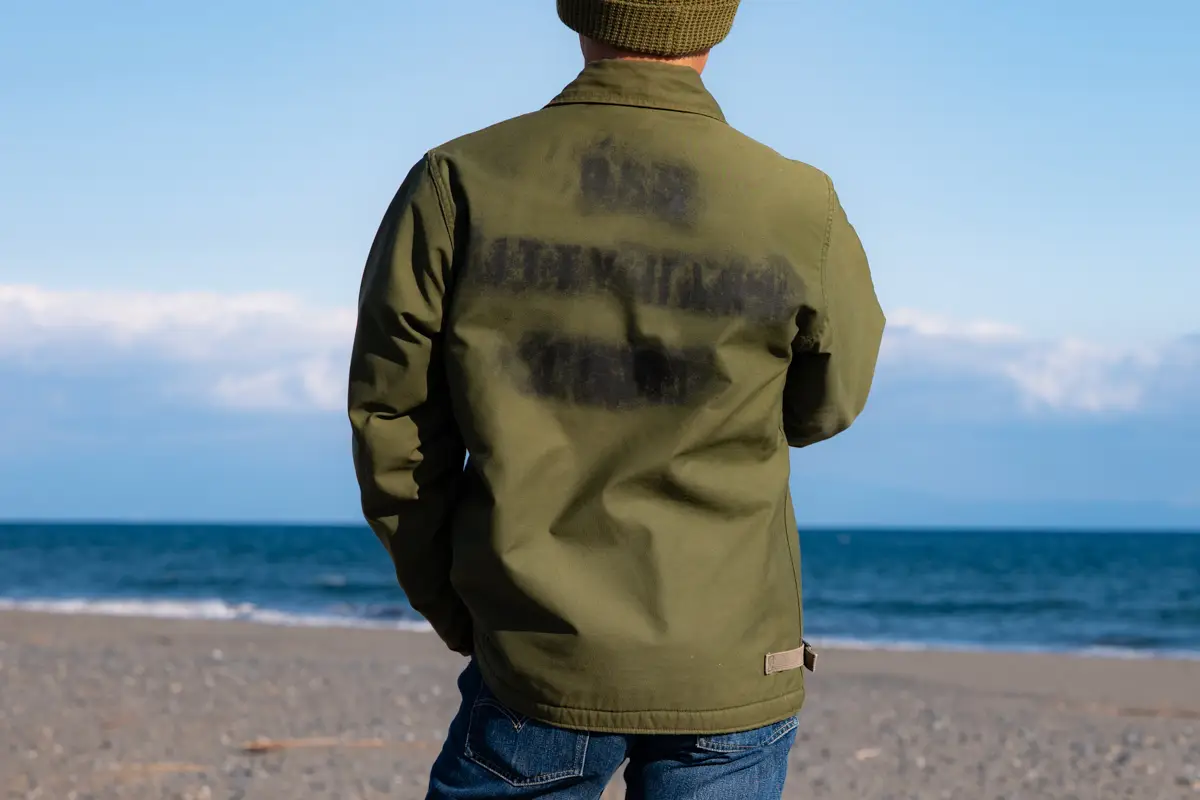
A-2 deck jackets feature stenciled markings to identify the unit to which the wearer belonged. While various patterns exist, my A-2 deck jacket has been sprayed to obscure the stencils. I suspect this was done by either the original owner or a subsequent owner to prevent the stencils being identified. The upper USN marking remains legible, confirming it was issued by the US Navy.
Combination
A-2 Deck Jacket features a fuller silhouette compared to field jackets, as it is designed as workwear for cold conditions. It also has a shorter length than field jackets.
The khaki colour pairs exceptionally well with denim, and it can be enjoyed not only with denim but also with various inner layers and bottoms.
The most noticeable difference from field jackets is that, due to the acrylic fleece inner layer, both the body width and armholes feel narrower.
Consequently, wearing thick inner layers can restrict movement and create a bulky appearance.
For inner layers, military-style thermal T-shirts pair most naturally. I favour the US Army-adopted thermal T-shirts, now reissued by Real McCoy’s. Their fabric thickness and honeycomb structure trap air, providing knitwear-level warmth. Being cotton, they also resist static electricity.
Despite being made from thick cotton fabric, the military thermal T-shirt has a fairly tight silhouette, allowing you to wear an A-2 deck jacket without looking bulky.
Paired with a sweatshirt, it creates a classic Americana style. However, modern sweatshirts often have wider armholes, so wearing one under an A-2 deck jacket can feel constricting around the shoulders and arms. Personally, I don’t mind and enjoy pairing it with items like Champion’s Reverse Weave.
Being khaki in colour, it pairs easily with denim or chinos. Provided you pay attention to the thickness and size of the items worn underneath, it’s quite forgiving in terms of colour coordination. Thanks to the acrylic fleece lining, even just the thermal T-shirt and A-2 deck jacket provide sufficient warmth during the daytime in winter.
This time I’ve paired the Champion Reverse Weave with a military-style thermal T-shirt, but the thermal T-shirt wins in terms of comfort and styling. If you don’t fasten the front, you can enjoy it as a sweatshirt too.
I don’t do this myself, but if you plan to wear sweatshirts or similar as inner layers, choosing a size one step larger than your usual will alleviate any feeling of tightness or bulkiness.
In early spring or late autumn, you can even wear it over a short-sleeved T-shirt. Rather than using it solely for deep winter warmth, enjoy it as a light outer layer for early winter or early spring. This way, you can wear it comfortably without feeling bulky or constricted.
The A-2 deck jacket boasts a long service life of over 30 years in US military issue, meaning a large number of second-hand items are available, making it a relatively easy piece to acquire. As genuine military wear in khaki, it is an excellent outer layer that effortlessly creates a rugged or stoic look simply by throwing it on.