
Wearing example.
Wearing the Suit
In these photographs I am wearing the Tie Your Tie suit with a matching shirt and tie from the same shop, paired with John Lobb derby shoes and an Omega Seamaster.
As a rule, I have always preferred navy suits, and most of the suits I own are plain navy. At the time, however, Tie Your Tie did not offer ready-to-wear suits in plain navy, so the image that guided my choice was somewhat different. What I had in mind, rather vaguely, was the kind of dark suits worn by jazz musicians in the 1960s — figures such as Miles Davis and John Coltrane.
When I think of Miles Davis in a suit, the image that comes to mind is the album cover of My Funny Valentine (recorded at the same concert as Four & More). Miles appears in a dark navy suit, paired with a white shirt with a regular collar and a dark navy tie with large polka dots. In my own photographs I happen to be wearing sunglasses — perhaps that influence comes from Sonny Rollins. (That is partly a joke, though the image of Rollins wearing sunglasses on the cover of A Night at the Village Vanguard has always stayed with me.)
When I was a student listening passionately to jazz, the internet did not yet exist, and there were few opportunities to see musicians in motion. Most of the time, the only visual reference we had was the album cover itself. Yet many modern jazz musicians of that era appeared on stage wearing suits, and their presence — combined with their strong physical bearing — left a powerful impression of elegance and confidence.
Information about musicians was also far more limited than it is today. We often relied on liner notes and album reviews to learn about the music. Some of the liner notes that impressed me when I was young remain in my memory even now, intertwined with the sound and atmosphere of the albums themselves.
Because information was scarce, discovering new records often depended on chance encounters. One of my gateways into jazz was a book titled Karaguchi Jazz Notes by Yasukun Terashima, the owner of the well-known jazz café Meg in Kichijoji. Terashima’s perspective was fascinating. Although he was a devoted modern jazz enthusiast, he also wrote about guitarists such as Johnny Smith and Al Haig — tastes that differed somewhat from the mainstream modern jazz canon. I found his viewpoint so compelling that I returned to the book many times.
Influence from Music
As an aside, Miles Davis has always been one of my favorite musicians. The albums I listened to most intensely were those from My Funny Valentine through In a Silent Way. Records such as E.S.P. are widely regarded as masterpieces in the history of jazz. In that album, Miles’s approach to jazz becomes particularly clear through the extraordinary interplay of what is often called his “second great quartet.” It was also through this music that I began to recognize something like Miles’s unique sense of blues.
I recall reading a jazz theory book that analyzed E.S.P., explaining the contrast between Wayne Shorter’s flowing, accessible phrasing and Miles’s more twisted interpretation of the blues. The explanation was striking and helped deepen my understanding of their musical language.
In one of Yasukun Terashima’s books, I also remember reading a column claiming that Miles used the same stock phrase — something like a habitual lick in rock guitar — only once throughout his entire career. Whether literally true or not, the idea captures something essential about Miles: he was a pure improviser who continued to evolve the core spirit of jazz throughout his life, carrying forward a lineage that can be traced back to Parker (though Gillespie’s influence may have been just as significant).
According to the liner notes, the recordings of My Funny Valentine and Four & More were taken from a concert in which Miles performed as part of a charity event. Before the performance he informed the band that the show would be unpaid, which reportedly created a tense atmosphere among the members. The resulting performance is filled with an unusual intensity and energy; throughout the album the musicians play with a level of tension that is almost palpable. (It is said that Miles later paid the band members after all.)
I apologize for drifting into a discussion of music in what is essentially an article about suits. Yet even the suits or denim I wear casually are influenced, in my own way, by cultural experiences such as music and film.
1.The overall silhouette is very clean.
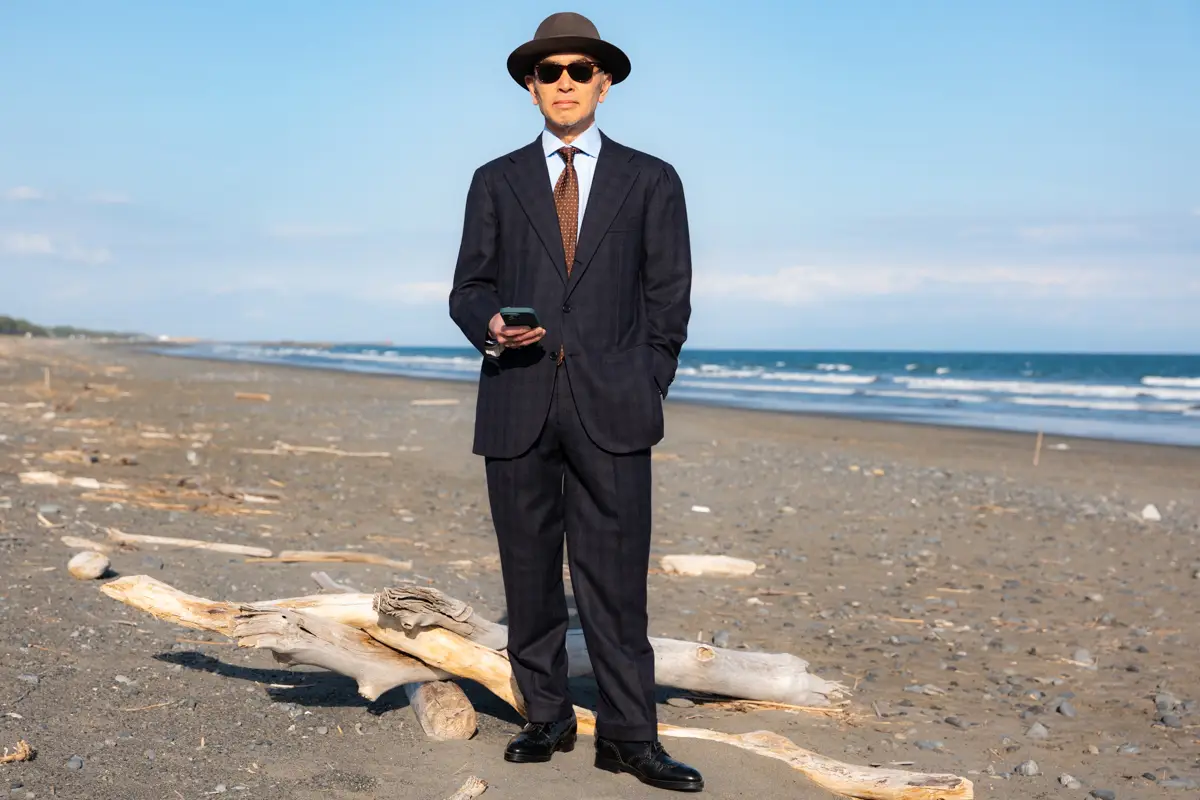
At first glance, the suit may appear slightly large, but it actually creates a very classic silhouette.As you will see in the photos below, the intention behind the suit becomes clearer when viewed from different angles: from the side it presents a clean and streamlined profile, while from the back it gives a stronger, more powerful impression.
2.The Side Silhouette

From the side, the silhouette appears far more refined than it does from the front. The line from the shoulders to the chest, the waist suppression, and the gentle fullness toward the back are all carefully balanced to create a distinctly masculine silhouette.
3.The Silhouette from the Back

It was the silhouette from the back that truly convinced me to buy this suit. The broad shoulders, the taper at the waist, the gentle fullness toward the hips, and the balanced width of the trousers create a three-dimensional shape with depth, producing a distinctly masculine and classic look.
4.Wearing the Jacket Open

Even with the front button undone, the classic character of the suit remains intact. The length and texture of the tie create an excellent balance, so the overall look still works even if the narrow blade extends a little longer.
5.The Trousers Silhouette

The cut of the trousers is well balanced, allowing the outfit to retain a strong and masculine silhouette even without the jacket.
6.The Waistline of the Trousers

The trousers are a high-rise, double-pleated design. The clean silhouette around the waist creates a flattering shape that makes the physique appear stronger and more balanced.
The tie has curled slightly in the wind. Unlike the thicker sette pieghe ties made by Marinella, Tie Your Tie’s ties use a lighter fabric with a more open weave, which means they are more prone to losing their shape. Yet this characteristic also gives the tie a certain liveliness, allowing it to respond naturally to the wearer’s movements.
It may be a subtle detail, but moments like this reflect the philosophy of Franco Minucci, who proposed a style of dress that considered not only the garments themselves but also the gestures and movement of the person wearing them.
7.The Seat and Hip Silhouette

From the back, the trousers also create a strong and masculine silhouette. The shaping around the seat gives a solid structure that makes the physique appear more substantial and well balanced.
8.The Silhouette from an Angle

The silhouette appears even more refined when viewed from an angle rather than straight from the front. This is the result of the high level of craftsmanship required to construct a suit three-dimensionally.
I only noticed after taking the photograph that the tie had flipped in the wind. Having not worn the suit for many years, I had forgotten how light the tie is, which caused it to move so easily.
Combination
- Suit: Ciro Paone (Tie Your Tie Kiton Special Order)
- Shirt: Tie Your Tie
- Tie: Tie Your Tie
- Shoes: John Lobb Darby
- Watch: Omega Seamaster Ref. 2532.80
- Hat: Hermes Balthazar Brown
In conclusion
This article began simply as an attempt to photograph my John Lobb derby shoes with a suit. When I took a suit out of the closet — one that had been resting there for many years — and tried it on again, I found myself making new discoveries, which ultimately led me to write this piece.
Although more than twenty years have passed since the time when I wore this suit regularly, it remains a remarkably fine garment, full of classic charm even by today’s standards. As I began to consider why the suit — together with the shirt and tie I paired with it — still appeared so naturally elegant, I found myself reflecting on the philosophy of Tie Your Tie and its owner, Franco Minucci, as well as on the deeper intentions behind the clothing offered there.
When I first purchased the suit, I wore it without thinking too deeply about such things. Yet in writing this article, I felt as though I had finally begun to understand why I chose this suit in the first place and why it remained so dear to me. It was almost as if a question that had lingered quietly for twenty years had at last found its answer.
In the process, the article drifted beyond the suit itself. The watch I wore at the time, the shoes that accompanied it, and even the image of Miles Davis that originally shaped my idea of a dark suit gradually led the narrative toward music and jazz. As a result, the piece may have become somewhat difficult to read. Nevertheless, writing it has allowed me to organize my own thoughts about what dressing in a suit has meant to me over the years.
Shop
As Tie Your Tie has now closed, there is no shop information to share here. Although this article looks back on the past, the store offered many remarkable pieces whose ideas remain relevant even in contemporary dress. It was also a place that helped shape my own understanding of men’s style.
Among the suggestions once made to me at Tie Your Tie were two small “assignments” that I was unable to fulfill at the time. In later years, I managed to complete one of them. If the opportunity arises, I would like to write another article about that experience — the answer to a question that took many years to resolve.
With gratitude and remembrance for Franco Minucci.
Shinichiro Takeda