In Closing
On the Culture of Italian Sartoria
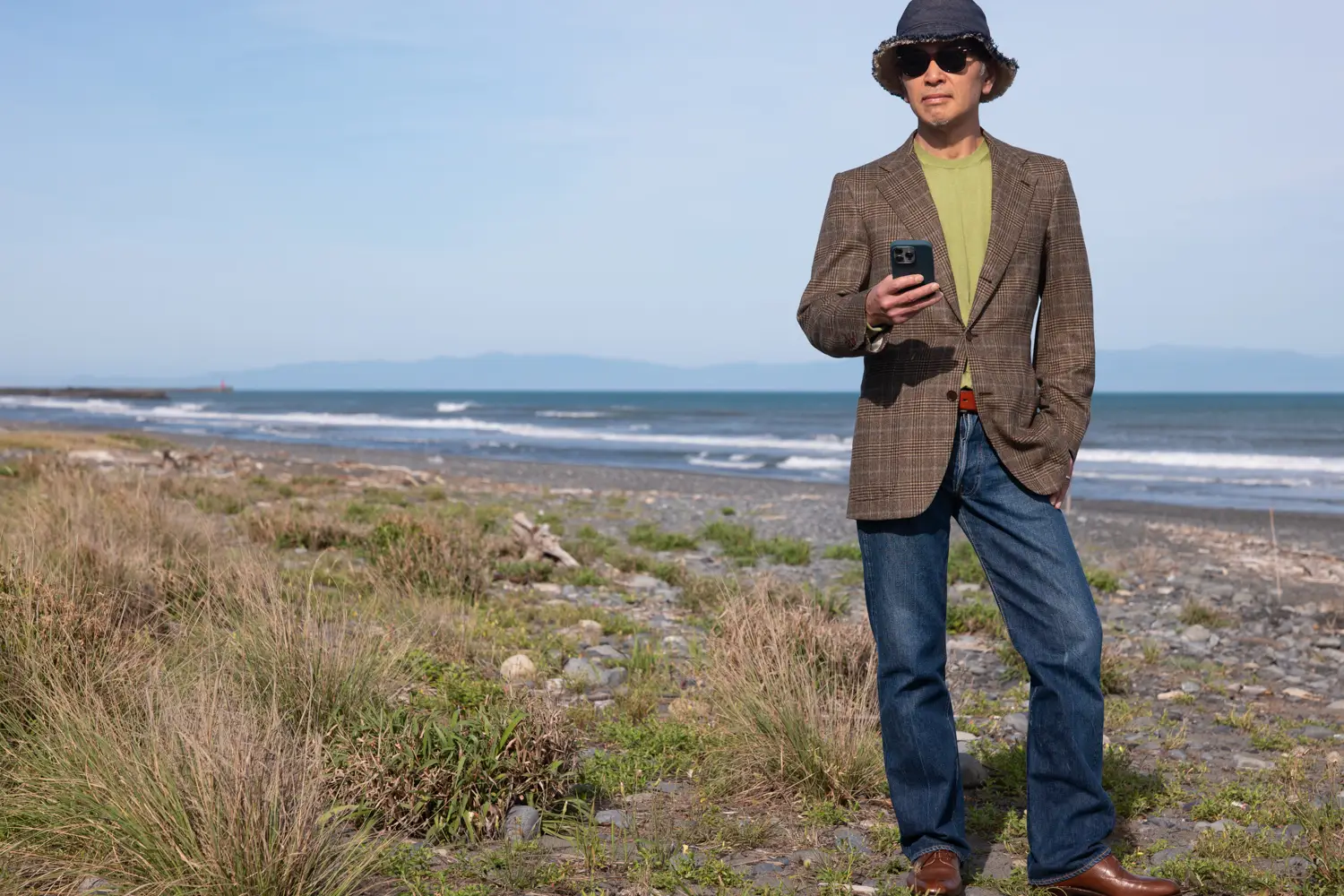
I came to this Formosa cashmere jacket through a shop I found while searching for Marini shoes — I talked with the owner, was moved by what he had to say, and bought it from him. It came laden with the culture of Italian sartoria, carrying not just a way of dressing but a philosophy along with it. What I took home was as much knowledge and outlook as it was a garment, and the satisfaction was correspondingly deep.
My Formosa is secondhand, but every stitch of it carries the previous owner’s intentions, and the relationship between him and Sartoria Formosa — the kind of relationship in which a maker rises fully to a customer’s vision — is built into the jacket itself.
The Long View
Reading what’s essential in Italian sartoria, what comes to the surface is the importance of time itself — of how time flows through these garments. I happened to find another man’s bespoke jacket that fit my own body and bought it secondhand, but if you turn the situation slightly and look at it from a different angle, something deeper begins to show.
To commission a bespoke jacket is to pay a substantial price and to wait. Substantial labor goes into it, and what emerges is one jacket in the world, fitted to one body.
Considered as an object of ownership, that is the ultimate kind of purchase — the acquisition of something genuinely good. To live with something so completely fitted to oneself, one can imagine, would enrich a life.
But what’s essential becomes visible only when the original owner stops wearing the piece. In my case, I came to it as secondhand, and I will wear it with the same care its first owner did.
My case is inheritance between strangers; in a family, the path runs from father to son, son to grandson. (The sentiment will be familiar to anyone who remembers Patek Philippe’s older campaign.)
I’ve come to believe that what’s essential in the tailoring culture of Naples — and of Italy — lies not only in the making, which is obvious enough, but in the length of the cycle of time that begins after the making, and in the act of inheritance that closes that cycle.
Stewardship
A jacket or a suit built with that kind of care, and at that kind of cost, is naturally worn long by the man who commissioned it. The workshop that made it is still there if alterations are needed. If the time comes when he no longer wears it and chooses to pass it on, the workshop can adjust the piece to fit the next person, and the garment continues into a new ownership.
There is a tradition in Europe of treasuring what’s been handed down from someone close. A well-made jacket that a father or grandfather wore daily is exactly the kind of thing a son or grandson would be glad to receive.
That same person, in turn, may go on to commission tailoring of his own. A cycle in which one customer leads to the next forms naturally on its own. And because customers value the workshop, they introduce new ones — the kind of new customer they actually want to bring through the door.
Customers who hold the workshop’s work in respect, sustaining long relationships across long time horizons, bringing in those they trust — that cycle, I would argue, sits at the heart of Italian sartoria.
A workshop that deliberately avoids broad advertising — sustained instead by long customer relationships and word-of-mouth introduction — is closed and salon-like in character. When wealthier customers exist within that circle, they patronize the house, give it volume, and support its survival. This is, in effect, the European tradition of patronage.
Japan offers a parallel — increasingly rare these days — in the practice of taking apart a mother’s kimono and remaking it for her daughter. The feeling is close to that uchinaoshi. A kimono is expensive enough that one is typically made only a handful of times in a lifetime, and a sartorial suit, considered in the same register, makes complete sense.
The deeper point — to use something good for a long time, and to pass it on when the moment requires — is the premise on which the garment is made, and that cultural premise is itself transmitted from one generation to the next. That, to me, is the heart of Italian sartoria.
The Reciprocal Whole
The cultural side of the maker — the sartoria itself — has on its other face the cultural side of the customer who commissions the work. The two are inseparable, two faces of one whole, and the relationship between them is what raises the sartorial culture and what allows it to keep evolving day by day.
Once you understand that this is the soil from which a jacket or a suit emerges, the act of wearing it — the simple pleasure of dressing — takes on a cultural dimension, and your own way of dressing acquires depth.
There are any number of reasons one chooses to dress as one does — the personal pleasure of wearing things, the social function of dress, the basic conventions. But the essential cultural side held within an Italian sartoria’s jacket — the European tradition of frugal, careful stewardship of things; the salon-like community; the soil in which serious enthusiasts raise the makers themselves — was something I came to understand through the purchase of this Formosa jacket. That understanding was as much a part of what I gained as the jacket itself.
It also reaffirmed something at the core of my own thinking — that buying something good and using it for a long time is what enriches daily life, and that this enrichment depends on a deeper understanding of what one wears. For that reaffirmation, I’m grateful to the owner of Artigiano Ciao, whose own understanding put the matter in front of me again.
When the chance comes, I’d like to commission a Formosa myself, with this cultural backdrop fully in mind.
A note: in different categories, and in different cultural registers, I’ve carried on this same practice of inheritance with my Berluti and C Diem pieces.
Shop
Artigiano Ciao
My Formosa came from Artigiano Ciao. I’d originally found the shop while looking for Marini shoes. Their stock is what people call Classico Italiano — known in Italy itself as Stile Classico — secondhand pieces in good condition: suits and jackets made in Italian sartorie, plus the shoes, shirts, ties, and coats that go with them.
Everything in the shop has been filtered through the owner’s eye — only pieces of high quality, and only secondhand pieces that have held their condition. I’ve always been comfortable with vintage clothing, so I’ve bought a number of things from him.
Because everything is secondhand, finding a bespoke jacket that fits one’s own body takes patience — but if you keep looking, while staying particular about silhouette and cloth, you can find a small number that work.
One of the shop’s strengths is that they understand the philosophy of sartoria and will alter pieces without disturbing the fundamental form. The owner has spent years studying classic Italian suits and jackets, taking the makers’ thinking seriously, and the alterations he supervises preserve what’s good about each garment while adapting it to its new owner.
When the original size sits too far from the buyer’s body, alterations begin to break the form — and the owner will tell you so honestly, helping you make the right call.
Cultural Continuity
The owner of Artigiano Ciao has loved classic Italian tailoring for years, has studied it carefully, and handles each piece with respect, fully informed by the philosophy of those who made it.
He works with secondhand clothing, but he treats his work as a matter of cultural continuity as much as commerce.
He has deep knowledge of what makes a classic Italian jacket or suit good, of its historical and cultural value, of the timelessness and durability that bespoke confers, and of how to think about time itself in this context.
Talking with him, I find a great deal in common with my own thinking. The depth of knowledge that comes from a long, sustained engagement with classic Italian dress, and his readiness to think of clothing at the level of culture, leaves a lasting impression.
I’ve always been drawn to small, owner-run shops where the proprietor’s particular tastes and his affection and respect for what he sells are visible in everything around you. So it’s no surprise that I became a fan of Artigiano Ciao and of the man who runs it. The Formosa jacket I’m covering here was chosen along that path.
Pieces of Note
Artigiano Ciao has its main store in Nagoya and a branch in Tokyo. The Tokyo location is small — about 8 tsubo, roughly 26 square meters — but for anyone who loves Classico Italiano it’s a treasure house. The space limits how much can be displayed at once, but every piece on the floor has been selected with care: sartorial jackets and suits of the kind one rarely encounters, and shoes of comparable caliber.
The shop offers a way of dressing that sits closest to the deeper cultural meaning of “Classico Italiano,” put in a form anyone can engage with — both casually and with depth, however one wants to enter it.
That, in turn, makes it possible to practice the quiet art of understatement — and to develop the knowledge and the eye one needs to practice it, while still enjoying the process.
This piece has run long and has wandered into some difficult terrain, but Artigiano Ciao is a remarkable shop for anyone — for the older man who has enjoyed tailoring for years, for the working professional who lives in suits, and for the younger reader stepping into tailoring for the first time. It offers everyone the same chance: to encounter the real thing, backed by history.
Artigiano Ciao Official Website
“Artigiano Ciao” Global shipping is not supported. Come to the shop when you come to Japan.