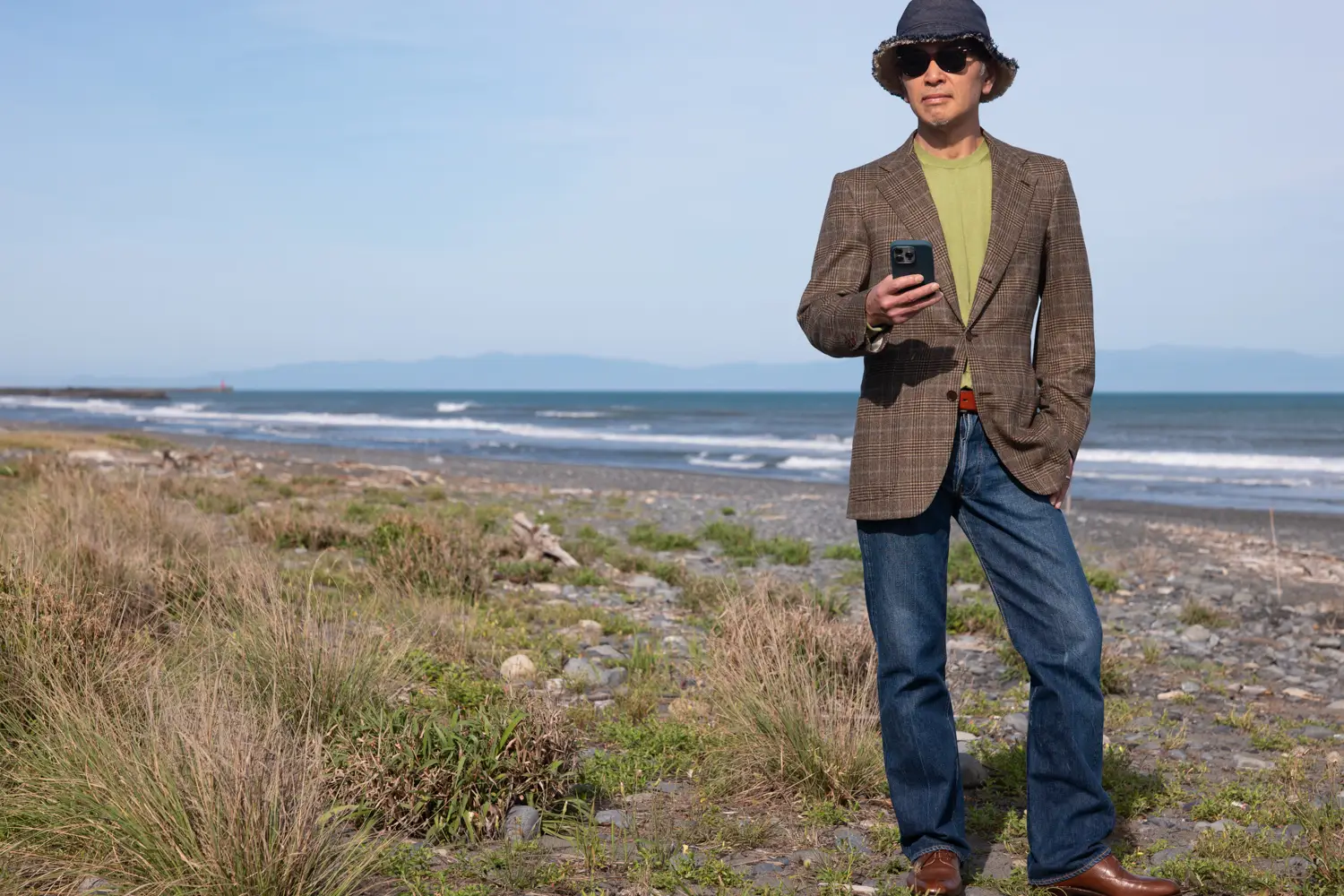
The Formosa Cashmere Jacket
The piece I chose draws on a vintage cashmere — measured in weight, distinctive in pattern, with a depth of color you don’t easily find in current production. It uses cashmere’s natural lightness and softness, and Naples’ particular approach to the shoulder, chest, and sleevehead, to put freedom of movement at the center of the build.
At the same time, it balances the comfort that comes from the cloth with the cleaner-than-Neapolitan fit the body tends to want — exactly the modern register Formosa does so well.
It’s lighter than it looks, and easier to move in than it looks. The shape is built — the line of the body comes through — but in a measured way, and the measure here is essential.
A simpler word for “built shape that reads the body in measure” is refined. That refinement is the side of Naples tailoring people often describe as aristocratic — which lives in tension with its other side, the vernacular and earthbound. Formosa lets the aristocratic side speak.
Because it’s 100% cashmere — light and warm in equal measure — a cashmere knit underneath and a scarf around the neck is enough to get through the depths of winter without needing a coat. That makes it useful, and useful makes it a daily jacket.
What It Pairs With
It’s Neapolitan in school, but the chest emphasis and the waist suppression are kept in check. Formosa pairs its high gorge with a distinctively shaped lapel curve — taking the standard Neapolitan idea of a lapel that follows the chest line and adding one further turn to the curve, so the lapel reads slightly more open than the genre’s norm.
As a result, the styling never has to push the chest forward, but the lapel’s shape still gives the chest presence — and the silhouette holds whether the front is buttoned or not.
This native silhouette also makes the jacket comfortable simply thrown on, in a more relaxed register.
The 1954 501XX
For all its refined construction, the cashmere jacket carries enough latitude to be worn casually, and I find myself reaching for it with a 1954 501XX more often than not — and almost always with a knit underneath rather than a shirt.
The 501XX and the Formosa together compose, to my eye, the cleanest line of any jacket I own.
Visvim’s Slim-Fit Denim
I’ve also tried the jacket with Visvim’s slim-fit straight, narrower than the 501XX. I’d reached for it thinking sneakers would round things out, but against the jacket’s silhouette, the bottom reads a touch slim.
It isn’t a bad pairing, but among denims, the 501XX simply meets the jacket better. If sneakers are the goal, I suspect a faded and repaired 502 would land more naturally.
With a Dior outer, the slimmer Visvim is an exceptional match and the 501XX reads heavy. The Neapolitan-tailored jacket flips that calculus — an interesting outcome to register.
Brioni Trousers
Because the Formosa’s silhouette reads as a tall rectangle, the trousers that pair best are straight in line, with a softer taper and a measured opening at the hem — slim, but not pinched, and flat-fronted. That combination pulls the whole composition together.
Finding flat-front trousers that are slim without being heavily tapered turns out to be surprisingly difficult these days. Brioni’s trousers — designed with their own jackets in mind — meet the criteria, and so Brioni is what I run with the Formosa.
When I dress with shirt and tie, this is the configuration. The shirt is either FRAY or Brioni.
ROTA also makes a flat-front trouser, with slightly more taper than Brioni. I tend to pair ROTA not with the Formosa but with my Attolini cashmere jacket, which has a more body-conscious cut. The Attolini and ROTA combination is something I’d like to write about separately, when the moment is right.
Choosing the Inner Layer
The jacket pattern is a glen check on a brown ground — at a glance it can read gray — overlaid with a faint blue windowpane. Working from there, I pair it with a sky-blue shirt; warm-toned combinations come together cleanly, so a softly colored yellow tie does well. The jacket’s weight in cashmere also makes a knit tie a natural fit — a deep red, almost brick, or a more orthodox navy, both work.
For this shoot, I’ve worn a knit instead of a shirt — and given the jacket’s brown register, I’ve gone with green. A slightly muted green sits more comfortably with the jacket than a brighter shade, and the Tom Ford silk knit I own falls right into that register.
Choosing the Shoes
With the 501XX, I pair Marini’s brown derby. A John Lobb Barros works too, but Marini’s Italian shape — a derby with a touch less formality in its lines — matches the Formosa more naturally.
With the Brioni trousers, I switch to a Marini black semi-brogue oxford. Like the derby, its Italian shape sits well with both the Brioni below and the Formosa above.
Choosing the Watch
I haven’t yet covered a leather-strap dress watch in these pieces, but a leather strap genuinely belongs with a jacket and trousers, so I’ve worn my A. Lange & Söhne Richard Lange.
Like the Omega Seamaster, the Richard Lange was bought as a pair with my wife’s. I tend to wear it when we go out together rather than daily, which is why it hasn’t appeared here before.
My wife chose the pink gold; I chose the platinum. The cases are the same size, so I occasionally borrow hers and wear the pink gold instead of my platinum.
Lange’s watches are expensive, but they read to me less as luxury watches than as high-performance ones — performance, in this case, including build, design philosophy, and the kind of considered detail I find compelling. I’d like to write properly about Lange in its own piece, when the moment comes.
Working with the Vintage Market
My cashmere jacket was not made bespoke for me — I came to it as a piece on the secondhand market. Formosa once held trunk shows in Japan; today they don’t, so anyone who wants a Formosa cashmere jacket made for them has to travel to the Chiaia workshop in Naples and order it there.
Being secondhand, the jacket isn’t strictly cut to my measurements — but the previous owner’s build was close enough to mine that I wear it as is, without alterations. The sleeves run slightly long, but for fall and winter wear that extra length earns its keep.
For a secondhand piece, you can feel the previous owner’s care and judgment all over it — and what stands out most is the cloth choice. He clearly understood what Formosa does best: a light cashmere with a measured weave, which lets every Formosa virtue come through. The result is a piece that is light to wear, finely made enough to absorb every ordinary movement, slightly long in cut, and clean in line — essentially a textbook example of how to commission a Formosa jacket if one ever did.
With the price tag and the trip to Italy involved, that isn’t going to happen any time soon — but this jacket has set such a high bar that I’d like to commission a Formosa myself one day.
The shop where I bought it is covered at the end of the piece.