John Lobb Darby: The Soul of an English Standard | 25 Years of Heritage
Introduction: The Archetype of the English Derby
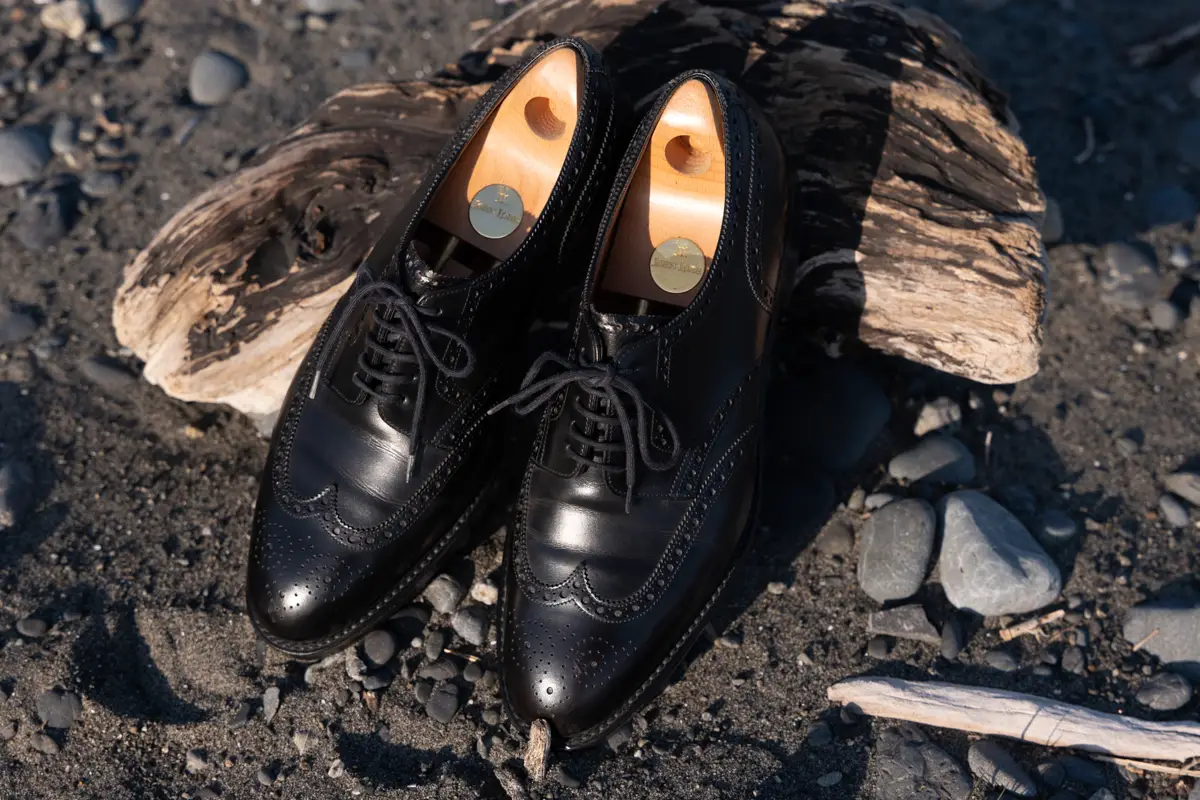
Introducing the John Lobb Darby — a masterpiece that faithfully inherits the standards of traditional English footwear. When one envisions an English “Derby,” it is precisely this silhouette that often comes to mind. With its full brogue detailing, open lacing (derby), and robust double sole, it remains the most orthodox expression of the genre.
While its appearance is rugged and stalwart, the Darby is elevated by John Lobb’s unparalleled craftsmanship and the quintessentially British philosophy of shoemaking. Utilizing the world’s finest calfskin — a hallmark of the brand’s heritage under the Hermès group — this shoe achieves a rare harmony: it is universally sophisticated yet built with a tenacity that lasts a lifetime.
The Catalyst: A Reunion with Kiton
The impetus for my recent article on the Tie Your Tie Kiton suit actually began with this pair. In preparing to photograph the Darby, I reached into the depths of my closet for a suit that had long been resting: the Kiton. Putting it on again sparked a realization.
Like the suit, this Darby had been tucked away ever since I stepped back from wearing formal attire. However, after rediscovering the joy of wearing my Barros in a more casual context, I felt a rekindled desire to walk again in my Darby and Chambord. It has inspired me to once again embrace the art of coordination, bringing suits and jackets back into my daily life.
Reflections: Beyond Consumption
Reflecting on the memories associated with the Tie Your Tie suit while preparing this footwear chronicle was a fascinating exercise in time travel. The passing years have revealed layers of meaning I hadn’t noticed before. Although the suit article was published first for clarity, it was the Darby that truly set this journey in motion.
A pair of John Lobb shoes is a significant investment, yet if cared for with devotion, they truly serve for a lifetime. To wear them long-term is to understand the essence of value; it is an invitation to experience the depth of European and British culture.
The Heritage: A Lost Icon
Authentic English shoes offer a tangible gateway to the British ethos of “cherishing things for a long time”. My own pair belongs to the classic John Lobb line — a “Derby” with its roots in the rugged lifestyle of the Country Gentleman.
Though it possesses a masculine allure born from practical necessity, this traditional Darby has sadly been discontinued and is no longer available for purchase. It remains a vestige of a golden era of shoemaking.

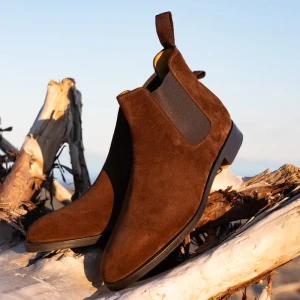
Barros’s article
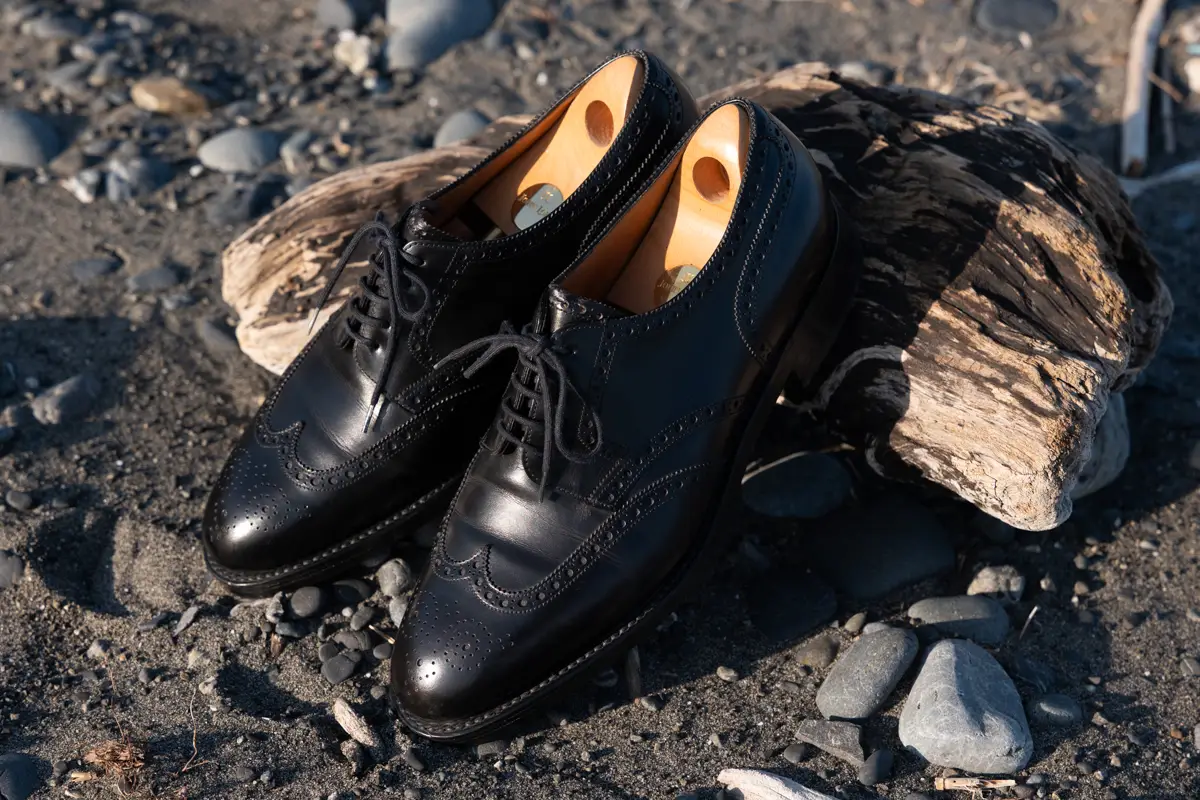
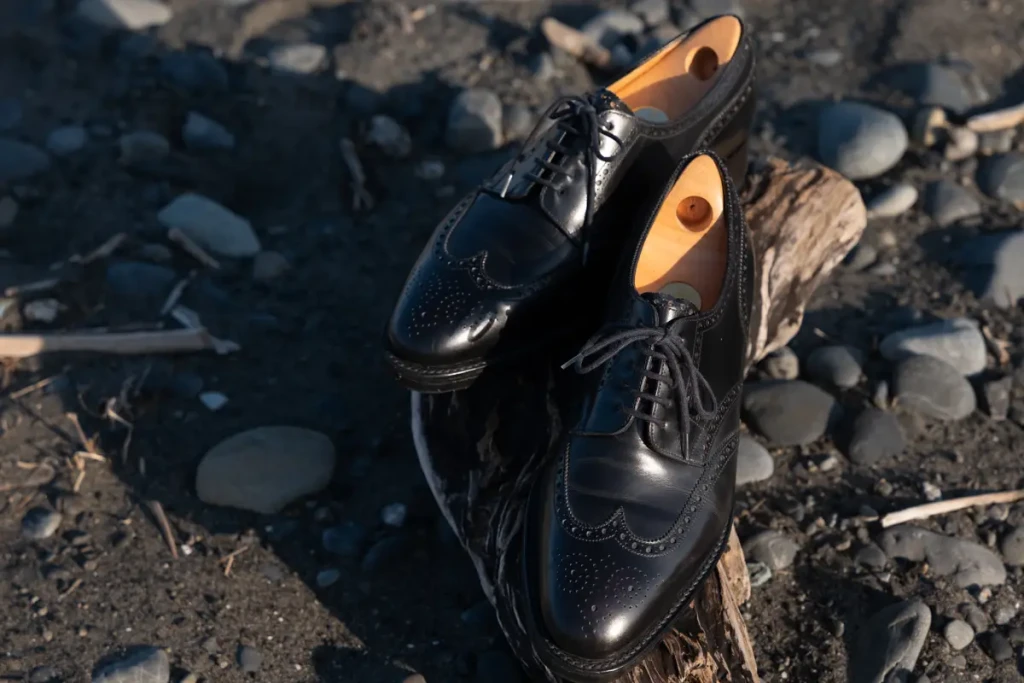
The toe features the gracefully sharp round-toe profile that was the hallmark of 1990s shoe design.
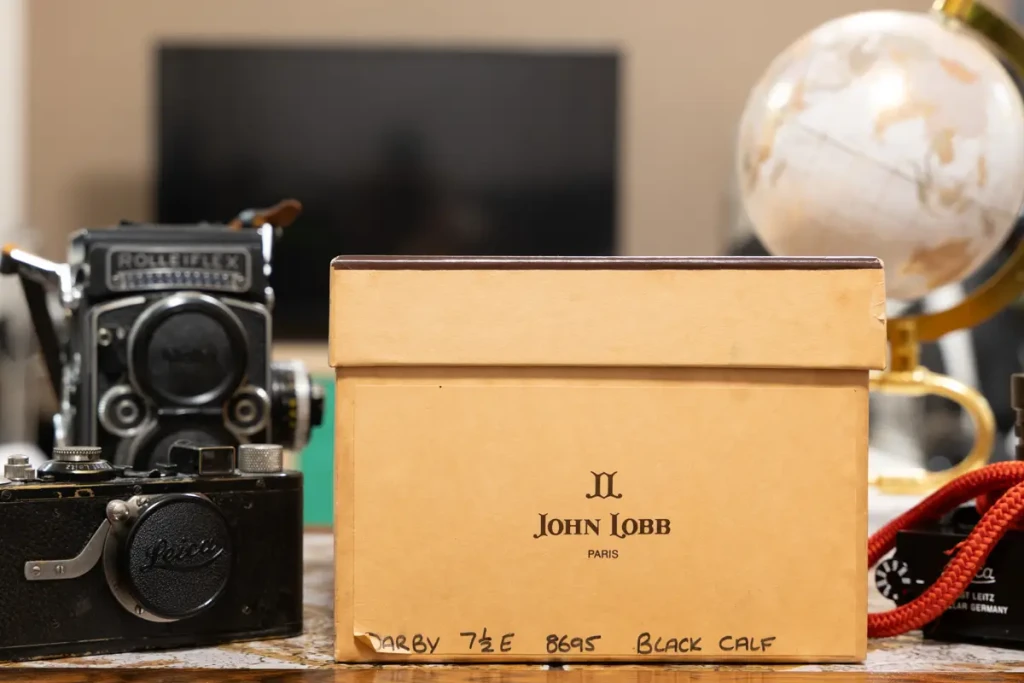
An authentic shoebox from the 1990s to the mid-2000s. The model name, size, last, color, and leather type are all handwritten in marker—a charming vestige of the artisanal, small-batch spirit that defined the London bespoke workshops before the era of mass production.
Introduction.
I purchased my John Lobb shoes 25 years ago and at one point rotated between three pairs. However, when I stopped wearing suits daily, opportunities to wear them diminished. Recently, due to a change in my mindset, I’ve gradually begun wearing them again.
At the time of purchase, I didn’t fully grasp the shop assistant’s claim that they were shoes for life. Yet, 25 years on, I truly understand what they meant by “a pair for life”.
This brand embodies a philosophy of what truly constitutes a fine product – encompassing not only robust construction but also timeless, enduring design.
The meticulous craftsmanship and decades of accumulated expertise mean that, with wear, the shoes gradually mould to the wearer, becoming an extension of the body. One can personally experience the legendary notion that once John Lobb shoes have been broken in, they become utterly indispensable.
At first glance, the design appears simply well-made, lacking ostentatious flair. Yet when worn, their intrinsic quality emerges naturally – true masterpieces backed by history.
The three pairs of Derby shoes I cherish are now discontinued, making new purchases impossible. It’s also regrettable that, with the changing times, John Lobb has discontinued the double-soled Derby itself.
In the past, I would only wear John Lobb shoes with a suit or blazer style. However, as I’ve grown older and become less constrained by such particulars, I’ve started wearing them again.
As I shall detail in another article, I recently purchased a pair of John Lobb Lawry boots for the first time in 25 years. The customer service at the Marunouchi store where I bought them was precisely the kind of personal, old-school shoemaker’s workshop experience I remember.
The service and attention were truly excellent. I also had the shoes I bought 25 years ago serviced, and they even fitted rubber soles to the leather ones – something I would never have considered back then.
In my youth, I held rather fundamentalist views and would never have considered rubber soles. However, leather soles have a significant drawback: they become extremely slippery on surfaces like marble floors, causing me to nearly fall on numerous occasions. Addressing such shortcomings is part of the shoemaker ethos that continues to be upheld by John Lobb today.
The Double Sole: A Foundation of Utility
My personal collection of John Lobb footwear is defined by a singular preference: the double sole with open lacing. While a single sole is traditionally favored for its lightness, elegance, and superior flex in formal settings, the double sole offers a different kind of merit.
Though arguably more rugged, the thicker, stiffer sole excels during extended periods of walking. It shields the foot from uneven terrain and, much like a pendulum, its deliberate weight assists the gait, significantly reducing fatigue. For me, the appeal lies in this “tool-like” reliability—a functional beauty akin to high-quality workwear.
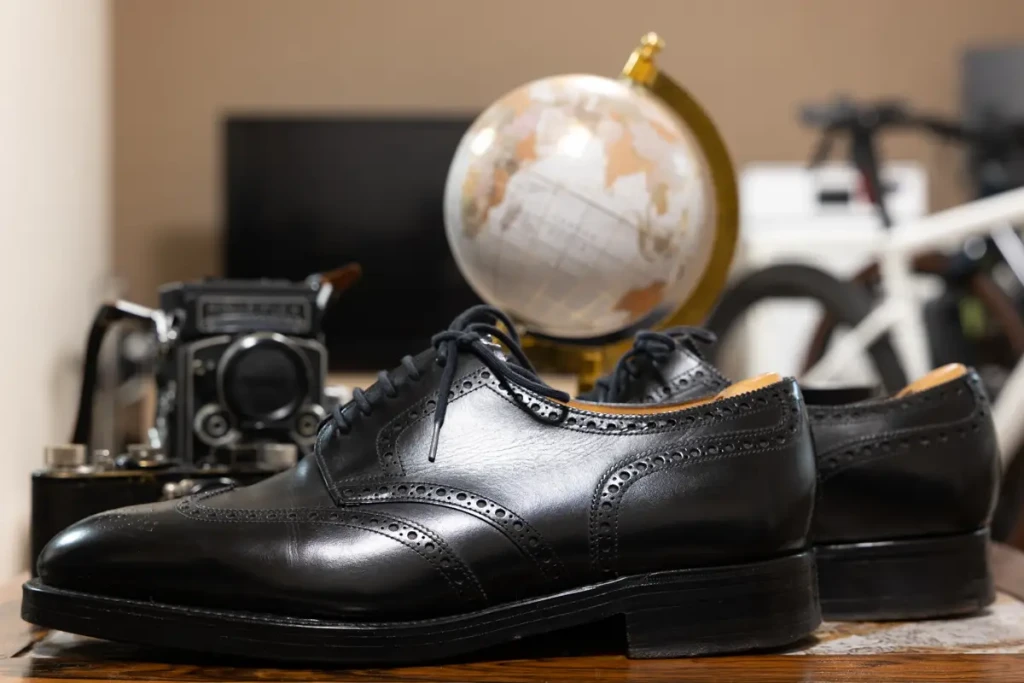
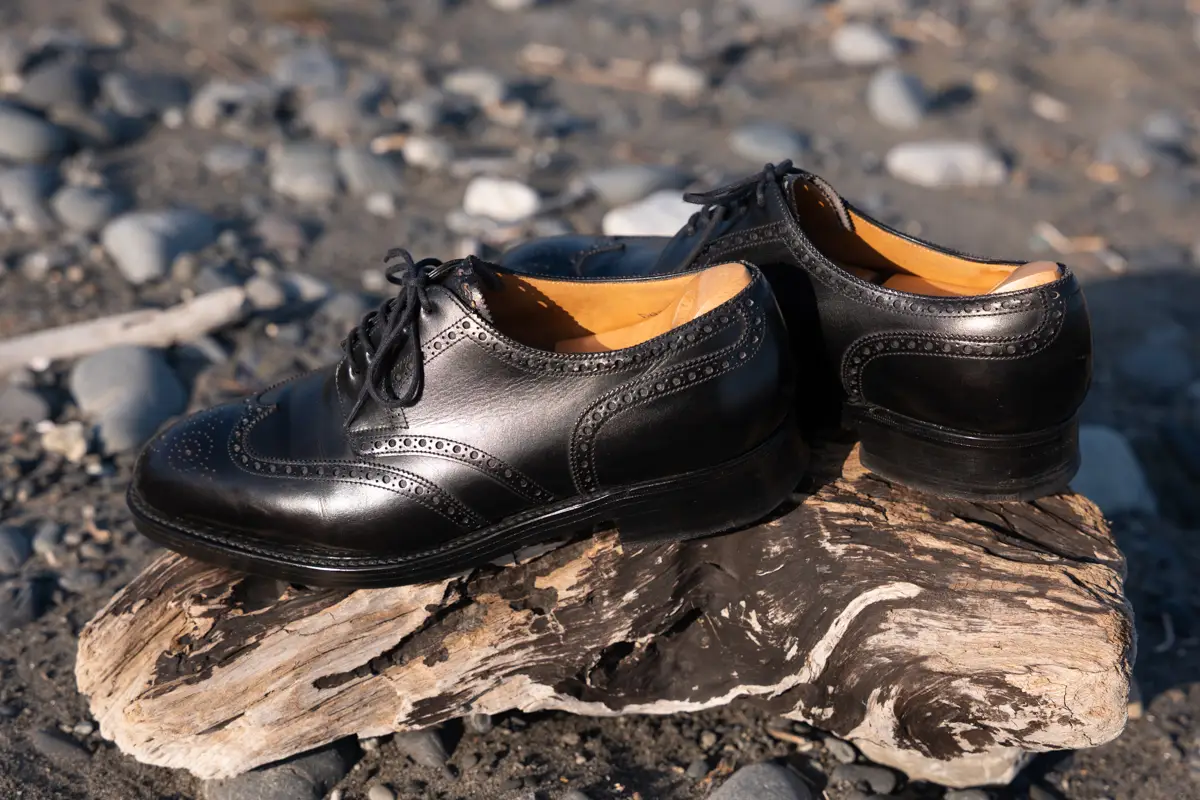
A clear view of the substantial double leather sole. Rooted in military utility and later evolved for hunting, this double-layered construction was originally designed to protect the wearer’s feet on the rugged, unpaved terrain of the English countryside.
Open Lacing (Derby): A Choice of Practicality
My personal preference has always leaned toward the Derby (open lacing), and as a result, the majority of my leather shoes share this construction. The initial reasoning was simple: an Oxford is designed to be worn with the eyelet tabs (the “wings”) closed perfectly flush against one another. When I first considered a pair of John Lobb shoes, I harbored a concern that an Oxford might not close as elegantly on my feet as intended. Combined with the inherent ease of slipping Derbies on and off, this led me to my current path.
The Maturity of the Last: A Realization Over Time
However, after decades of walking in these Derbies, I have arrived at a new understanding. I now suspect that even an Oxford, once seasoned over many years, would gradually conform to the wearer’s anatomy, allowing those once-gaping tabs to settle into a perfect, flush closure. Indeed, my three pairs of Derbies now close far more beautifully than they did on the day of purchase.
The Longevity of John Lobb
A pair of John Lobb shoes is built for extraordinary longevity. Through years of wear, the leather insole subtly compresses to mirror the foot’s contours, while the upper leather achieves a seasoned suppleness, eventually becoming a natural extension of the wearer. With this in mind, I no longer believe an Oxford is “unsuitable” for me. Should the occasion arise, I find myself increasingly eager to experience the refined embrace of a John Lobb Oxford.
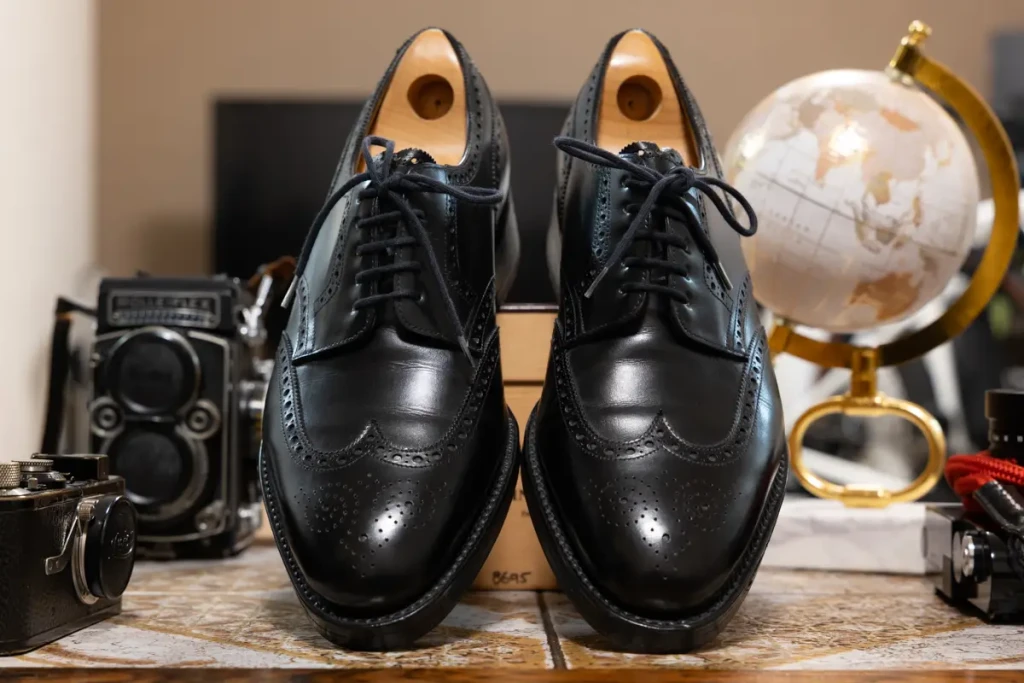
Defined by “open lacing” (Derby), where the eyelet tabs are sewn on top of the vamp. Unlike the “closed lacing” (Oxford) where the tabs are integrated into the shoe’s body, the Derby construction offers superior ease of entry and allows for more nuanced adjustments to the fit across the instep.
Editorial Note: As the industry shifts toward “comfort” and softer constructions, traditional double-sole Derbies are becoming a rarity. John Lobb has phased out double-sole leather options from its ready-to-wear lineup, now offering only the long-nosed Manchester or the casual Smith. Today, securing a classic leather double sole requires the By Requestservice.
Full Brogue: The Heritage of the “Wingtip”
To those who came of age during the fashion movements of the 1980s and 90s, the term “Full Brogue” is perhaps more familiarly known as the Wingtip. The distinctive “W” shape created by the additional layer of leather at the toe, adorned with decorative perforations (perforations), defines this aesthetic. It is a look that balances ornamentation with a historical sense of purpose.
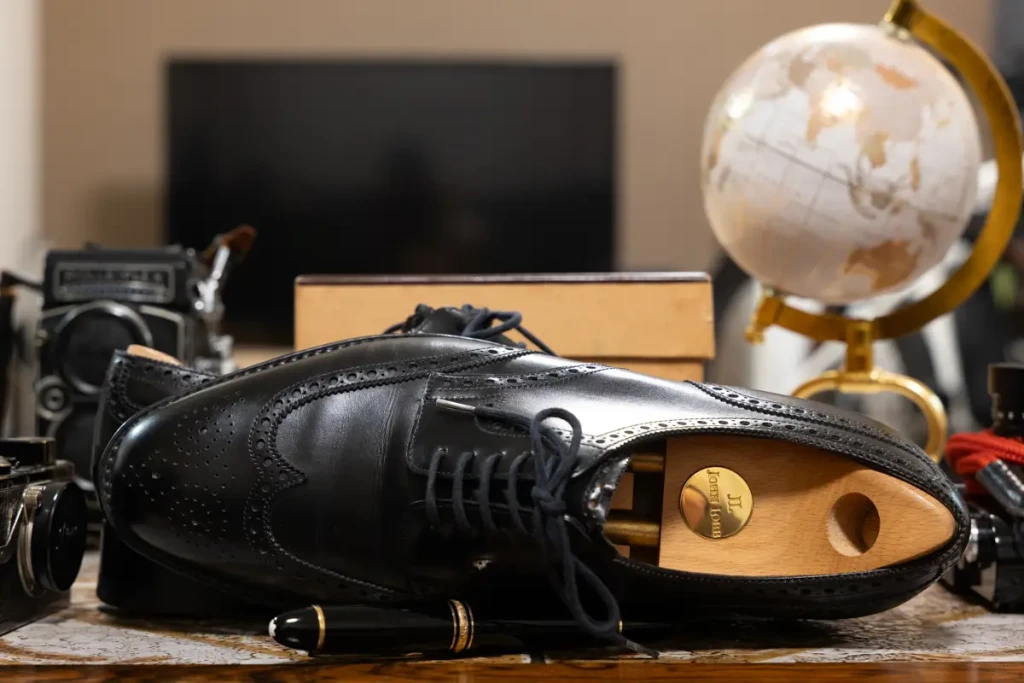
Often referred to as a “wingtip,” this style features an additional layer of leather at the toe and heel, forming a distinctive “W” shape. While the extensive perforations are purely decorative today, they originated as a functional means to improve water drainage and protect the foot during inclement weather.
Versatility: Conquering the Elements
Rooted in the functional requirements of hunting boots, the Darby is inherently resilient against the weather. Its multi-layered construction—double soles, reinforced toe and heel caps, and protective broguing—makes it remarkably water-resistant.
My 25-year-old pair has weathered countless storms. The key to its longevity lies in the maintenance ritual:
- Remove laces immediately after exposure to rain.
- Stuff the interior with newspaper or parchment paper to absorb moisture.
- Wipe the exterior thoroughly and wrap the entire shoe in paper.
- Lean the shoes against a wall with the heels down for natural air-drying.
- Once dry, apply John Lobb’s proprietary cream to restore essential oils.
While I generally avoid rain to preserve the leather’s pristine condition, this robust construction has allowed my Darby to survive even torrential downpours without losing its shape or integrity.
A Note on Color: Black calfskin is exceptionally forgiving; unlike brown suede or calf (such as my Barrosor Berlutimodels), it rarely shows water spots. However, one must always remember that leather soles are treacherous on wet surfaces—treading carefully or adding a rubber half-sole is highly recommended.
Styling the Darby: A Study in Contrast
The Darby is a master of adaptation. In the accompanying photographs, I have paired it with a 20-year-old Kiton Glen check suit in dark navy. While the suit’s silhouette is more relaxed than modern trends dictate, the combination creates an undeniably powerful, classic aesthetic.
Surprisingly, the Darby also complements more formal ensembles. Even when paired with my most structured suit—a navy Brioni Brunico in Super 160s—the Darby holds its own. While a plain dark tie and white dress shirt might feel slightly unbalanced, switching to an Oxford cloth shirt with a regimental tie, or a sax-blue shirt with a yellow madder tie, creates a sophisticated interplay. The Darby’s functional form softens the austerity of the Brioni, introducing a refined sense of “play.”
Whether paired with the soft tailoring of Neapolitan masters like Kiton and Attolini, or the traditional lines of British and American icons (Brooks Brothers, Ralph Lauren), the Darby remains peerless. For those who find the “Italian Way” of brown shoes too ornate, the stoic presence of a black English Derby offers a perfect, grounded counterpoint.
Wearing example.
A Study in Classic Proportions
For these visual examples, I have paired the Darby with the Tie Your Tie special-order Kiton suit, purchased twenty years ago. Given the era of its construction, the suit features a more generous, relaxed silhouette compared to modern, slim-fitting trends. This inherent ease in the tailoring finds a natural ally in the rugged, steadfast form of the Derby, creating a balanced and undeniably classic aesthetic.
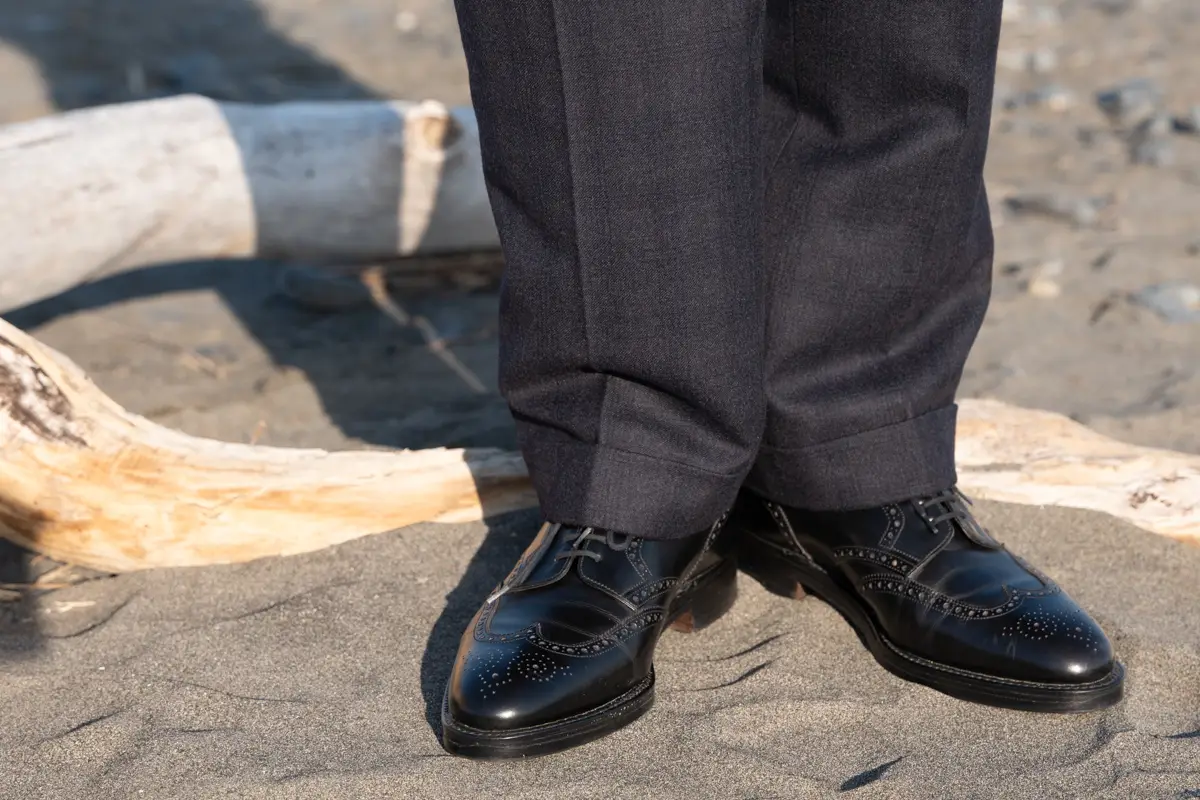
The timeless character of the full-brogue Derby makes it a peerless companion for a classic, structured suit.
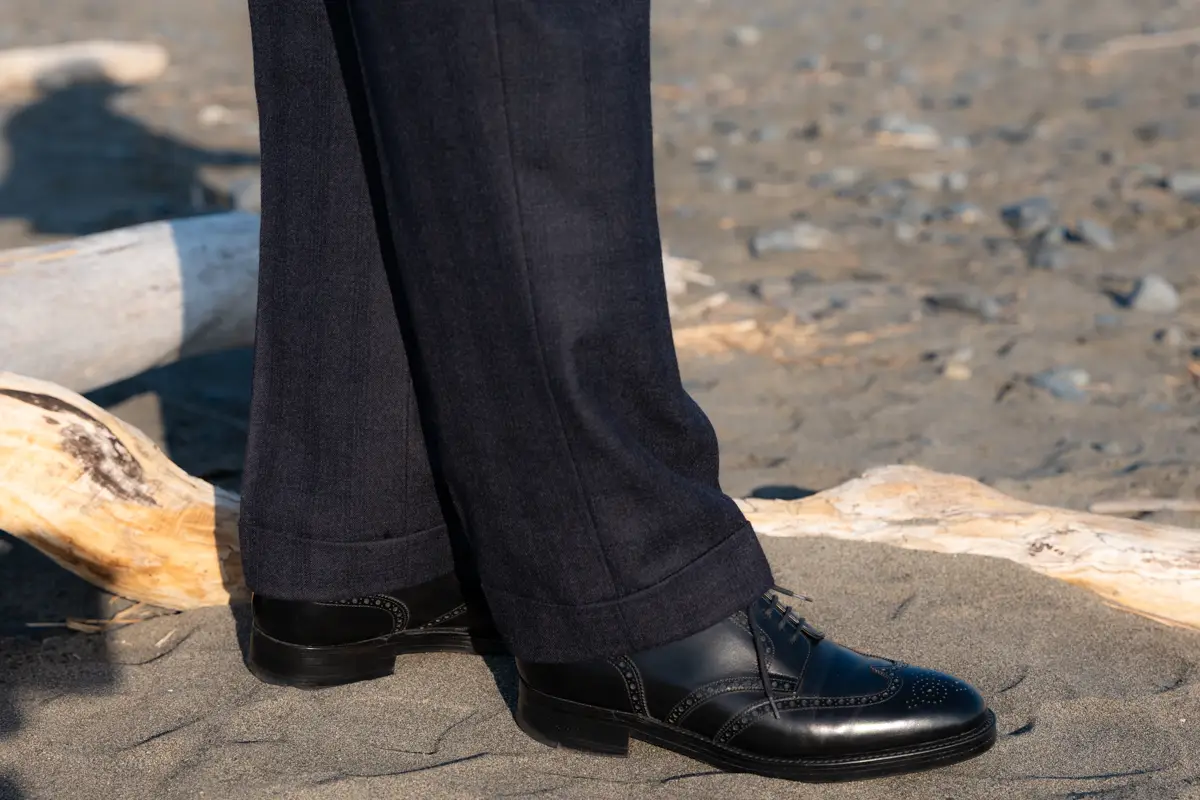
Even when paired with a twenty-year-old suit featuring a slightly wider hem, the sheer visual weight and gravitas of the shoe’s construction maintain a perfect sartorial balance.

While the thickness of the double sole is prominent, it is harmonized by the elegant silhouette of the instep, ensuring the profile remains sophisticated rather than bulky.

The Darby provides a grounded, substantial foundation that perfectly balances the fuller, more relaxed silhouette of classic trousers.
Darby
- Last 8695
- Colour: Black
- Leather: Calfskin
- Sole: Double sole
- Size: 7½ E width
Outfit
Tie: Tie Your Tie original
Shoes: John Lobb Darby
Suit: Kiton (Tie Your Tie special order)
Shirt: Tie Your Tie original
In conclusion
A Bridge Between Eras
Revisiting the John Lobb Darby after years of rest in my closet has been a profound experience. Despite the gaps in its wear, this pair has been a companion for over twenty-five years. Its steadfast construction and universal design allow it to bridge the decades; even with nearly thirty years of history, it settles into the landscape of modern masculine style without the slightest hint of dissonance.
The Genealogy of Form
The lineage of the Derby, evolving from military utility to the rugged elegance of British country life, mirrors the evolution of the suit itself, which traces its roots back to uniforms. It is therefore no surprise that the two find such natural harmony when paired together. The Darby’s inherent functionality and robustness are quintessential symbols of the British ethos — a philosophy that cherishes longevity. To truly embrace and wear such a piece is to experience the profound reality of a craft that only deepens with time.
Beyond Consumption: The True Meaning of Luxury
In today’s landscape of informational saturation, houses like John Lobb and Berluti are often categorized merely as “luxury brands,” subjected to the same cycle of fleeting consumption as anything else. However, these are not mere status symbols to be consumed; they are enduring vessels of value.
By walking alongside such shoes through the greater part of one’s life — and through the meditative ritual of their care — one attains a value that far transcends the initial price.
Final Reflections
Slipping into these Derbies once more after twenty-five years has reaffirmed a vital truth: true luxury possesses a value entirely distinct from the disposable nature of modern commerce. This pair stands as a living testament to the central theme of this site — “Things to love for a long time”.
Shop
I purchased the Derby shoes featured here at the John Lobb Aoyama flagship store.
As I mentioned in a previous post, the store has relocated to Marunouchi.
I’ve written about the shop in my posts on Barros and Lawry, so please refer to those.