
A comment from a younger colleague — “wouldn’t it be great to wear Dior at sixty?” — sent me out to buy a few Dior pieces, and I’ve been enjoying styling that sits outside what I’d normally wear.
[ The Dior Cashmere Peacoat piece ]
My image of Dior is shaped by what Hedi Slimane built there in the 2000s — what amounts to the ultimate minimalism: slim silhouettes stripped of ornament, in a palette of black, gray, navy, and white.
Today’s Dior runs collections with a range that goes well beyond the minimalism that once defined it. Within that range, I want to introduce a pair of slim-fit black jeans that sits close to the Dior I remember from those years.
Slim black jeans were what every long-haired member of the band I played in during my teens wore. I never felt at ease in black clothing, though, so I was the one who stuck with blue jeans — mine ripped at the knee. The slim black jeans of the time were, if I remember right, the Levi’s 606, the model people called “Super Slim.”
Even now, slim black jeans aren’t something I gravitate toward, but thinking through what to wear with them — the layers above and below — they pull a look together with real style.
Rock fashion
Rock-inspired pieces are a recurring theme in the world of mode.
It probably wasn’t until the 2000s that rock-inspired pieces came to be treated as fashion. Back in the 1980s, when I was a teenager, that look had nothing to do with being stylish.
Bleached, long hair, a band tee, and slim black jeans — at the time that combination got tagged with the word hebimeta (a clipped, slightly sneering way of saying “heavy metal”), and anyone who wasn’t a musician or a kid who loved heavy metal looked at us with open curiosity.
Those of us actually in bands called it “metal,” and we wrote off the people who used the more dismissive hebimeta as outsiders who didn’t know the real thing. (Looking back now, that was just a healthy dose of teenage defiance.)
This style traces back to what’s known as the NWOBHM — the New Wave of British Heavy Metal — a look that grew naturally out of bands like Iron Maiden and Motörhead, names still respected today, together with the audiences around them.
In the mid-1980s, American heavy metal bands that came to be called “LA metal” rose to prominence, and their look — bleached-blond, teased-out long hair, cut-off tees, bleached and ripped jeans — left its mark on the young metal fans and musicians of the time too.
That same look went mainstream in the 2000s, riding the crash-denim boom that Dolce & Gabbana helped popularize.
Rock fashion among Japanese youth in the 1980s wasn’t nearly as varied as it is now — it came down to either heavy metal, with long hair and slim black jeans, or punk (hardcore), with army pants, safety boots, and hair spiked up or shaved into a mohawk.
These looks have since become mainstream, read now more as streetwear than as anything tied to rock — but at the time, wearing them meant getting looked at sideways by everyone around you. (That’s where rock starts for any kid. Though back then, it made finding a part-time job a real headache.)
Dior’s Slim-fit Jeans
These are the slim-fit black jeans that carry that rock-leaning image. The same cut also comes in indigo blue and a washed light gray.
Being a contemporary take on slim-fit jeans, they’re built throughout with small adjustments that make them easier to wear.
- “Medium rise” — In the Hedi Slimane years these sat low on the hip; today’s Dior cuts the rise deeper, for ease of wear. (In the early years black wasn’t even offered — the lineup was close to rigid denim only.)
- “A touch of stretch” — The Slimane-era denim was 100% cotton; today’s version blends in a little stretch, at 98% cotton and 2% elastodiene.
My guess is that the current slim-fit shape took form when Kris Van Assche reworked Slimane’s original silhouette into something more wearable. (I wasn’t paying attention to Dior during that period, so this is speculation on my part.)
The slim-fit black jeans are garment-dyed — dyed after construction rather than woven from pre-dyed thread — a method built less for denim-style fading and more for keeping the color enjoyable over the long run.
1. Garment-Dyeing
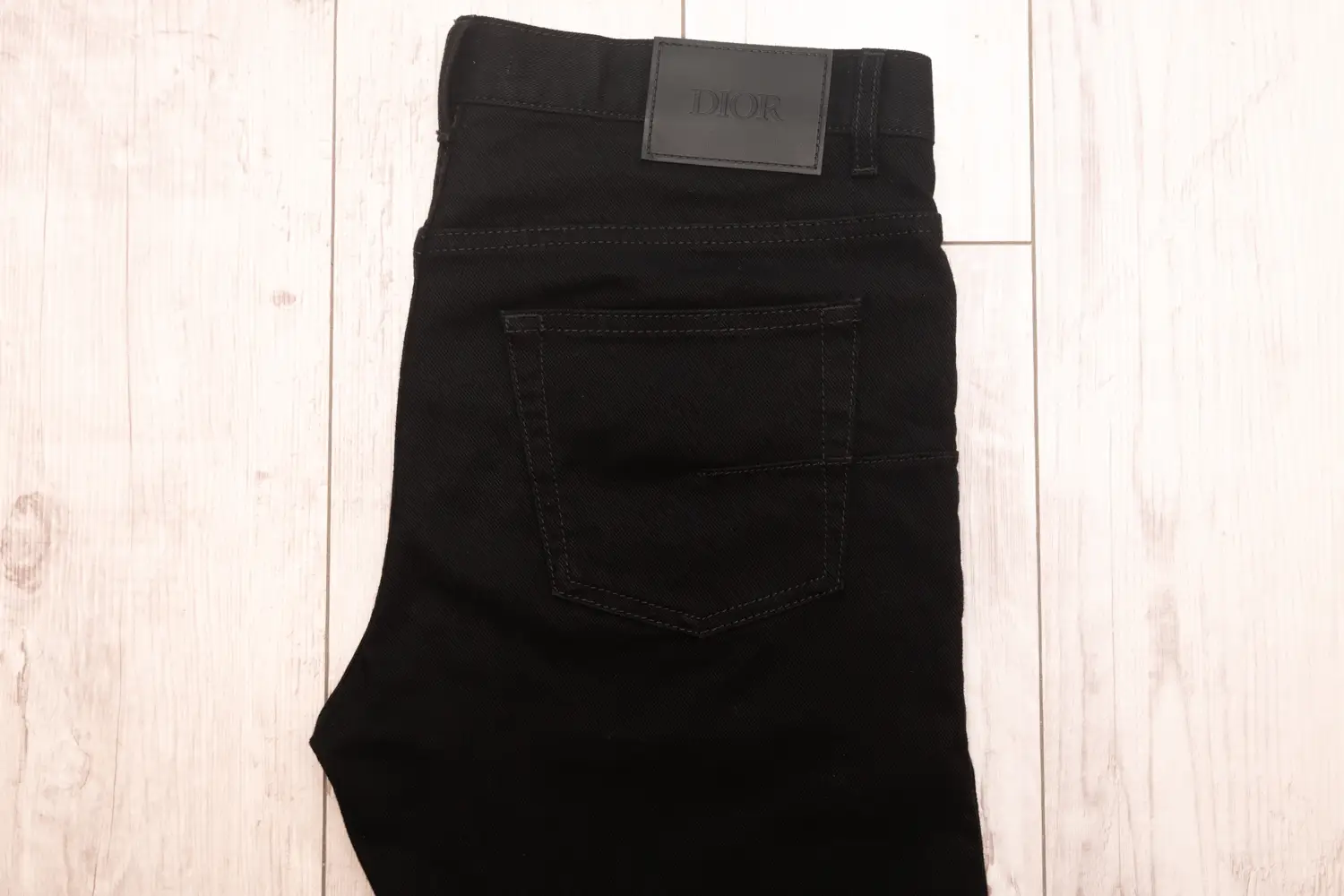
These are deep, garment-dyed black jeans. They read as slim, but the rise sits deep and there’s a measured ease through the hips, so when worn they fall into soft creases that make the silhouette look good.
2. Button Fly
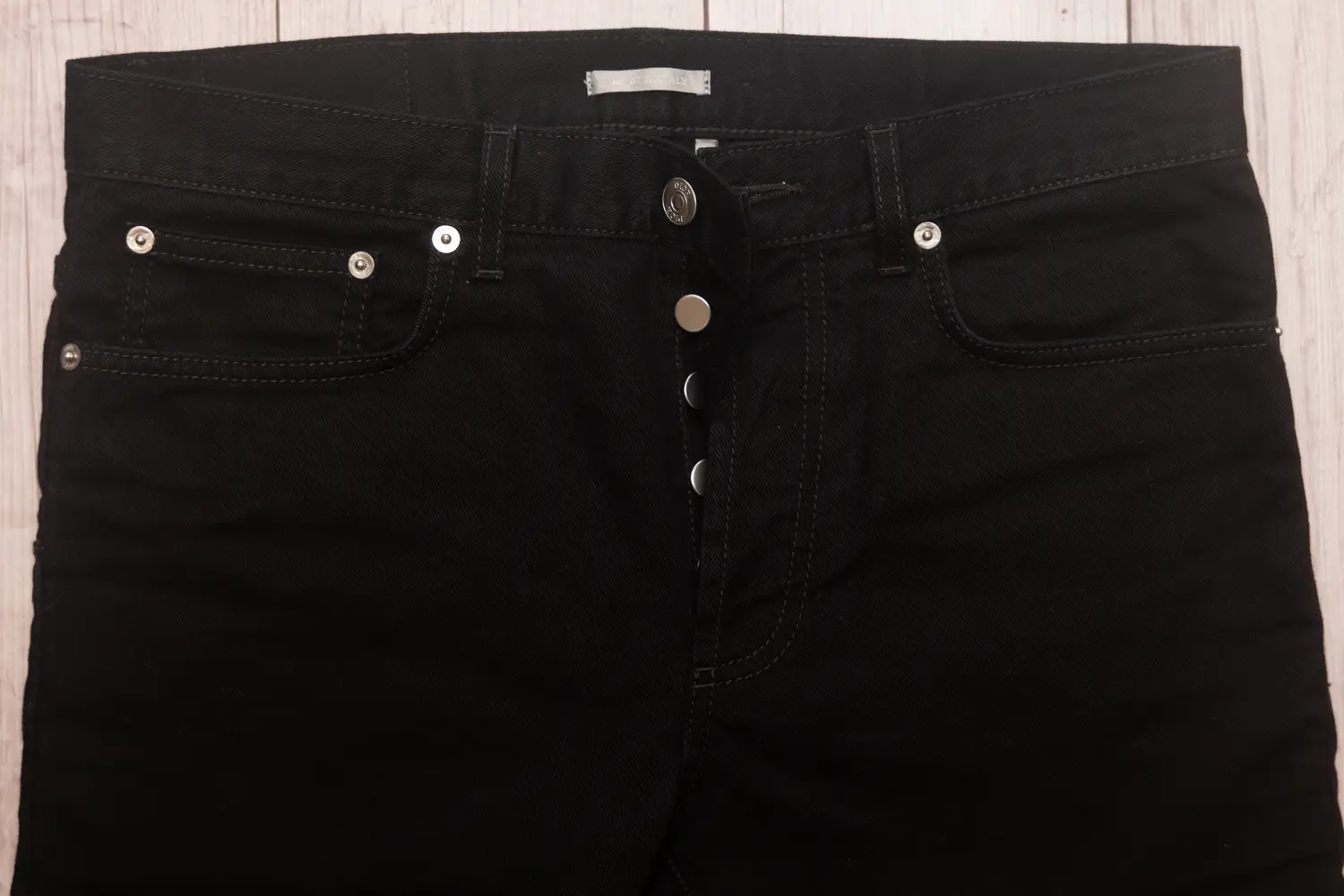
The front closes with a five-button fly. Every button is finished in silver, reinforcing the achromatic image. Keeping the front opening short makes the deep rise read as a low rise — a small trick that lengthens the line of the leg.
3. Rivets
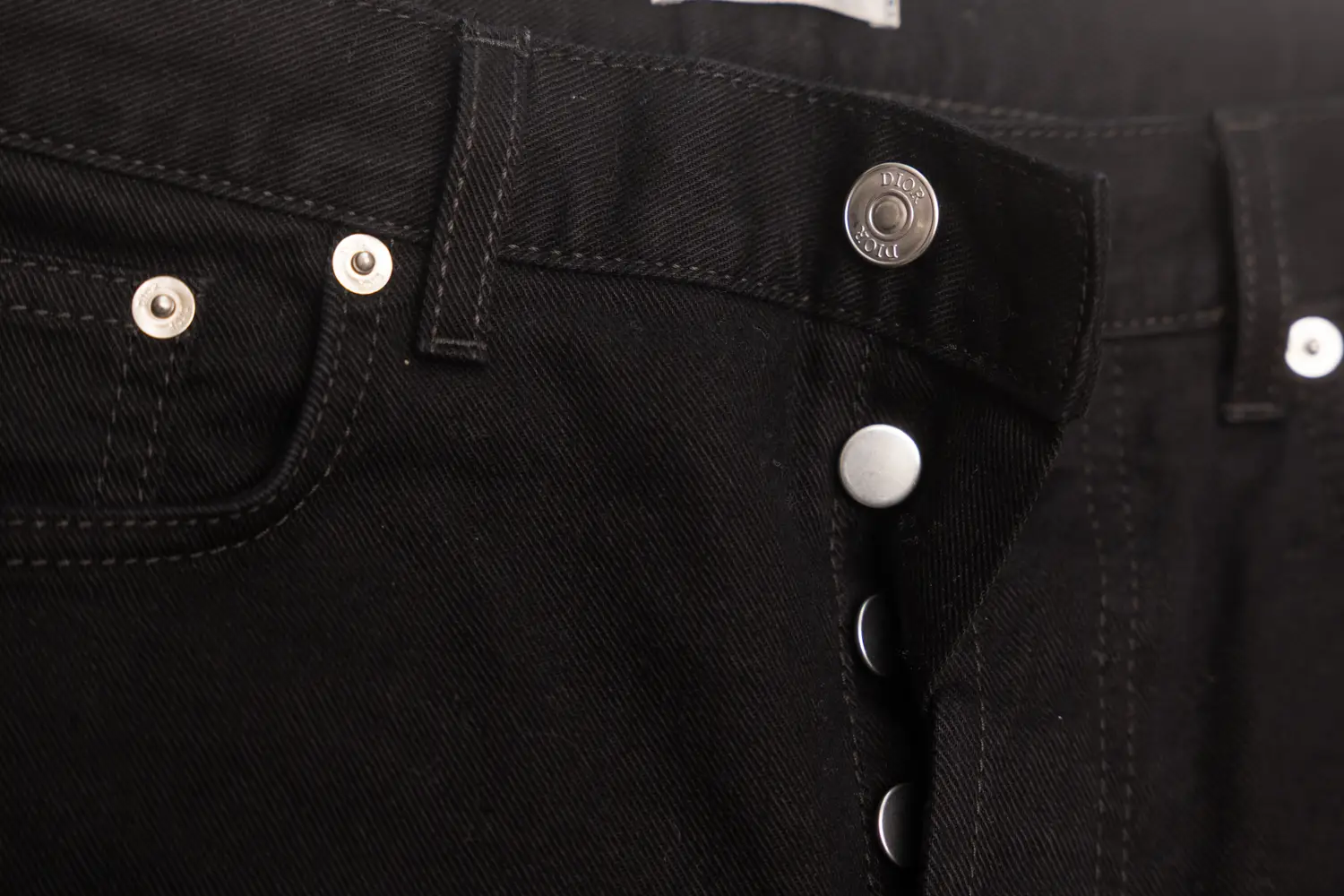
The logo appears only on the top button. That restraint reflects the minimalism that’s so much a part of Dior. Even on a pair of jeans, the stitching is handled with care — and it’s this kind of attention to small details that marks the standards of a top maison reigning over the Paris collections.
Minimalism
Decluttering
Minimalism, in the sense the word carries here, is close to danshari — clearing away what isn’t needed. The style Hedi Slimane proposed at Dior carried this kind of minimalism through to the letter. I’m drawn to the concept itself, and I gravitate toward clothes that carry no sense of ornament.
This isn’t unique to Dior — menswear in general has evolved out of uniforms and workwear, so it carries at least some element of minimalism by nature. That said, minimalism that starts to work against function or purpose defeats its own point.
The white tee is probably the clearest example of minimalism in menswear. It comes down to the bare minimum of construction — neck, sleeves, body — an unadorned crewneck in white, made up of the fewest elements a person could wear.
It started life as underwear, but it’s since evolved into many forms and is now worn widely through the spring and summer seasons.
Even within today’s more diverse Dior collections, the style-driven, slim, mode-leaning pieces still carry this minimalism through without compromise.
Achromatic
Achromatic means without color — built from black, white, and the grays between. This achromatic quality plays a large part in shaping Dior’s minimalism. In the current collections it’s limited to certain pieces, but the style built on black with white as its only counterpoint is still alive. The refined silhouettes and the way that world of minimalism comes through are something no other brand quite manages to copy.
I like the concept of minimalism, but I’ve never been comfortable in the black-based clothing that makes up achromatic style, and I’d never taken much interest in Dior’s black-based collections.
The black cashmere peacoat I bought this past winter changed that — it had real impact on how I’d thought about this until now. The slim-fit jeans I’m introducing here are what I bought alongside that peacoat.
Combination
Because Dior’s slim-fit jeans are so thoroughly minimalist and achromatic, they’re particular about what they’re worn with. As I noted in the cashmere peacoat piece, that difficulty of pairing is itself characteristic of Dior’s clothing.
A Fitted Tee
Even with a white tee, a loose fit makes the pairing difficult, so I reach for one that fits close to the body. Finding a tight-fitting tee in an era when loose fits dominate isn’t easy, but Tom Ford’s underwear line meets that condition.
For the base layer I chose a white Tom Ford undershirt, paired with a black Henley-neck tee that Tom Ford makes from viscose.
A Black Outer Layer
In winter, the natural outer layer would be a Dior piece — the black cashmere Chesterfield coat or the peacoat — but come spring and summer, nothing obvious comes to mind.
What I reach for instead is one of the few black-based outer layers I own — a black moleskin jacket from Le Mont St Michel. It’s a vintage piece from the 1930s, said to have been worn by supervisors in French factories of that era. (Line workers, the story goes, wore blue.)
The fit is judged so well, and even though it’s a workwear piece, the details on the buttons and pockets carry such an air of their own, that it could pass for something out of Margiela’s current collection — it has that same sharp, mode-edged quality.
A Tighter Size
For another option — a slightly unexpected one — I tried pairing the jeans with Boncoura’s black hooded parka from last winter. On paper, putting Boncoura, with its American-casual roots and its obsession over construction, next to Dior sounds like a stretch, but it works better than you’d expect.
For both the moleskin jacket and the Boncoura hooded parka, I went a size down from what I’d normally wear. That keeps the silhouette from breaking down when worn with Dior’s slim-fit jeans.
Suede Boots
On my feet I’m wearing Visvim’s black suede boots. A round-toe black suede Chelsea boot — something along the lines of John Lobb’s Lowry — would pair well too, but it doesn’t sit right with a hooded parka, so I went with the round-toe, work-boot-style Visvim instead.
Tom Ford’s White Tee

I’m wearing the white tee from Tom Ford’s underwear line. It’s 100% cotton, comfortable against the skin, and has just enough stretch to fit the body well.
Le Mont St Michel Moleskin Jacket

I’m pairing the jeans with the Le Mont St Michel moleskin jacket — one of the few black-based outer layers I own. It’s a 1930s French workwear piece, but the fit is judged so well that it carries a mode-like air.
Boncoura’s Hooded Parka

I’m wearing the black hooded parka Boncoura put out this past winter. On paper, this shouldn’t be a pairing that works — and yet it comes together better than I expected.