
Following the Dior button-down shirt and chino pieces, I want to introduce a denim shirt Ralph Lauren released in the 1990s — a shirt sold under the Polo Country sub-label.
[ The Dior Button-Down and Chinos piece ]
Polo Country
Polo Country was produced for only five years, from 1988 to 1993. RRL — the Ralph Lauren line that continues today — launched in 1993 and effectively absorbed what Polo Country had been doing.
RRL takes vintage garments that inspired Ralph Lauren as its starting point, releasing pieces tied to American clothing history in small runs that mass production cannot reproduce, with close attention to construction.
Polo Country, as the name suggests, centered on country-style pieces. The denim shirt I own is itself a country-style design.
RRL’s lineup functions as an archive of American clothing history. Through vintage finishes and a deliberate choice of fabrics, the pieces evoke the older America that runs from the frontier era forward.
The Polo Country shirt that preceded RRL follows the same logic. Heavy, sturdy denim — the kind a hand on an American country ranch might have worn — is given a measured vintage finish.
Because it was sold in the early 1990s, the cut reflects a different idea of styling from today: a generous body in the American sizing of that period. The proportions are remarkably well judged, and along with the design itself the shirt holds a universality that doesn’t feel dated when worn now.
Back to Basics
As I noted in the Dior piece, over the past year or so the fashion industry — the brands that orient themselves toward mode — has felt to me as though it’s circling back to origins. Within that, post-bubble pieces from the 1990s keep catching my eye.
The collections show items that read as American Trad, or as the softer Italian suiting of that era. These were the keywords of the late 1980s through the early 1990s.
The very habit of sorting fashion styles into these categories took shape between the 1980s and 1990s. (The roots run a little further back, but the vocabulary entered general use in those two decades.)
The American Trad style that took hold in Japan during the 1990s is now reappearing across a range of brands. The button-down shirt and the crease-less chinos I covered in the Dior piece read clearly as a reworking of 1990s American Trad. (Dior being Dior, the silhouette is on different footing altogether.)
Through the 2000s and 2010s, as the market expanded, fashion came to lean heavily on keywords and concepts. The current shift may be a return of attention to the wearer — to people enjoying clothes more naturally.
Ametora
The button-down-and-chinos combination would, at the time, have been filed under American Trad. As I discussed in a separate piece, the term classico italiano only entered general usage in the mid-1990s.
In my twenties, American Trad was exactly what I was drawn to, and button-down shirts with chinos were what I wore most often.
American Trad takes its cues from the Ivy League. In today’s vocabulary it sits on the cleaner end of dressing. I wanted something more relaxed in my twenties, so I left the shirt untucked over the chinos.
The button-down was the base, but the heavier weight of denim let me wear it almost as a jacket — which is why a denim shirt ended up in far more rotation than the button-downs did.
By the older categorization, denim shirts didn’t belong to American Trad. But because Ralph Lauren was making denim shirts, and because young wearers in 1990s Japan — myself among them — were using the denim shirt as a stand-in for the American Trad button-down, the style took hold. Afterward, denim shirts were absorbed into the American Trad category as well.
In the 2010s, this Japanese take on American Trad was introduced to the wider world under the name Ametora, and it found its place in the global market.
Around then, a few pieces in the overseas fashion press read along the lines of “the Japanese saved Ivy League and preppy style.”
A style native to America gets reshaped in Japan and then exported back — the parallel to Neapolitan pizza struck me as oddly fitting. (Neapolitan pizza had been quietly losing ground in Italy when Japanese cooks recognized its value, developed their own springier dough, and earned recognition by going to Naples to work in the kitchens there.)
1990s Style
Since the Polo Country denim shirt is from the early 1990s, wearing it puts you in a 1990s silhouette. What’s interesting is that thirty-some years on, it doesn’t read as dated.
As I did then, I wear it untucked over chinos. The body is wider than today’s shirts — not the oversized look that’s current now, but a measured looseness of its own.
The chinos I pair with it are Boncoura, which sit close to what we were wearing then.
Underneath, a crewneck white tee. Back then it would have been a Hanes pack tee; this time it’s a Tom Ford undershirt.
For sneakers, Stan Smiths were the choice then. This time I’m wearing a pair from Visvim built on the Converse All Star.
1. Untucked, Casual
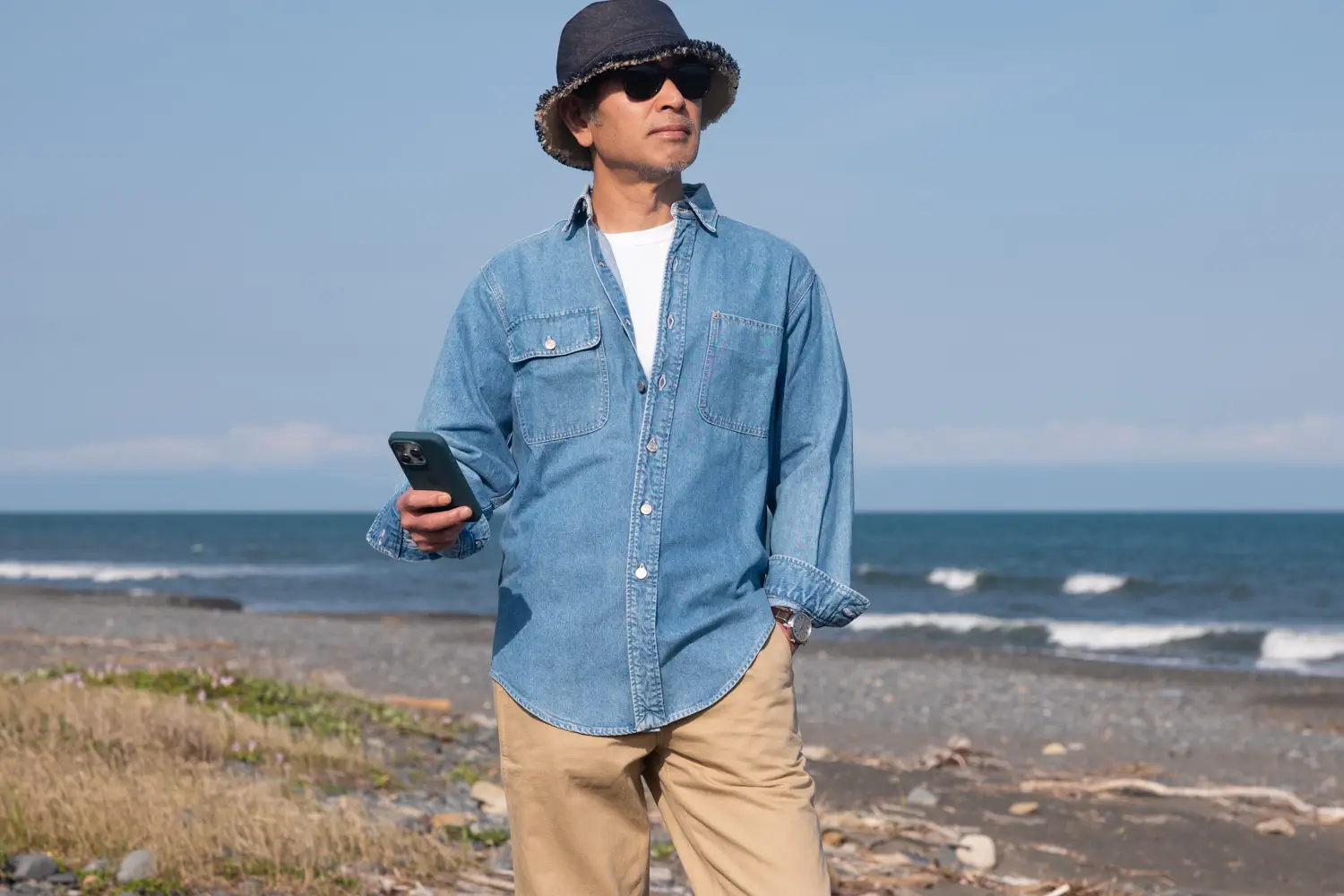
Because the denim is heavy and country in feel, buttoning the front loosely and leaving it untucked still pulls together. The overall silhouette is built to the American proportions of the period, so it wears with an easy looseness.
2. Open as a Light Jacket

For the cool stretch of early summer or early autumn, when a tee runs cold and a shirt runs warm, I leave the front open and wear it as a light jacket. If it gets hot, I tie it at the waist.
3. The Rounded Tail
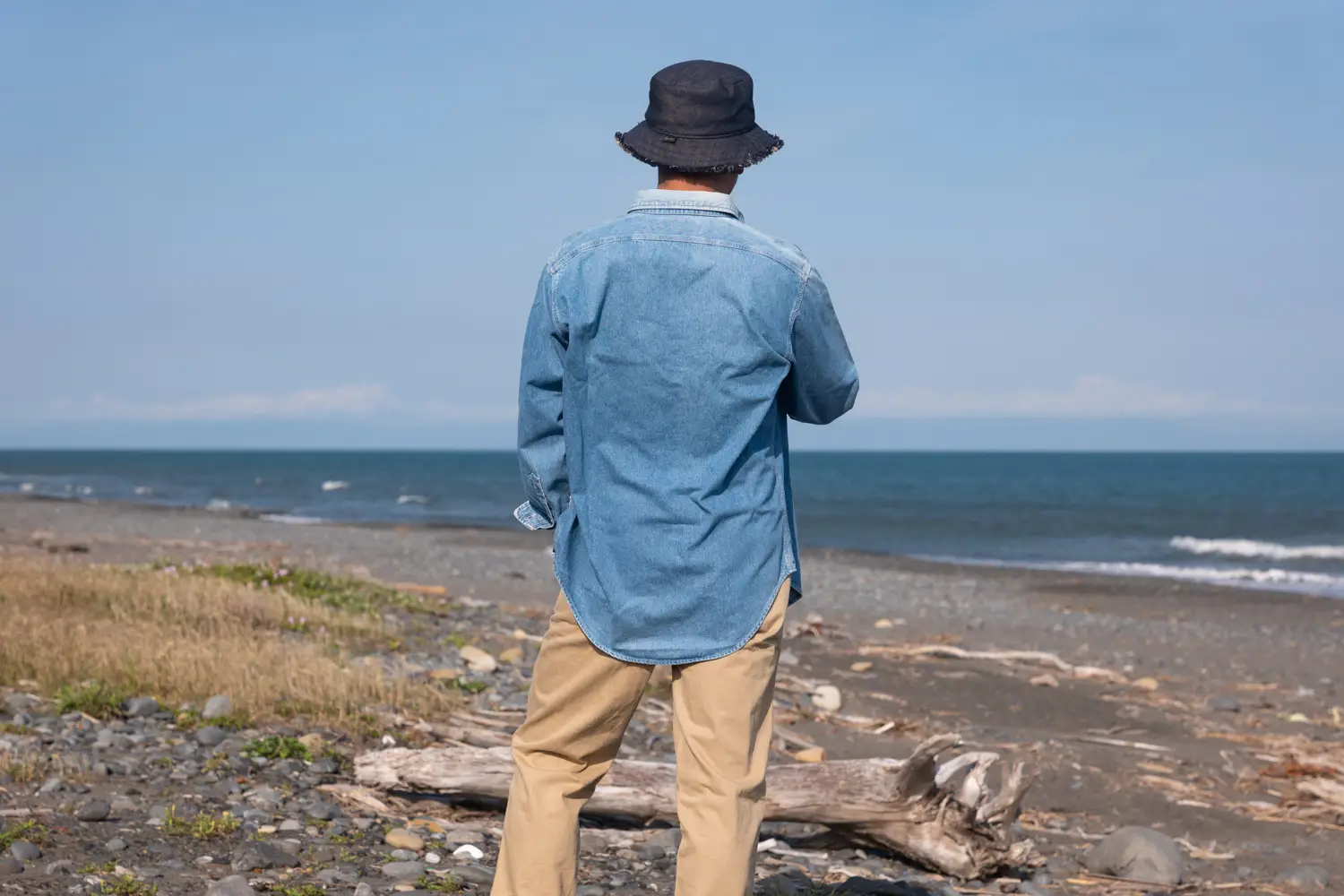
From the back, the line is the same — not built for a close fit, but for a measured ease. The rounded tail runs long with a deep curve, since wearing shirts untucked wasn’t the norm at the time.
Everyday Wear
The Ease of Not Thinking About Fashion
At the root of how I choose clothes is the idea that what I wear every day should be something I can put on without thinking. Reaching for whatever’s in front of me when I get up in the morning is the baseline of how I dress.
One reason I’m drawn to Levi’s, military pieces, and American casual more broadly — what we call amekaji in Japan — is that the wear is meant to be rough. Creases don’t matter; if something gets dirty, it goes in the wash.
American casual pieces grew out of workwear, so washing and continued use are built into the design, and the durability is high.
Because these garments were made for function first, that functional logic was what later generations came to value. And because the resulting forms read as masculine, the category settled into menswear.
American Trad follows the same logic, just at a slightly more formal register — a reflection of American clothing culture, and of an American practicality that makes it remarkably well suited to everyday wear.
What drew me to American Trad in my twenties was practical. I had started working, and even on weekends I was often around people from the office, so a shirt and chinos felt less out of place in front of older colleagues than torn denim with a sweatshirt or a tee.
Back then I wore Brooks Brothers button-downs unironed, top button open, untucked over chinos. Eventually a denim shirt — easier to handle, easier to use — took over from the button-down.
Youth Culture: Subcultures and Otaku Culture
Among the things that the younger generation noticed and made their own during the post-bubble 1990s were items that are now staples of the fashion industry — the Levi’s 501, the steel Submariner that collectors call aka-sub.
What pushed these items into broader awareness wasn’t the fashion press. It was Japanese subculture and otaku culture — terms I use here without any negative weight, since this is the same native culture now valued internationally — and the Mono Magazine-style enthusiast press that surrounded it.
Young wearers at the time chose the steel Submariner — a sports watch, not a solid-gold Rolex — and put it on with denim rather than a suit. In choosing the Rolex on their own terms, they ended up creating the trend. The phrase itten gōka shugi — one luxurious thing — was current then too, and stands as another emblem of that youth culture.
The styles that grew out of that subculture and otaku culture now feed into global trends.
The story of the aka-sub and the 501 runs forward into Japan’s distinctive evolution of American casual, which is itself now valued worldwide.
The same is true for the distinctly Japanese reading of American Trad. What put it on the global radar wasn’t the fashion industry — it was the youth culture of the time, people outside that industry.
That a street sensibility carries through, drawn in from youth culture, is what makes Japan’s American Trad its own thing — and is, I suspect, part of why brands now working in mode are looking back at it.
A Universality That Crosses Generations
Wearing a denim shirt and chinos loosely is a style that came out of young men in their twenties — me, then — dressing without overthinking it day to day.
Age inevitably changes the body’s lines, but the denim shirt and chinos of that era carry enough room to allow for the change without falling apart.
The cut goes back to the American idea that bigger is better. Even worn a little loose, the silhouette doesn’t break down — and putting it on still gives off a measured youthfulness.
As I wrote in the A-2 piece, the older American casual and American Trad templates offer one answer to dressing without looking like a tired older man. They’re worth recommending to people in my own generation.
[ A-2 Real McCoy’s — Styling ]
The Denim Shirt
Because the Polo Country denim shirt dates from the early 1990s, it was built to the standard shirt silhouette of that period. Vintage finishing wasn’t yet widespread, so the treatment is little more than a measured fade.
What stands out is the detailing: metal buttons, and two breast pockets cut to different shapes. Those details make it as easy to wear as a shirt as it is in a coverall or jean-jacket role.
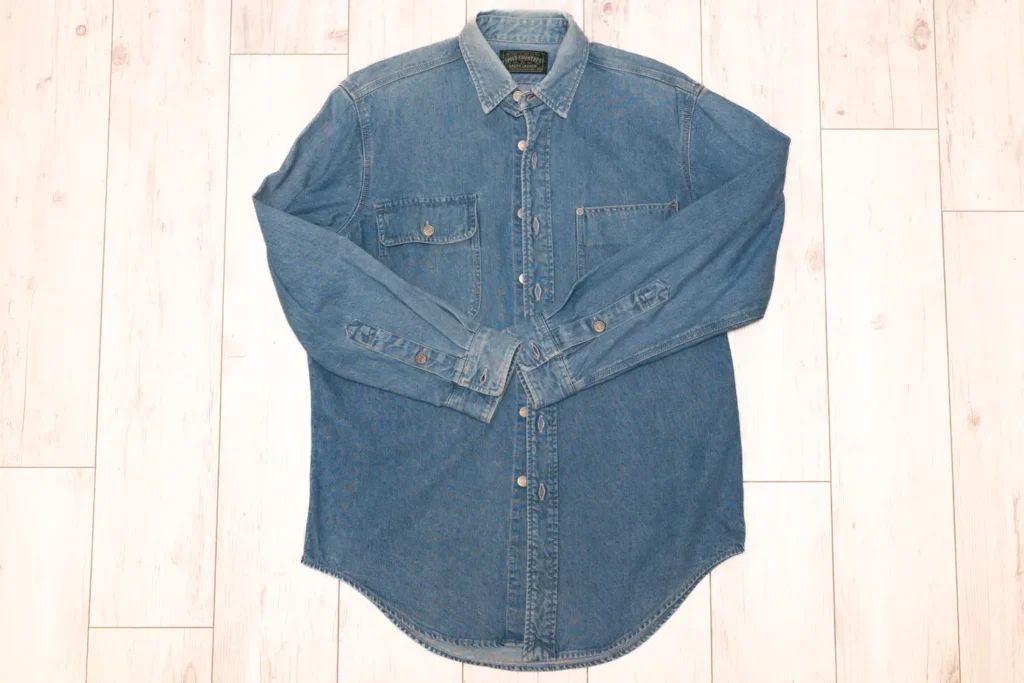
An orthodox denim shirt, but the metal buttons and the asymmetric breast pockets open up coverall and denim-jacket ways of wearing it.
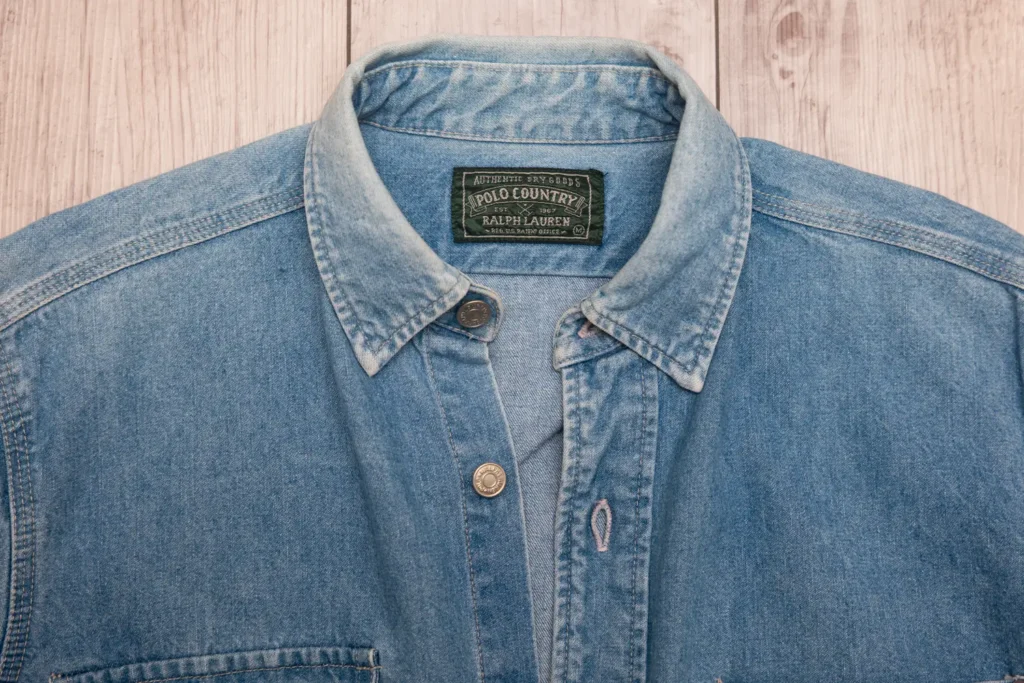
The Polo Country logo.
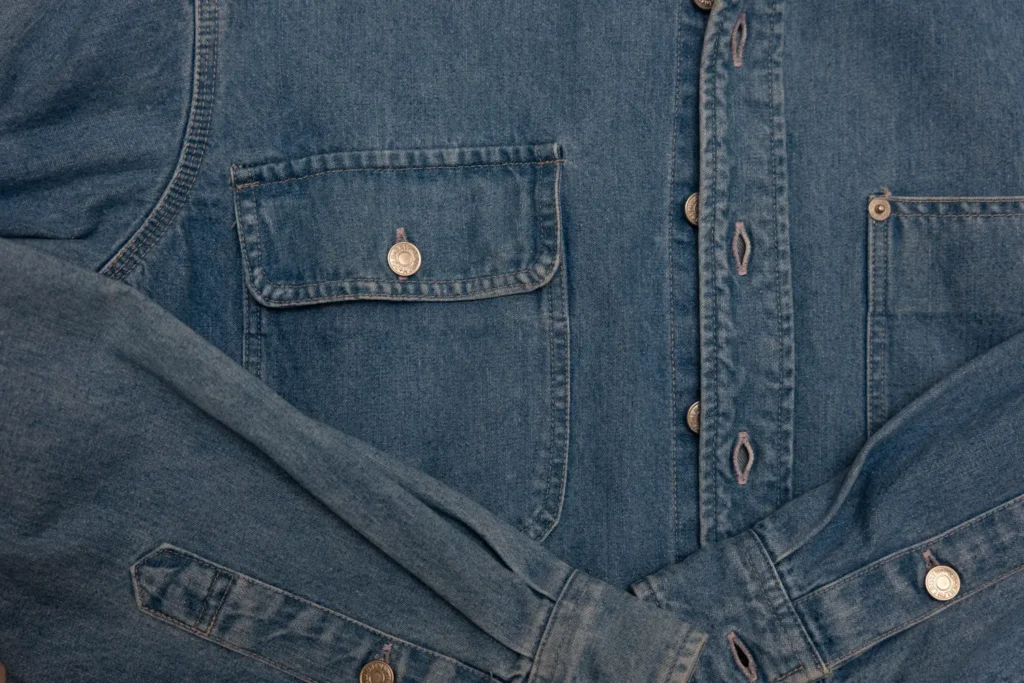
Metal buttons made for a shirt, and a finish that’s a general fade rather than a modern vintage treatment, leave room for a range of ways to wear it.