
How I Came to Choose It
Artigiano ciao
Artigiano ciao stocks vintage pieces from sartorie across Italy. The rail holds jackets and suits cut by the names you’d call masters of the craft — work that earns the word masterpiece — and I look through them for something that might fit me.
What sets the shop apart is the depth of its Naples holdings in particular. And though it all falls under the umbrella of “Naples tailoring,” each sartoria has its own style — and when you actually put a piece on, the differences become unmistakable.
Because these are bespoke pieces, unlike off-the-rack, they were cut to the previous owner’s body. The job, then, is to find one that lines up with your own.
Measurements That Match the Body
On the shop’s website, Artigiano ciao lists guide measurements for every jacket and suit they carry.
For jackets, the details run to overall length, chest, minimum chest (after intake), shoulder width, sleeve length, the position where the cuff buttons begin, and the fabric reserve folded back inside the sleeve.
For trousers, the list covers waist, waist reserve, thigh, knee, hem, rise, inseam, and — since most are finished with turn-ups — the depth of the turn-up and the fabric reserve available for lengthening.
I match the listed measurements against my own and shortlist the suits and jackets on the site that look like they could work.
Working With the Owner
From my shortlist, I talk to the owner about which pieces are likely to work for me. He helps me pick out the ones where alterations — taking in the waist, that kind of thing — won’t disturb the original silhouette.
Then I visit the shop, see the few suits the owner has narrowed down to my build, and try them on.
What sets Artigiano ciao apart is that the owner knows each sartoria‘s style inside and out. Even two suits in similar colors and shapes show, on direct comparison, distinct house styles. I slip on a jacket, and the owner walks me through what’s different about each cut and what each one does well.
From there, I work through which suits suit my own build. The Formosa cashmere jacket I’d already bought fit me well, and a Formosa charcoal gray suit close to that size and proportion came up as a strong candidate — the owner recommended it.
Choosing from the Naples Cuts
Other candidates surface as well — an Antonio Panico (a brighter navy in the heavy sharkskin that’s typical of Panico), and a Kiton (and, remarkably, a Super 180s bespoke).
Working with vintage, the fit has to be there from the start. The Panico and the Kiton are both fine suits, but on me, the chest came out wide — I’d need to bring it in to wear either one.
Antonio Panico, Kiton, and the Formosa I ended up choosing — all of them are Naples cuts. And yet, on the body, the overall silhouette of each one comes across entirely differently.
Going through that process, I landed on the Formosa charcoal gray suit, which fit me almost exactly.
Wearing the suits side by side, each sartoria‘s house style — its approach to the suit, its philosophy of cut — comes through clearly. One caveat: since each piece was made bespoke to its previous owner, that wearer’s build and intent are baked into the cut, and you have to account for that bias when reading the house style off any single suit.
Since the suit was cut to the previous owner’s body, alterations are needed for mine. Luckily his build was close to mine — he was a touch taller — so the changes were modest: about 1 cm off the jacket sleeve, about 4 cm off the trouser waist, and about 2 cm off the inseam, to bring it to my measurements.
We worked out the alterations in conversation, talking about how the suit should sit and how I’d wear it. The owner knows Classico Italia inside out and has a fine eye, so in the end I left the calls to him.
The suit I chose holds on to the constructed, English-rooted form that’s characteristic of Formosa, but is cut in a high-count, soft, light cloth of real quality. With the level of craft involved, it wears extremely comfortably.
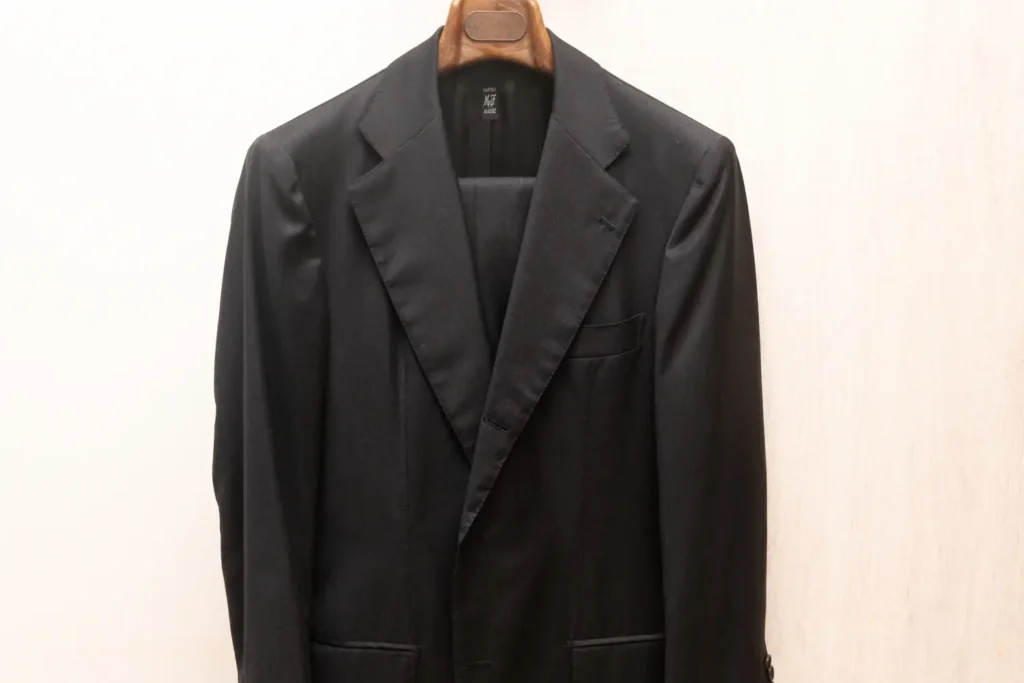
On the hanger, the concave shoulder that’s so visible on the body disappears. You can see how the construction handles the shape through small creases at the top of the sleeve, around the shoulder.
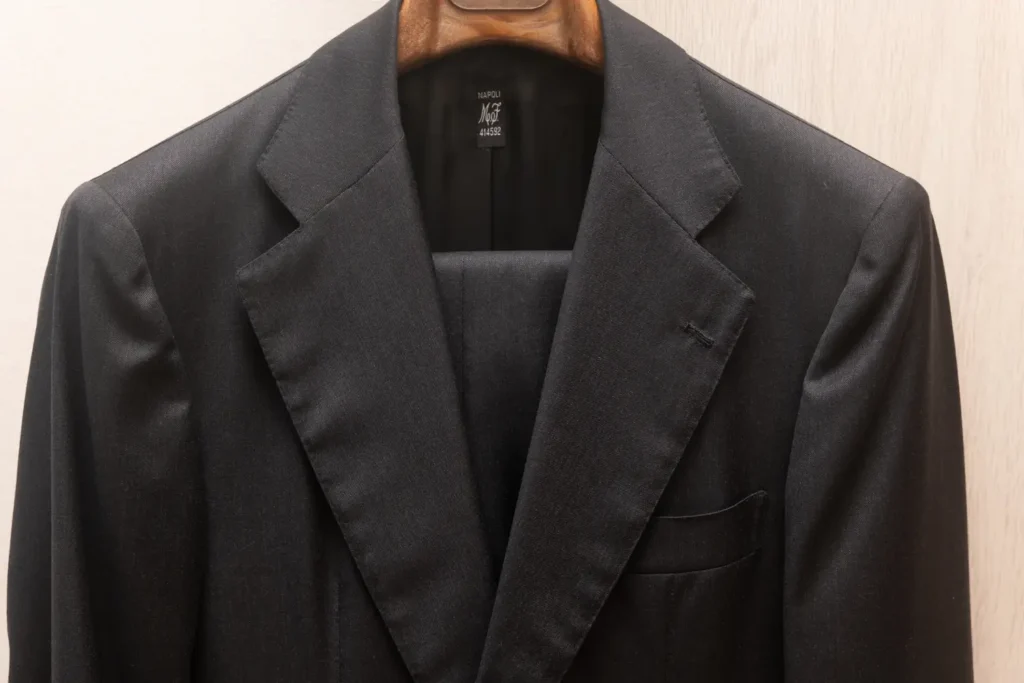
How the suit looks on the body differs from how it looks on the hanger. The cut is three-dimensional, built around comfort and around the cleanest silhouette in wear. The lapel roll isn’t as pronounced as on the cashmere jacket, but it’s cleanly constructed.
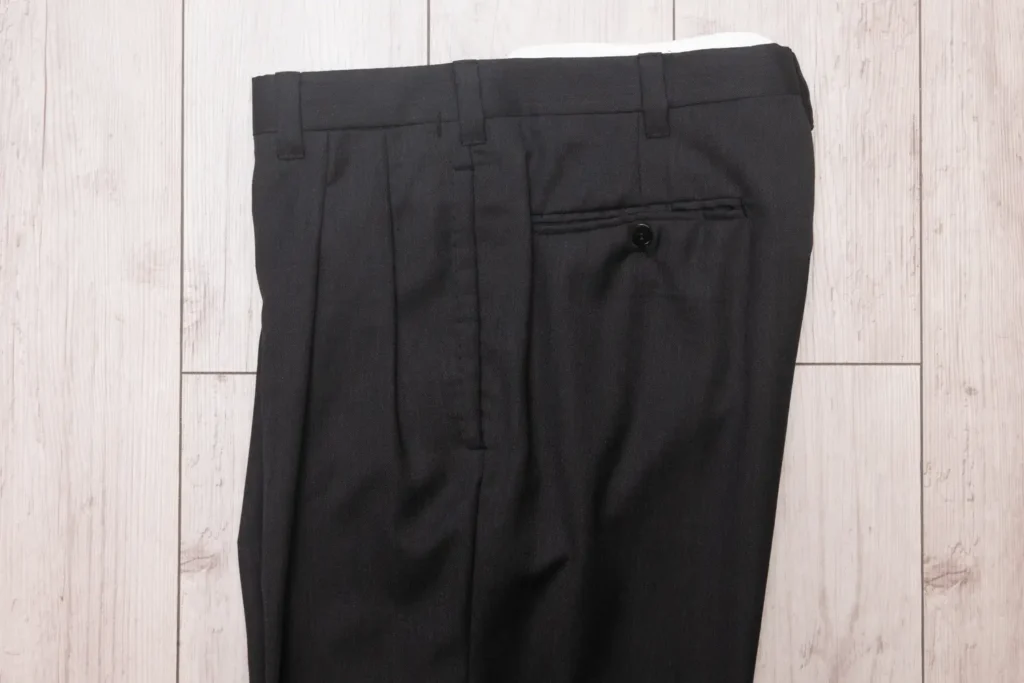
Standard double-pleat trousers, cut on straight lines to wear comfortably and to give a clean line through the seat.
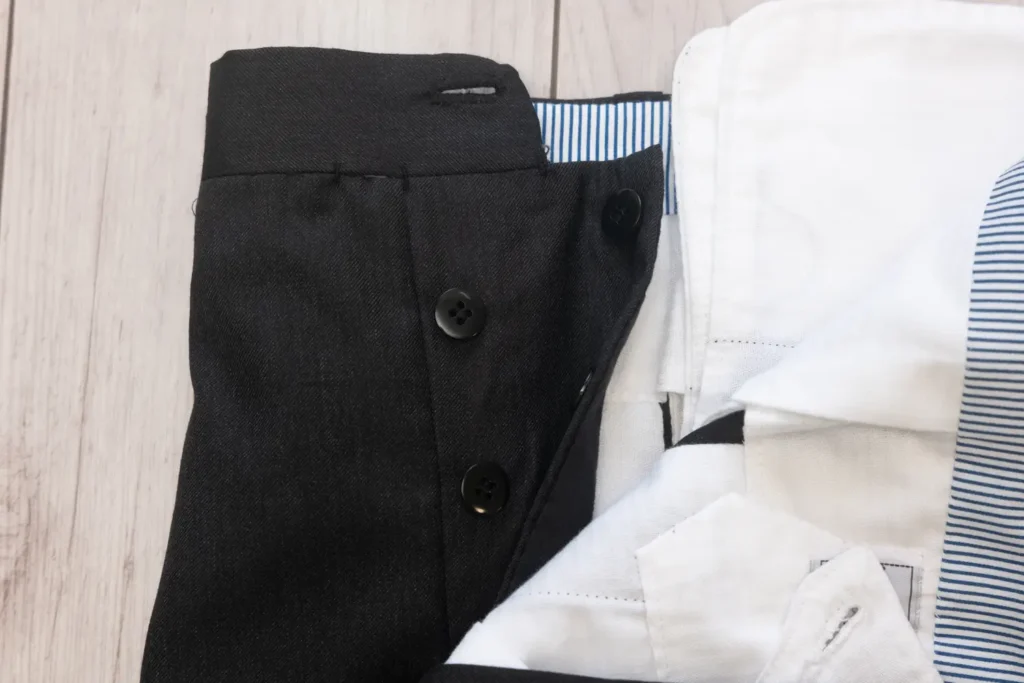
A carefully finished button fly. The hidden work shows the same care as the visible — nothing skimped, and the sewing is at a high level.

Classico Italia
The Formosa charcoal gray suit covered here was made in 2005, cut by the founder of Formosa himself — Mario Formosa, a master of the craft.
The skill in the cut, and the previous owner’s eye in commissioning it, both come through on the suit. As it happened, it fit me — and so I’m the one wearing it now.
Formosa’s house style — a constructed cut rooted in English tailoring, but with measured room left in and a clean overall silhouette — comes through plainly here.
On that form, the choice of a quietly unremarkable charcoal gray — but in a cloth of real quality — produces what you could call the heart of Classico Italia: an understated style.
Looking at the photographs of me in this suit, the profession that came to mind — strictly in movie terms — was a Secret Service protection detail. And that reading itself tells you something about both the tailoring at Formosa and the eye of the man who originally commissioned the suit.
Working through why opens up the heart of Classico Italia — what a bespoke suit from a Neapolitan sarto really is.
Understatement
If wearing this Formosa charcoal gray suit makes me read as a Secret Service agent on a protection detail, then what’s at work here is understatement of the most extreme kind.
Their job is to stay out of sight while protecting a principal — to disappear into the task. Put that way, understatement, which describes a mode of behavior, fits less well than inconspicuous, which describes a physical fact.
Understatement describes a particular kind of restraint — modest, a step back from the foreground. But the Formosa, by reading as a Secret Service agent who has erased his own presence, carries something beyond restraint: the physical fact of being inconspicuous.
Part of what bespoke at a sartoria is for is this: the suit fits your body, and the sartoria answers — at full effort — your requests for where and how the suit will be worn. That’s the working relationship behind it.
Each sartoria has its own strengths and its own house shape. Formosa carries an English flavor, but doesn’t push to trace the body’s line; it leaves room in the cut, and the result is a clean, modern overall silhouette. That’s where the house excels.
Take that clean, modern silhouette, then cut it in a strikingly plain charcoal gray of real quality, and the resulting suit reads as something past understatement — as inconspicuous, in the physical sense.
Calling the suit inconspicuous might sound dismissive. It isn’t. To cut a suit whose form and styling come across as nothing more than ‘plain’ — that’s exactly where Formosa’s craft and the previous owner’s eye both reveal themselves.
Strength and Intelligence
There’s a second reason it reads as Secret Service: wearing the Formosa also brings out a kind of masculine strength. Close protection calls for a body shaped by training, skill in martial arts, and a clear mind that can adapt to whatever the situation throws up. To read as that figure means the suit is bringing out the full range of what makes a man compelling — outwardly and inwardly, both.
For the record — I don’t have a body shaped by training, I haven’t done martial arts, and I’m not unusually quick on my feet, mentally. That someone like me, in this suit, still reads as Secret Service is the proof: wearing the Formosa lets you put forward, all at once, an extreme restraint, masculine strength, and intelligence.
That’s another reason I find both Formosa’s philosophy and the previous owner’s eye in this suit.

The Italian dandy — the uomo elegante — is defined not as someone who chases trends, but as someone who embodies sprezzatura: an ease and lightness that never registers as studied. Commissioning a suit that looks strikingly restrained while still drawing out a masculine presence — that’s the move of someone already living sprezzatura. Having inherited the suit, my hope is to keep working at it, in my own way, until I can carry the same bearing the previous owner did.
Why It Wears the Way It Does
This Formosa, like the cashmere jacket, holds its styling while carrying no stress at all through any movement or gesture. Let me think through why.
Three-Dimensional Construction
When people describe a Naples suit, the phrase that gets used most often is something like stress-free comfort. The technique credited with delivering both that comfort and the style is what’s usually called three-dimensional construction.
Putting one on confirms it. The styling and the comfort both come through, and you start to feel firsthand what people mean when they say Naples tailoring resolves the style-and-comfort tension at a high level of craft.
The reason becomes clearer when you wear the suit and look at the photographs. The structural heart of Naples tailoring is easier to see if you think along two axes at once: the silhouette from the front and back, and the depth of the body seen from the side.
Front and back, the silhouette has clear points where the cut takes in and clear points where it lets out. Build only on that axis, though, and you end up either with a suit that feels tight, or with extra room that breaks the line.
Naples tailoring puts ease where ease is needed, and tightens against that ease in three dimensions. The judgment of where to do which is precise. The result is a suit that doesn’t bind regardless of how you sit or stand, and whose line doesn’t break. What makes the Naples cut what it is is the way it routes that ease into the body’s depth — the front-to-back dimension.
It’s hard to see in the photographs, but the shoulder-to-sleeve line is a different width seen from the front versus from the side. By routing the ease into the depth you can only see from the side, the cut keeps the shoulder and sleeve from feeling stressed in any posture.