Introduction
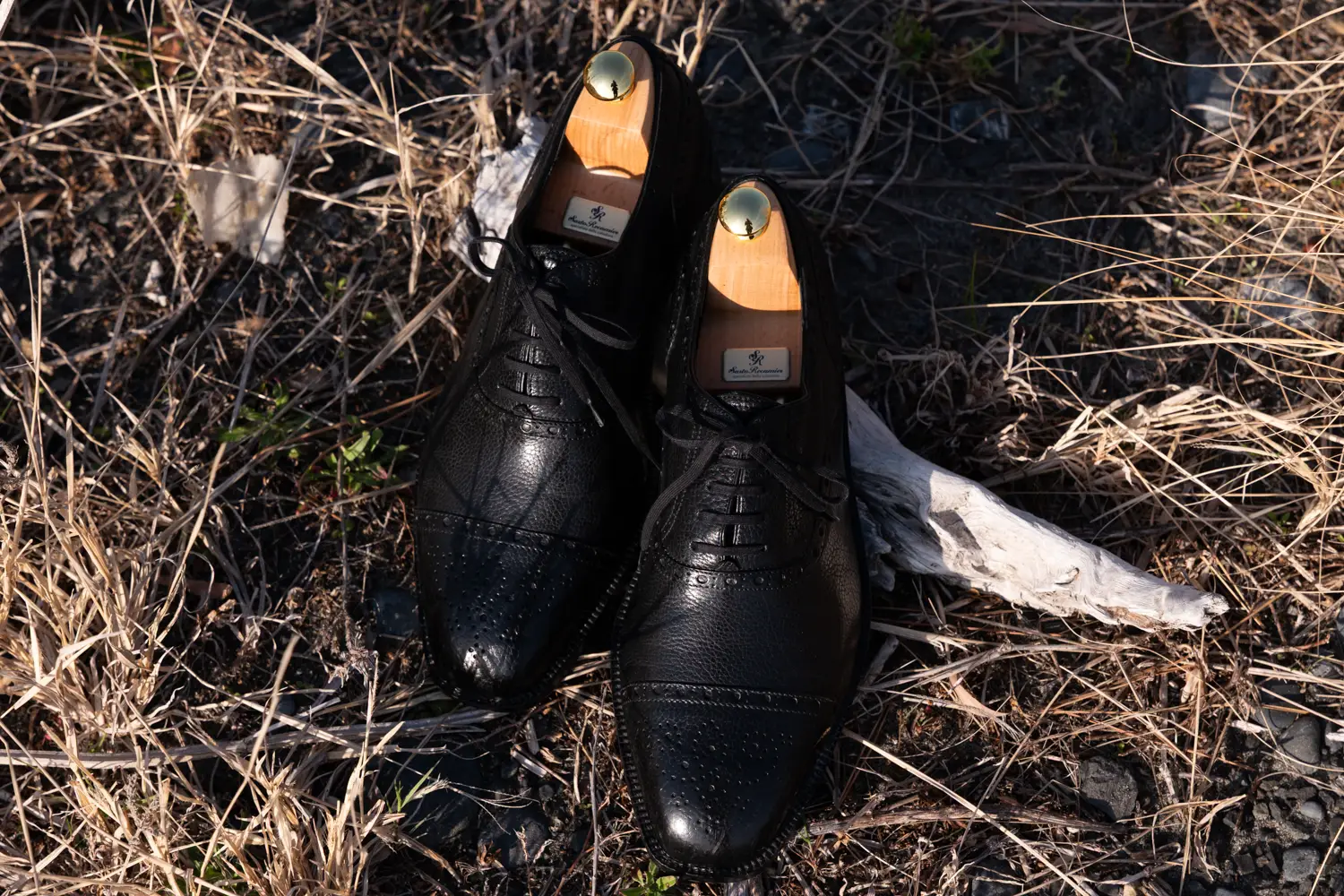
The Marini Oxford Shoes introduced here were recommended to me twenty years ago alongside a suit I purchased at Tie Your Tie, but I did not acquire them at the time. Having them in my hands two decades later carries a certain quiet sense of emotion.
Once I settle on something I love, I tend to lose interest in alternatives — a personality trait of mine. My go-to dress shoes are John Lobb derbies, and despite trying others over the years, my preferences have not fundamentally changed in nearly 30 years. So while Italian shoes have always held a certain appeal, they never quite made it into my regular rotation.
When I think of Italian shoes, the image that comes to mind is something like Silvano Lattanzi — distinctly Italian in its flair, with light tan shoes worn with azzurro (bright navy).
I own a pair of Silvano Lattanzi whole-cuts myself, but unlike the Marini oxfords, they carry a casualness and sensuality that works even with jeans.
The Marini oxfords introduced here are black and lack a sharp silhouette, making them quite different from the typical image of Italian footwear.
The llama leather makes them soft shoes, yet when worn, they present as thoroughly formal and classic. This likely reflects the influence of Rome — a city with a long history and a cultural center underpinned by politics and heritage — and a clientele that has always valued understatement, being well-versed in both politics and culture.
Features
These are classically orthodox oxfords in construction, but the quality of craftsmanship and beauty of form are on an entirely different level — the result of a master artisan who sees every stage of the process through with meticulous care.
Single Sole
I have always preferred open-laced shoes with double soles, and every John Lobb I have purchased has been double-soled.
A pair of Berluti Alessandros I once owned and later passed on to a friend were single-soled, making the Marini oxfords my first single-sole dress shoes in quite some time.
The reason oxfords read as more formal than derbies comes down to the single sole and closed lacing. The grain texture of the llama leather is unlike anything found in British shoes, yet the fact that elegance is not compromised speaks to Marini’s distinctive approach to shoemaking.
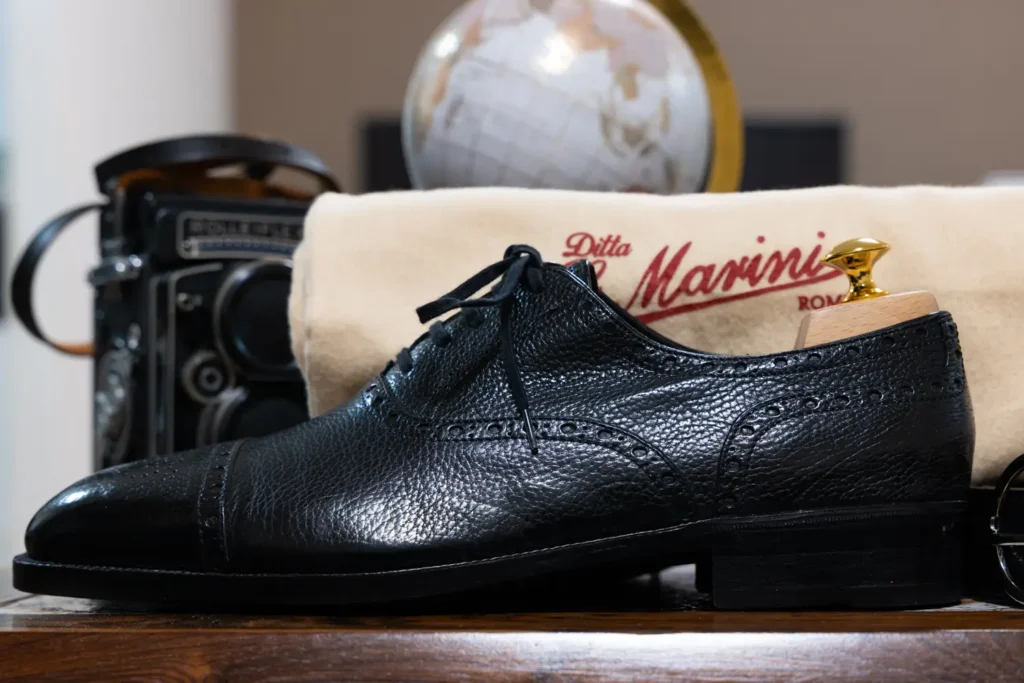
The leather sole is single but built slightly thick. It is difficult to convey in photographs, but the fine stitching and welt finishing are handled with exceptional care.
There is no shoe box; instead, a felt shoe case bearing the Marini name is included.
Closed Lacing
My preference has always been for open-laced shoes, and nearly all of the dress shoes I own are open-laced.
I have preferred open lacing for its practicality — ease of putting on and taking off, and the way the quarters sit when laced — but the softness of the llama leather in the Marini oxfords means the closed quarters close with ease, and putting them on and off is never a hassle.
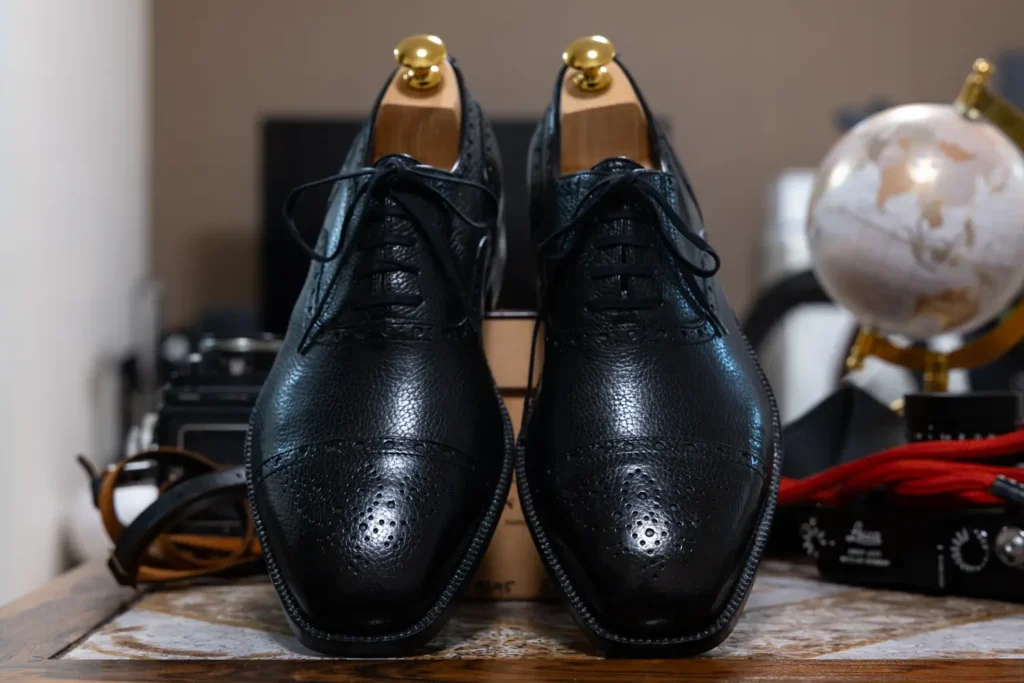
The closed lacing is finely finished, and the excellent last ensures the quarters close neatly when laced.
A common issue with closed-lacing oxfords is that the quarters often fail to close neatly when worn, leaving a gap. With the Marini oxfords, the quarters close without opening excessively when on the foot — another mark of the quality of construction.
Semi-Brogue
As I touched on in the John Lobb derby article, the derby features a wingtip toe cap and is known as a full brogue. When that wingtip is replaced with a straight-tip cap toe, the result is called a semi-brogue.
The common decorative element is perforations — known as broguing. A straight cap-toe shoe with perforations is what is generally understood as a semi-brogue.
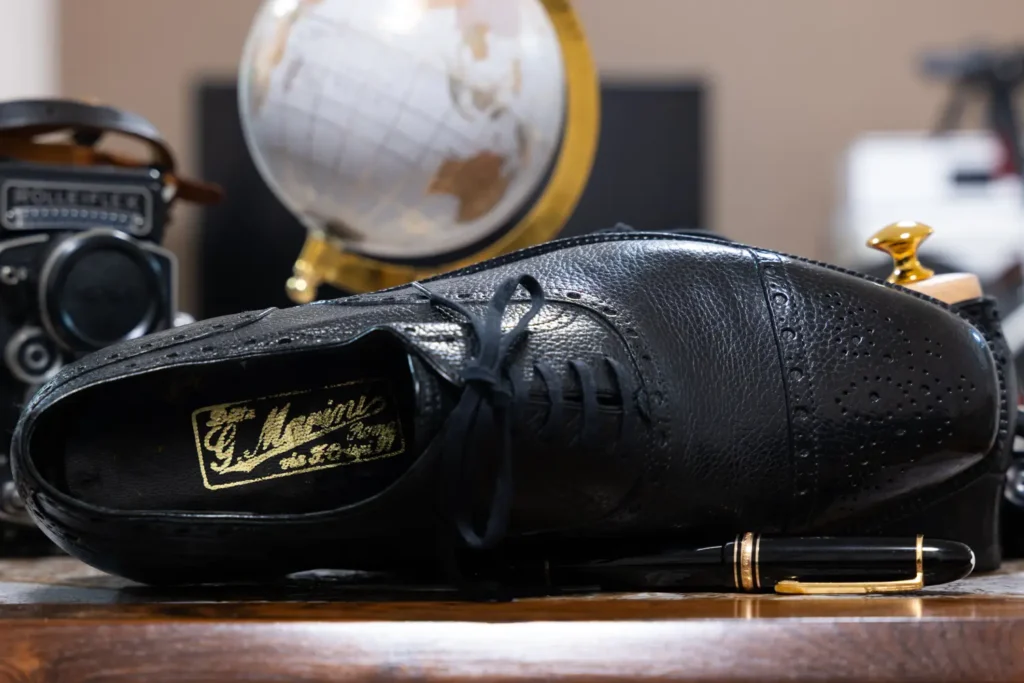
The llama grain pairs well with the perforations, and the subdued sheen compared to smooth leather contributes to the shoe’s refinement. The insole bears the Marini imprint. Viewed from above, the toe is a gentle square shape.
Perforations appear throughout. While today they are largely decorative, they are said to have originally served to improve water repellency and prevent moisture penetration in wet weather.
Classic
Oxfords are generally considered more formal than derbies in terms of dress codes, but with its semi-brogue detailing and llama grain, the Marini oxford would technically be classified as more casual by conventional dress code standards.
Yet despite the perforations and llama grain, Marini carries decades of history and prestige — they are, to cite one example, the workshop that made shoes for Pope John Paul II. This is a house of houses, and one could argue that conventional dress code logic simply does not apply to shoes of this caliber.
These shoes embody the unspoken dress code of conduct in international society — but they also demand a certain depth of character and personal dignity from whoever wears them.
They possess a timeless, classical quality that makes them appropriate for any occasion, but these are shoes that are difficult to truly carry off without understanding and embodying the historical and cultural context behind them — something that goes far beyond fashion.
Wearing the Marini Oxford Shoes
Italian shoes tend to conjure an image far removed from the formality and dress codes associated with British footwear, but Marini is a Roman workshop, and the history and culture of Rome runs deep throughout.
Just as Brioni — also Roman — prioritizes understated social presentation over showiness in dress, Marini shoes are guided by the same principle of quiet social refinement, which in turn gives them a classicism and supreme elegance.
Treating these as just another fashion item makes them difficult to balance. I would recommend that everything paired with them share the same philosophy as Marini — and that this be understood and embraced in the choices made.
It is easy to understand why Franco Minucci chose to carry them at Tie Your Tie. These are shoes with a philosophy unto themselves — an uncompromising pair that only those with a truly cultivated aesthetic eye can wear with conviction. The full vision of dress is realized when combined with the other items Minucci selected.
The price was certainly part of why I did not acquire them at the time, but twenty years on I am freshly aware that the real barrier was something higher than the price tag itself.
Artigiano Ciao
The Marini Oxford Shoes introduced here were purchased at Artigiano Ciao. It was the Marini Oxford Shoes that first led me to Artigiano Ciao.
What is remarkable is that they had deadstock Marini shoes — bespoke-only by nature — in stock. Discovering this by chance and dropping by to see them in person was the beginning of our relationship.
When I visited, not only was the condition of the deadstock shoes excellent, but in the course of various conversations about fashion with the owner, I was so impressed by his knowledge and vision that I left not only with the Marini Oxford Shoes but also an unplanned Kiton cashmere coat.
Since then, I have discovered the fascinating world of vintage Italian sartorial pieces (primarily Neapolitan) that the shop carries, and have purchased the Formosa cashmere jacket and suit I wrote about in previous articles.
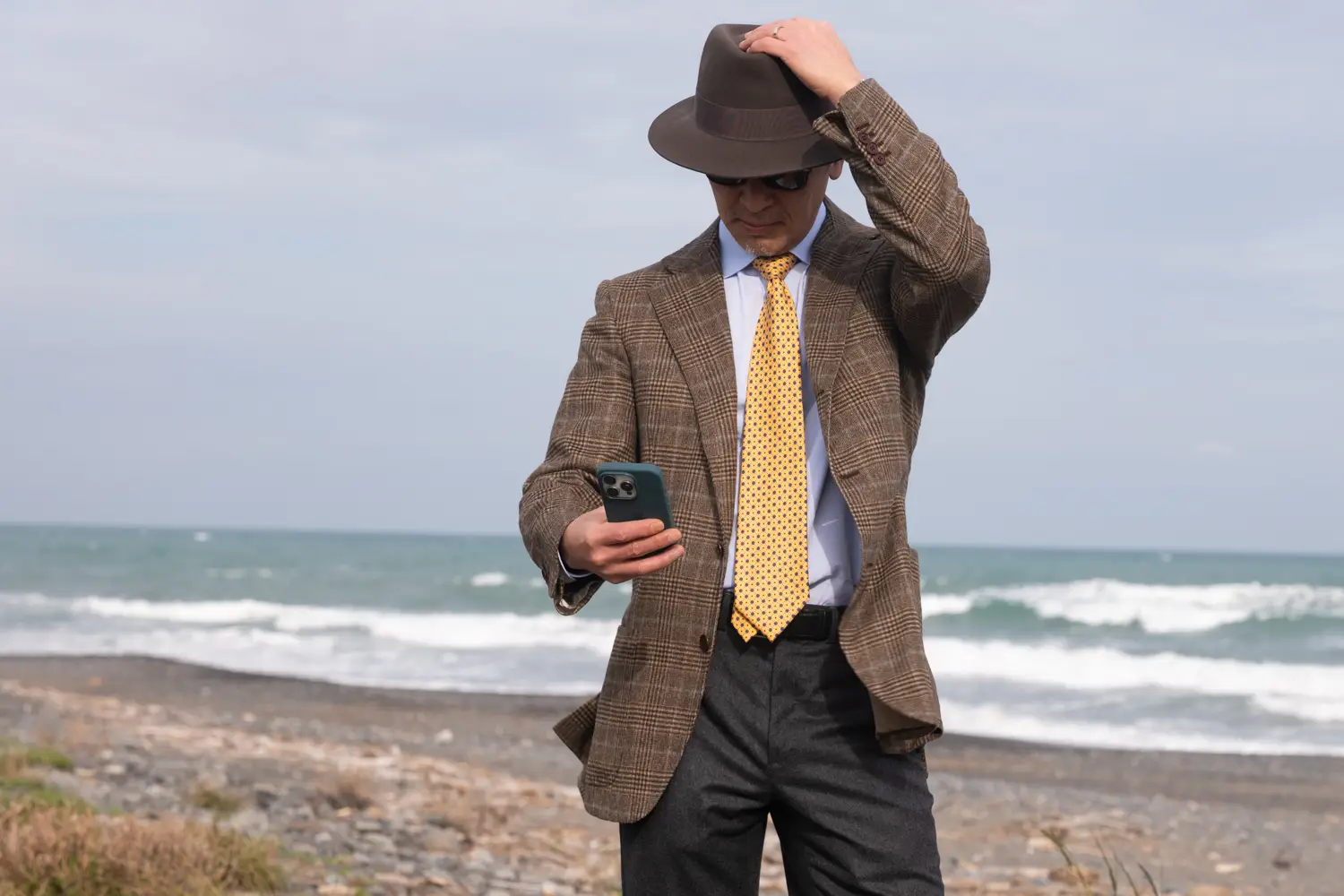
Formosa
Inspired by the knowledge of Artigiano Ciao’s owner, I discovered the appeal of suits and jackets made by Italian sartori and purchased these Formosa pieces — the articles covering them.